Building High-Performance Teams The Expedition Way
You don't build a high-performance team by throwing talented individuals together and hoping for the best. It’s about forging a single, cohesive unit—a team where the group’s capability is far greater than the sum of its parts. This requires a deliberate focus on creating shared norms and deep psychological safety, building an environment where a team can not only survive but thrive under pressure. Think of it like an expedition team bracing for a polar storm.
The Unseen Architecture Of High-Performance Teams
Before setting foot on the ice, every piece of equipment is checked. Every route is scrutinised. Every possible contingency is mapped out. Building a truly high-performance team demands the same relentless initial survey.
Too often, corporate "team building" is a one-off offsite event, a fleeting memory by the time everyone is back at their desks. This approach almost always fails because it skips the most critical foundational work—the unseen architecture that holds a team together when the pressure is on.
In our world, this architecture is non-negotiable. When you’re facing -30°C on the Greenland ice cap, success has little to do with individual talent. It comes down to the group's collective discipline, absolute trust, and shared operating procedures. Roald Amundsen’s South Pole expedition was a masterclass in this principle. His team’s meticulous preparation on the Hardangervidda plateau in Norway and their complete, shared understanding of their mission gave them the decisive edge.
More Than Just Talent
The intense pressure of a critical business quarter and the unforgiving environment of a polar expedition share a common, brutal truth: they reveal the real strength of a team. That strength is built on two core components:
- Shared Norms: These are the unwritten rules of engagement. How does the team communicate when things get stressful? How are decisions made with incomplete information? How is conflict handled productively, not destructively?
- Psychological Safety: This is the bedrock of trust. It's the shared belief that every member can speak up, admit a mistake, or challenge an idea without fear of being shut down or penalised. Without it, you get silence precisely when you need candid feedback the most.
These elements are far more important than individual skill. A group of brilliant individuals without shared norms is just a collection of people working near each other, not with each other. A team that has taken the time to establish this architecture can overcome unforeseen challenges, adapt to changing conditions, and maintain momentum when others would fall apart. To dig deeper into these foundations, it's worth exploring different perspectives on building high performing teams.
The impact is real and measurable. A CIPD review in the UK found that teams with strong cohesion consistently and significantly outperform their peers. Businesses that actively foster these principles report up to 1.5 times higher financial outperformance . Their engaged teams also see 43% lower turnover and a staggering 81% lower absenteeism . This is not about "feeling good" – it's about creating the specific conditions for exceptional, repeatable results.
Conducting A Team Diagnostic And Setting A Clear Objective
Every expedition, whether across an ice cap or through a market disruption, begins with an honest, unflinching look at your starting point. Before a single pulk is packed, we run a thorough diagnostic – not of the equipment, but of the team itself. This is not about slapping on generic personality tests; it's about gathering real, observational data through structured, candid conversations.
The goal is to map the team's current position with absolute clarity. We're looking for the subtle fractures in communication, the unstated assumptions, and the gaps between individual strengths and the mission's demands. An honest diagnostic gives you the essential coordinates from which you can plot your course.
To do this effectively, we assess the team across several critical dimensions, much like an expedition-readiness check before heading into the unknown.
Core Components Of A High-Performance Team Diagnostic
| Dimension | What to Assess | Method |
|---|---|---|
| Shared Purpose & Goals | Is there a universally understood and compelling mission? Does every member see how their role contributes to the objective? | 1-on-1 interviews; group workshops; analysis of existing goal-setting frameworks (e.g., OKRs vs KPIs). |
| Role Clarity | Are roles, responsibilities, and decision-making authorities clearly defined and respected? Is there overlap or ambiguity? | Role-mapping exercises; RACI charting; direct observation of team meetings and project execution. |
| Psychological Safety & Trust | Do team members feel safe to speak up, challenge ideas, and admit mistakes without fear of blame? | Anonymised surveys (e.g., Amy Edmondson's 7 questions); facilitated feedback sessions; observational analysis of team interactions. |
| Communication & Conflict | How does information flow? How is conflict handled – is it avoided, destructive, or constructive? | Facilitated "real-play" scenarios; communication audits; analysis of meeting dynamics and decision-making processes. |
| Execution & Accountability | Does the team consistently deliver on its commitments? Is there a culture of peer-to-peer accountability? | Review of project outcomes and performance data; feedback loops (360-degree reviews); after-action reviews (AARs). |
This diagnostic is not a one-off tick-box exercise. It's the baseline map that makes the rest of the journey possible.
From Vague Goals To A Pole Of Inaccessibility
Once you know your starting position, the next step is setting an objective with the magnetic clarity of a polar mission. Too many corporate goals are vague statements that lack the pull needed to unify a team. They're destinations without coordinates.
A high-performance objective is different from this. Think of it as your 'Pole of Inaccessibility'—a clear, compelling, and measurable target that focuses every ounce of the team’s energy. It is unambiguous. Everyone understands exactly what success looks like and their precise role in getting there.
Just as every member of a ski team knows their responsibility—be it navigation, trail breaking, or camp routine—each person in a business unit must have a clearly defined role. Ambiguity is the enemy of momentum.
This process is about creating shared ownership of the objective. It is not handed down from on high; it's co-developed. This is how you shift a team from mere compliance to genuine commitment.
The journey looks something like this:
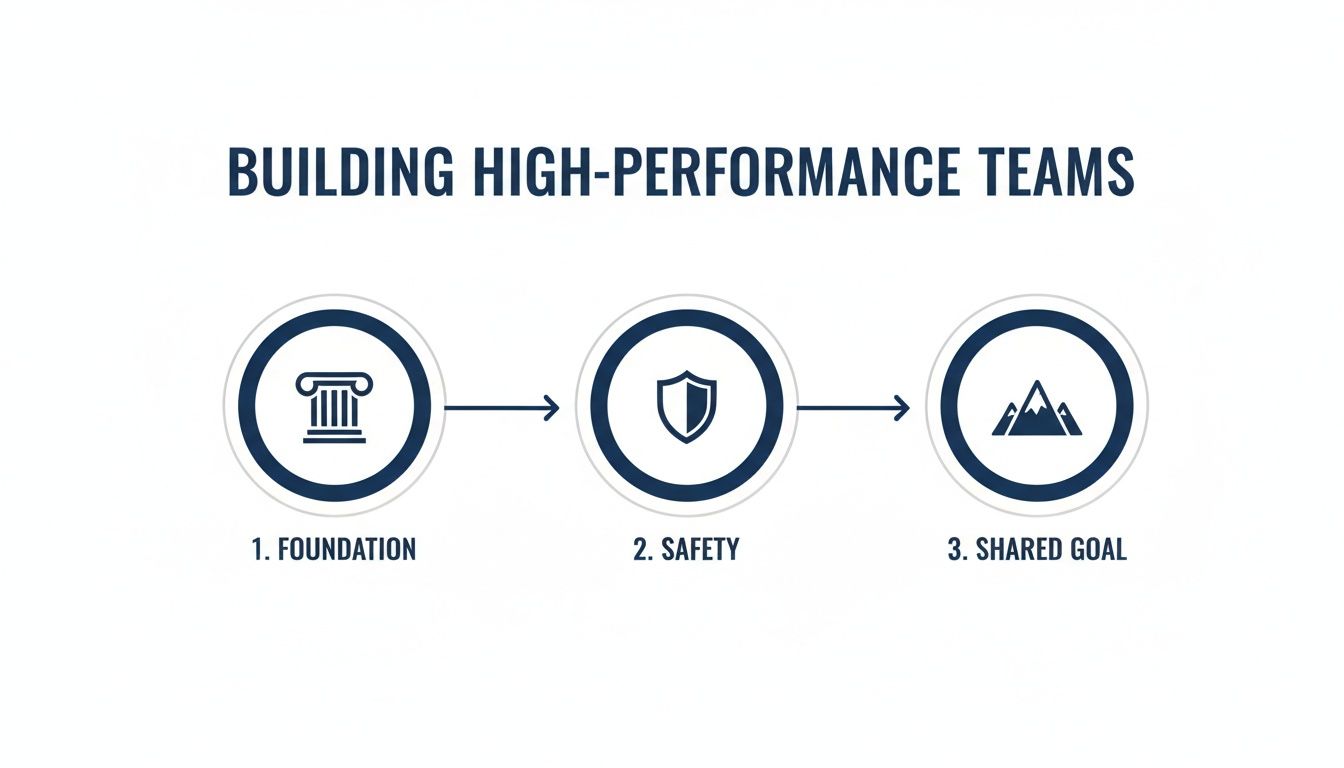
As you can see, a powerful shared goal is only reachable when it's built upon the bedrock of a solid foundation and true psychological safety.
After your diagnostic, getting to grips with the difference between OKRs vs KPIs is critical for setting these objectives and measuring what matters. This helps translate a grand mission into the tangible, daily actions that move you forward. It provides the rhythm—the steady cadence of ski, eat, sleep, repeat—that sustains a team over the long haul.
A powerful objective gives a team a reason to endure hardship. Clear roles and metrics give them the method. To see how we put these principles into practice, you can explore the purpose-built programmes at the Pole to Pole Academy.
Forging Trust Through Deliberate Shared Challenges
Trust is not built in a conference room. It's forged in adversity, when the outcome depends entirely on the person next to you doing their job properly. A team that has only ever known calm seas is not really a team; it's just a group of colleagues waiting for the first storm to hit.
Real high-performance teams are built through shared, structured challenges where true reliance is not just an idea, but an absolute necessity.
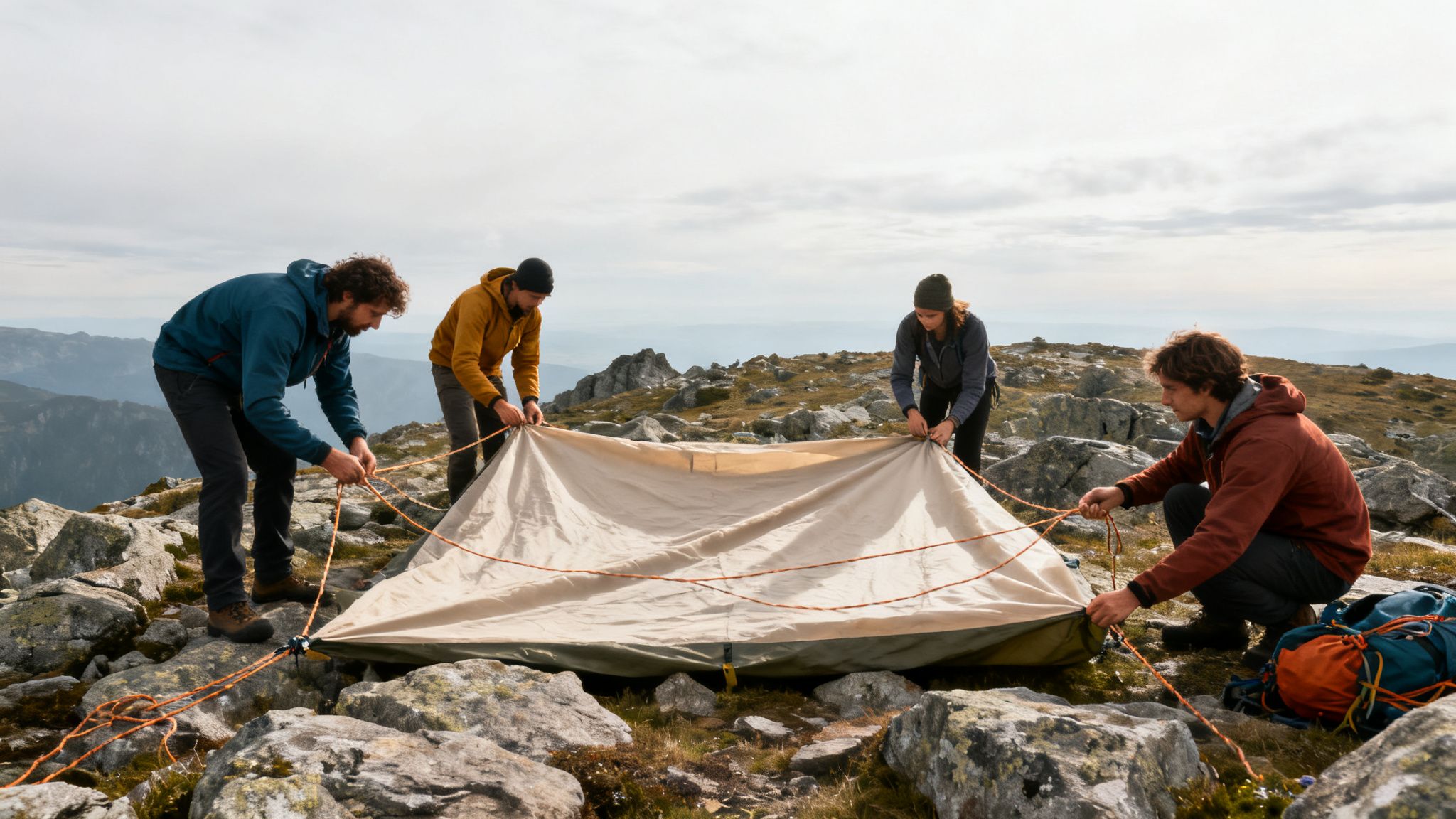
This is the very core of our philosophy at Pole to Pole: competence before confidence . We do not start with abstract trust exercises. We start by teaching a tangible skill—how to navigate in a whiteout, how to build a snow shelter, how to manage a stove routine at -25°C. Confidence emerges naturally from proven competence, both in yourself and in your teammates.
From Theory to Practice
When Ernest Shackleton’s ship, the Endurance , was crushed by Antarctic ice, his team’s survival had little to do with prior friendships. It was all down to their shared ordeal and mutual reliance. Those bonds were not talked about; they were formed whilst hauling lifeboats across kilometres of broken sea ice towards South Georgia.
We replicate this dynamic in a controlled environment. An 'offsite on purpose' at our Academy in Iceland (64° 25' 24" N) might involve a multi-hour navigation challenge with limited visibility. The team gets a map, a compass, and a destination. That's it.
Success demands:
- Active Communication: Constant updates on bearings and terrain.
- Healthy Conflict: The ability to disagree on a route choice, debate it, and then commit to a final decision.
- Role Delegation: One person navigates, another breaks trail, another monitors the team’s condition.
- Shared Accountability: A mistake by one person affects everyone. Simple as that.
Going through this process means psychological safety stops being a corporate buzzword and becomes a felt reality. Team members learn to depend on each other's skills because they have seen them demonstrated under pressure.
The Power of Cohesive Team Dynamics
This focus on small, cohesive teams is mirrored in business innovation. Data from the UK Innovation Survey shows that agile organisations with dedicated teams demonstrate a 2:1 throughput advantage . It also found that small, focused projects (under £1m) in the UK have a 76% success rate , a stark contrast to the mere 10% for large, complex projects.
These numbers highlight a key principle we see on every expedition: small, trusted teams with a crystal-clear objective are profoundly effective. You can discover more insights in the full UK government report.
Building a team is like packing a pulk for a Last Degree expedition. It must be deliberate. Every item has a purpose, every person has a role, and you cannot afford the dead weight of unresolved friction or ambiguity. A standard pulk for this journey will weigh 45-50kg.
These experiences provide a roadmap for teams to practise making decisions with incomplete information. They learn that asking for help is a strength, not a weakness. It's an environment where trust is an outcome of shared effort, not a prerequisite for it. Understanding this approach is key to harnessing physical and mental challenges to build true resilience in any context.
Forging Protocols for Decision-Making and Resilience
When conditions fall apart—a market dive, a project implosion, a blizzard that swallows the world in white—a team without protocols will break. It is not a matter of if, but when. What separates a truly high-performance unit from a group of individuals spiralling into chaos are the procedures they have already established and rehearsed.
These protocols are the team’s operating system, purpose-built to function under extreme stress when the mind is overloaded and clear thought is a luxury. They provide a default path, stripping away the ambiguity and emotion that can cripple you in critical moments.
On an expedition, this is simply how it works. Think of Roald Amundsen’s meticulous journey to the South Pole. His team did not just have a destination; they had a system for everything, from the smallest gear check to their daily travel rhythm. This relentless focus on process meant that when hardship inevitably hit, their response was automatic and efficient. Not panicked.
Creating Robust Operating Procedures
Bringing this into a corporate setting requires the same deliberate, focused approach. The mission is to create a clear blueprint for how the team acts when the pressure is on.
This blueprint needs to explicitly define a few key areas:
- Communication Protocols: Who says what, when, and how, especially when things go sideways? A simple "comms window" protocol ensures information flows in a structured way, cutting out the noise and misinformation that breed panic.
- Decision-Making Frameworks: How do you make a call when time is short and the data is incomplete? Define who makes the final decision (the "skipper's call"), what input is non-negotiable, and when an issue must be escalated. This kills analysis paralysis before it starts.
- Conflict Resolution Processes: Disagreement under pressure is guaranteed. Destructive conflict is not. A simple, agreed-upon method for raising and resolving issues without blame turns friction into a productive force, not a personal one.
These are not meant to be dusty documents filed away on a server. They have to be lived. They must be practised, stress-tested, and refined through realistic scenarios until they become muscle memory for every person on the team.
In the military, we call it "stress inoculation." You expose the team to controlled doses of pressure in training so they build immunity. When the real event occurs, their physiological and psychological response is managed, allowing them to execute the drills they have practised hundreds of times. This approach is something endorsed by operators like Jason Fox and Aldo Kane.
Building Resilience Through Deliberate Practice
A huge part of this framework is dedicated to building genuine, unbreakable resilience. This is not about being "tough." It's about having a systematic process for learning from every setback and relentlessly maintaining forward momentum.
At the Pole to Pole Academy, we are rigorous about our After-Action Reviews (AARs) . After every major training evolution, the team gets together to answer four simple questions:
- What was supposed to happen?
- What actually happened?
- Why was there a difference?
- What will we do differently next time?
This blameless debrief is the entire game. It shifts the focus away from individual mistakes and onto improving the system. It builds a culture where failures are just data points for learning, enabling the team to adapt and overcome without the dead weight of blame. This methodical, honest approach is the real engine of resilience. It ensures the team does not just survive adversity but actually becomes stronger because of it.
Measuring What Matters To Sustain High Performance
On an expedition, success is simple. Kilometres covered. Objectives met. Back in the corporate world, the metrics for building high performance teams need to be just as clear. Performance is not a vague feeling; it's a tangible outcome you track with the same discipline you’d use to log daily progress towards the South Pole.

It’s time to move past vanity metrics. Things like "engagement scores" feel good, but they do not tell you if you're winning. If the mission is launching a new product, you do not measure how busy the team looks. You measure what matters: hitting development milestones, nailing quality standards, and seeing real user adoption.
Linking Behaviours To Outcomes
The real work is drawing a straight line from the protocols you forged in training to the results you see every day. This does not happen by guesswork. It requires a steady rhythm of check-ins and debriefs—the same routine that keeps an expedition on course. Progress is not assumed; it's verified.
Your measurement system should split its focus across two connected areas:
- Performance Metrics: These are the hard numbers. The undeniable facts tied to the mission objective. Think project completion rates, sales figures, or customer satisfaction scores. They answer one question: "Are we achieving our goal?"
- Behavioural Indicators: This is the softer data that reveals the team’s health. It’s about tracking the quality of after-action reviews, observing how communication holds up under pressure, and gauging psychological safety. This answers the other critical question: "Are we working in a way that makes success repeatable?"
Sustaining high performance is not about a single, heroic push. It's about embedding a new operating system—a set of behaviours and disciplines that become the team's default, especially when conditions get tough.
Creating A Culture Of Continuous Improvement
The true test is not hitting peak performance during a focused offsite. The real challenge is sustaining it months later when the pressure is off and old habits creep back in. Teams will always revert to what's comfortable unless you make a deliberate effort to stop it. An expedition mindset, however, is built on constant adaptation.
To prevent this drift, you have to embed a culture of continuous improvement and mutual accountability. Make the team’s performance visible to everyone. Not as a tool for blame, but as a shared compass. When a metric slips, it should trigger a structured, blameless conversation about why , just like a proper after-action review.
This rhythm—measure, review, adapt—ensures the lessons learned under pressure are not forgotten. They become living protocols, sharpened with every new challenge. To see how this works in practice, you can learn more about how we define and apply Pole to Pole's approach to performance metrics. It’s a process that turns a temporary boost into a permanent upgrade in your team's capability.
Questions We Often Hear
When leaders first encounter our expedition-style approach, a few questions always come up. Here’s some direct, practical advice, grounded in the reality of building teams that can withstand any storm.
How Long Until We See a Real Difference?
You’ll notice the first shifts almost immediately. During an intensive offsite, you can see changes in the quality of communication and trust within days. Something as simple as a team debrief after a tough navigation exercise will feel different – sharper, more honest. That’s the first sign they’re learning a new way to operate.
But let's be clear: embedding these behaviours is a process, not a one-off event. Think of it as installing a new operating system for your team. You can expect to see real, measurable improvements in things like psychological safety within the first quarter. The big-ticket items – sustained performance, lower staff turnover, higher productivity – typically build over six to twelve months as new habits become second nature.
Does This Work for Remote or Hybrid Teams?
Absolutely. In fact, you could argue these principles are even more critical when you’re not all in the same room. Things like clear communication protocols, defined roles, psychological safety, and mission clarity remove the ambiguity that can poison a distributed team.
Whilst a physical challenge like our Svalbard training is a powerful accelerator, the framework itself is completely adaptable. For a remote team, the 'expedition' might be a high-stakes virtual project with a non-negotiable deadline. The key is to create deliberate moments for connection and structured 'rehearsals' via video, backed by crystal-clear documentation. The environment changes; the human dynamics do not.
What’s the Biggest Mistake Leaders Make When Building a Team?
Confusing team-building activities with the actual work of building a team. Taking everyone bowling is nice, but it will not forge resilience or build trust under pressure. High-performance teams are built through shared, meaningful struggle towards a common goal.
The real mistake is shying away from productive friction and difficult conversations. A team that has never navigated a genuine disagreement or made a tough call together is not a team at all. It is just a group of colleagues, completely unprepared for the first real storm they will inevitably face. The work has to be deliberate, structured, and yes, sometimes uncomfortable.
A team's true character is not revealed in the conference room. It's revealed at 2 a.m., in a blizzard, when the map is frozen and a decision must be made. The work you do beforehand determines the outcome.
What Do You Do With Someone Who Resists Being a Team Player?
On an expedition, survival depends on cohesion. The stakes make the choice simple. In a corporate setting, the process has to start with clarity. Make sure the team’s mission, roles, and behavioural norms are so explicit there’s no grey area to hide in.
Then, you address the resistance head-on, but privately. Seek to understand what is driving it. Is it a skills gap? A lack of clarity? Or is it a fundamental misalignment of values? If you have provided support and clear expectations and the individual still undermines the team’s psychological safety or mission, you have to act decisively. A high-performance culture cannot survive if it tolerates behaviour that actively harms the unit.
Ready to move from theory to practice? At Pole to Pole , we design experiences that forge resilience and build genuinely high-performing teams. Explore our purpose-built leadership programmes and see what's possible for your organisation at https://www.poletopole.com.