Leadership Development Programmes For Executives That Build Resilience
A market downturn hits with the force of an arctic storm, plunging your organisation into a state of near zero visibility. Your strategic map is suddenly obsolete, communication lines are strained, and every decision carries immense weight.
This is the modern executive's reality, a constant state of navigating unpredictable conditions where traditional classroom theory offers little shelter. Effective leadership development programmes for executives must therefore move beyond theory. They need to build the practical resilience required to not just survive, but lead decisively through the whiteout.
Why Traditional Executive Training Is No Longer Enough

The corporate world no longer moves in predictable seasons. It is a volatile environment where disruption is the only constant. Yet, the methods used to prepare its leaders often remain rooted in the past, boardrooms, PowerPoint presentations, and theoretical case studies.
These conventional programmes can impart knowledge, but they rarely build the deep seated fortitude required to make critical decisions under genuine pressure. They teach leaders what to think, but not how to think when tired, stressed, and facing ambiguous threats.
The Critical Gap Between Knowledge and Application
There’s a world of difference between understanding a leadership principle in a textbook and embodying it during a genuine crisis. Reading about team cohesion is simple. Maintaining it amongst an exhausted team during a high stakes project failure is another matter entirely.
This is exactly where conventional training falls short. It operates in a sterile environment, removed from the friction, fatigue, and fog of real world leadership. The result? Leaders who are theoretically sound but practically fragile.
The problem is widespread. In the UK, a staggering 82% of managers step into their roles having received no formal leadership training, according to the Chartered Management Institute. This creates a significant vulnerability, leaving organisations led by people unequipped for the expanding pressures of their positions. You can read more about the research into leadership development statistics.
"We don’t fight nature we live in it. The same is true for modern business. The goal isn't to conquer uncertainty, but to develop the competence to navigate it with quiet confidence."
Forging Leaders in a Real-World Crucible
To close this gap, development has to move from the abstract to the tangible. It requires placing leaders in situations where their decisions have immediate and real consequences, an environment that strips away titles and forces a reliance on core character, communication, and calm resolve.
This is the principle behind experiential learning. It’s not just an alternative to traditional methods but a necessary crucible for forging leaders capable of:
- Making clear decisions with incomplete information.
- Managing group dynamics under physical and mental strain.
- Building genuine trust through shared hardship and mutual reliance.
- Distinguishing between determination and stubbornness when a plan must change.
Ultimately, leadership isn't learned from a book; it's forged through experience. The most effective programmes understand this, creating deliberate challenges that build the muscle memory required to lead when it truly matters.
The Four Pillars of a Transformative Leadership Programme
Not all leadership development is created equal. A weekend seminar in a conference centre might tick a box for HR, but it rarely forges the character needed to lead when circumstances get tough. Truly effective leadership development programmes for executives aren't single events; they are integrated systems built on four essential pillars.
When these components work together, they create a powerful feedback loop. Theory is tested by reality, reality is clarified through coaching, and the entire process is validated by candid feedback. This is what creates genuine, lasting behavioural change, not just a temporary hit of inspiration.
Pillar 1: Strategic Curriculum
The foundation of any serious programme is a curriculum grounded in the real challenges leaders are facing now, not the challenges of five years ago. This means getting past generic management theory and focusing squarely on the competencies required to navigate ambiguity and complexity.
Core topics have to include decision making under pressure, resource management in constrained environments, and maintaining team morale when everyone is running on fumes. A critical part of this is often about deliberately reprogramming the mind for success and breaking old habits. The curriculum sets the intellectual framework for the experiences that follow.
Pillar 2: Dedicated One-to-One Coaching
If the curriculum is the map, coaching is the guide who has travelled the terrain before. One to one sessions with an experienced professional are vital for turning theoretical knowledge into personal leadership practice. A coach helps a leader make sense of their experiences, spot their own blind spots, and develop specific strategies for improvement.
This isn't a friendly chat. It's a structured debriefing process, much like an expedition team would run after a difficult day on the ice.
A coach’s role is to ask the hard questions: Why did communication break down at that critical juncture? What early warning signs of team friction were missed? How will you adjust your approach tomorrow when the pressure is just as high?
This guided reflection is where the most profound learning happens. It solidifies the lessons learned in the field and turns them into repeatable leadership behaviours.
Pillar 3: Robust Feedback Mechanisms
A leader can't grow without an honest mirror. Robust feedback mechanisms, especially 360 degree assessments , are essential for providing that reflection. This process gathers confidential, anonymous feedback from an executive's direct reports, peers, and superiors.
The insights are often revelatory, highlighting the gap between a leader's intent and their actual impact. When you combine this kind of direct feedback with coaching, it becomes a powerful catalyst for change, targeting the very behaviours that are holding a leader back.
Pillar 4: High Impact Experiential Learning
This is the crucible. It's where the other three pillars are put to the ultimate test. High impact experiential learning moves leadership development from the theoretical to the tangible, placing leaders in unfamiliar, demanding environments where their decisions have immediate and clear consequences.
Think about the direct parallels:
- Leading a team through a sudden Svalbard whiteout becomes a practical exam on the crisis communication skills learned in the curriculum.
- Rationing supplies for a multi day ski traverse becomes a real world exercise in resource allocation.
- Navigating with map and compass when the GPS fails builds the exact same mental muscle needed to steer a company through market uncertainty.
An environment like the Pole to Pole Academy, situated at 64° 25' 24" N in Iceland's interior, isn't just a backdrop; it's an active participant in the learning process. Here, leadership isn't a concept to be discussed, it's a set of actions required for the team to move forward safely and effectively. This integration of all four pillars is what separates a training event from a truly developmental experience.
Comparing Leadership Programme Delivery Models
Choosing how to develop your executive team is a critical decision. Each delivery model strikes a different balance between theory, practical application, and genuine, lasting impact.
The world of leadership development programmes for executives is vast. It stretches from university lecture halls all the way to the windswept interior of Iceland. Understanding what each approach offers and what it doesn't is the key to finding one that truly serves your organisation’s goals.
Not every programme is built to deliver the same outcome. Some are designed for scalable knowledge transfer, whilst others are precision engineered to forge real behavioural change under pressure.
The Spectrum of Delivery Options
We can break down the main approaches into four distinct categories. Each has its place, but they are not interchangeable. An online module can't replicate the visceral lessons of a shared physical challenge, just as an expedition can't scale to thousands of employees at once.
- University Led Academic Courses: Often run by prestigious business schools, these programmes excel at delivering deep theoretical knowledge and strategic frameworks. They’re a good fit for leaders who need to get to grips with complex business concepts, finance, or global market strategy.
- Internal Corporate Academies: Developed in house, these programmes are built around a company's specific culture, challenges, and strategic aims. They are powerful tools for embedding a consistent leadership language and methodology across the entire organisation.
- Online E-Learning Platforms: Offering maximum flexibility and scalability, these digital courses are effective for rolling out foundational knowledge to large, geographically dispersed teams. They are a cost effective choice for standardised training on topics like compliance or project management.
- Immersive Offsite Expeditions: This model pulls leaders completely out of their familiar environment. It puts them in a context where theory is irrelevant and action is everything. It’s designed not just to teach leadership, but to test it in real-time.
To make the right choice, it's vital to assess how these programmes weave together the four pillars of development we talked about earlier. This decision tree helps visualise what to look for in a truly integrated programme.
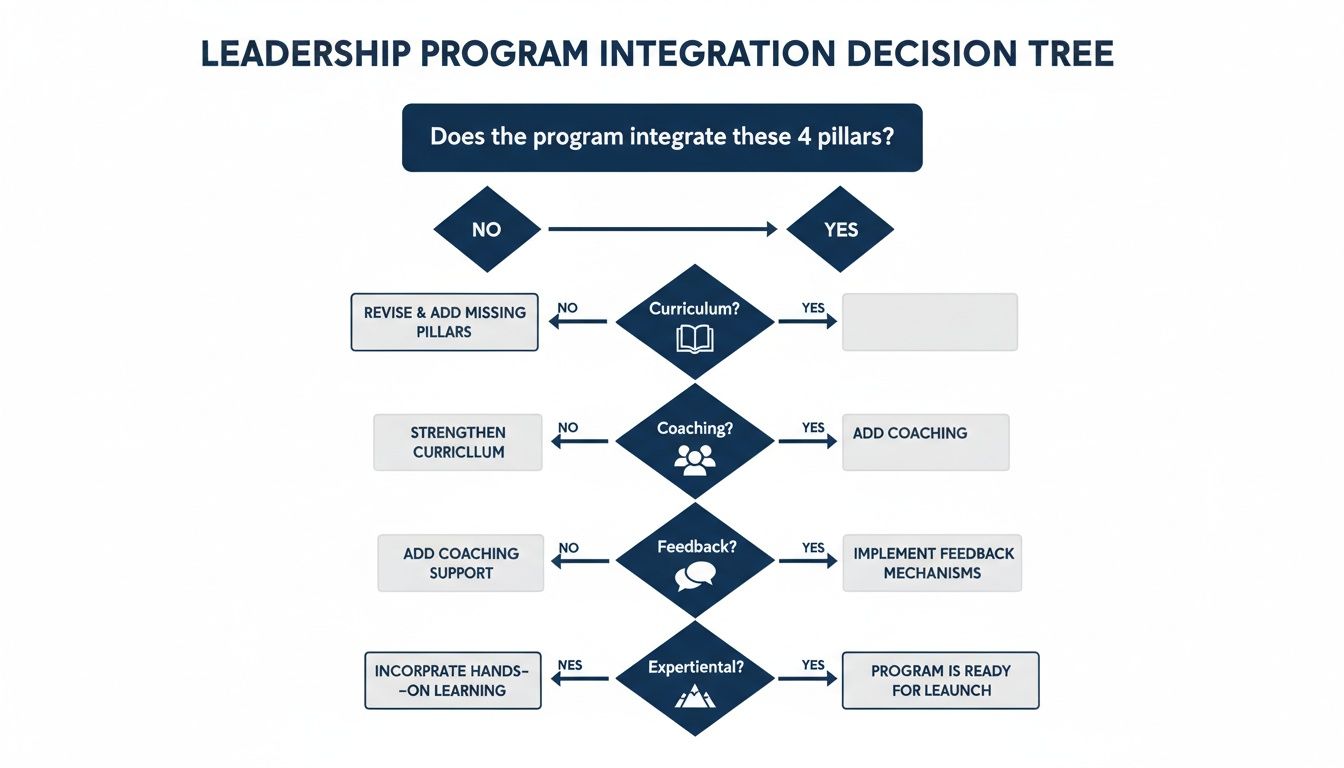
As the diagram shows, a programme's real value lies in how it integrates all four pillars. Experiential learning often acts as the crucible where everything else is tested and proven.
To help clarify the differences, this table breaks down how each model compares across key factors.
Comparison of Executive Leadership Programme Delivery Models
| Delivery Model | Primary Focus | Typical Duration | Impact on Behaviour | Best Suited For |
|---|---|---|---|---|
| University Courses | Theoretical knowledge, strategic frameworks | 1-4 weeks (intensive) or several months (part-time) | Low to moderate; knowledge-based | Leaders needing academic grounding in business principles (e.g., finance, marketing) |
| Internal Academies | Organisational culture, specific company processes | Ongoing modules over 6-12 months | Moderate; reinforces company values and methods | Embedding a consistent leadership style across a large organisation |
| Online E-Learning | Foundational knowledge, compliance, skills | Self-paced, a few hours per module | Low; primarily information transfer | Scalable training for large, distributed teams on standardised topics |
| Immersive Expeditions | Behavioural change, resilience, team cohesion | 5-10 days (intensive offsite) | High and lasting; forged through shared experience | Senior teams needing to build trust and develop leadership under pressure |
Ultimately, the model you choose should reflect the change you want to see.
Evaluating Impact Beyond the Classroom
The critical question is always this: which model creates lasting change?
Whilst academic courses and online modules are excellent at transferring information, they often fall short when it comes to shifting deep-seated behaviours. The kind of change needed in a crisis is rarely learned from a slide deck. It's forged through shared experience and genuine consequence.
This is why cohort based learning models are gathering so much momentum. When a team navigates a real challenge together, whether in business or on a glacier, the bonds and lessons are visceral. They stick.
A team that has learned to communicate clearly whilst navigating a crevasse field in Svalbard doesn't forget that skill in a difficult negotiation back in the boardroom. The muscle memory is already there.
For instance, the Leadership 2025 programme has been empowering cohorts of BME leaders in the UK housing sector since 2017 . Its intensive nine month structure tackles underrepresentation with strategic learning and peer challenges, mirroring the immersive model's power to drive executive growth.
The choice of delivery model comes down to your primary objective. If the goal is knowledge acquisition, traditional methods are perfectly fine. But if the goal is to forge resilient, adaptable leaders who thrive under pressure, the programme must provide a genuine test.
How Expedition Training Forges Resilient Leaders
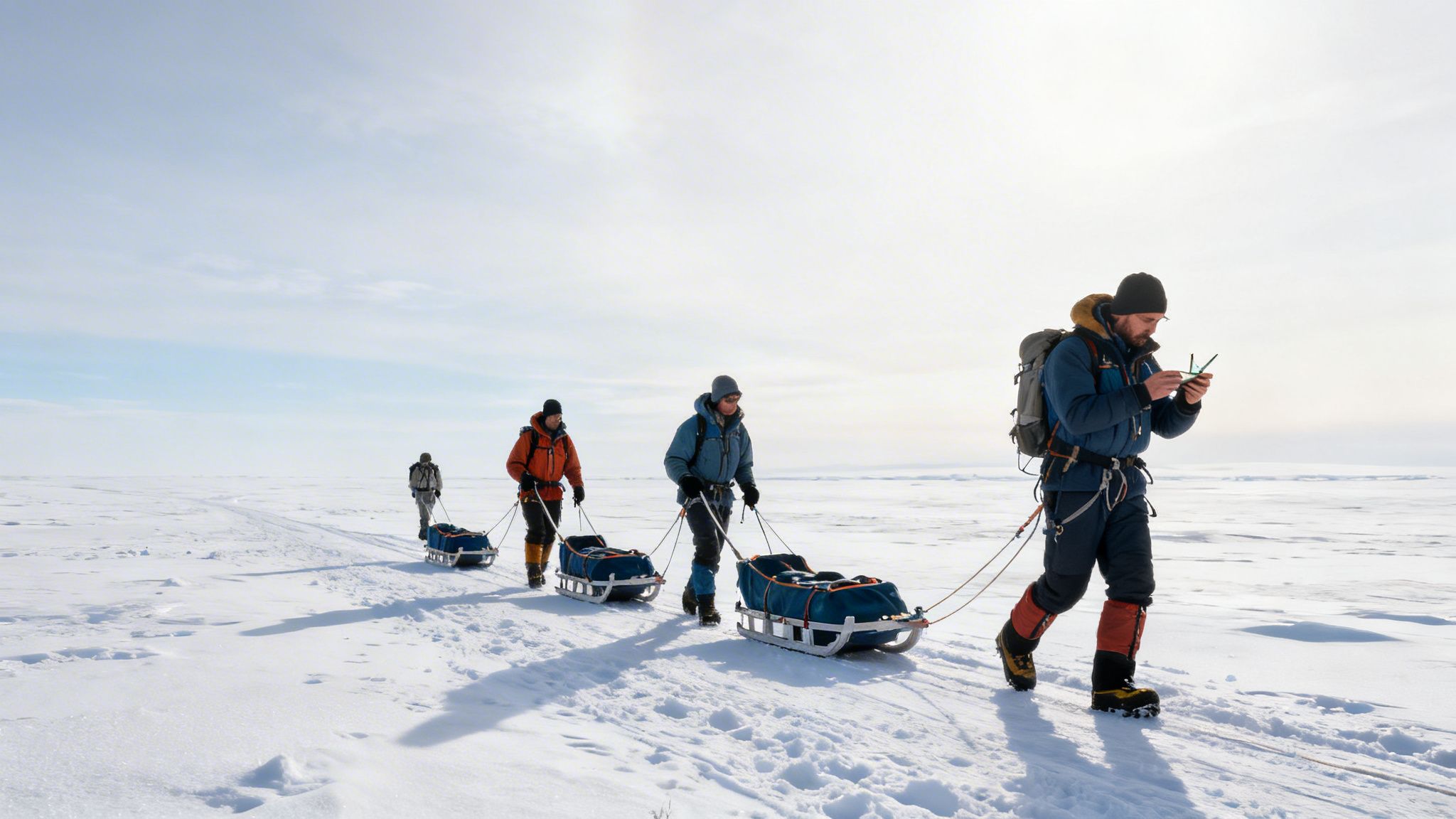
This is where theory gets stripped away, leaving only reality. People often ask how hauling a 50kg pulk in -30°C across the Hardangervidda plateau translates to managing a budget during a recession. The answer is simple. Both demand absolute clarity of thought when you’re tired, cold, and under pressure.
In the boardroom, a bad decision might mean a missed quarterly target. On the ice, a bad decision can mean frostbite or getting dangerously lost. The environment doesn’t give you theoretical feedback; it delivers immediate, real-world consequences. It’s a powerful learning loop you can't replicate in a conference room.
The Crucible of Consequence
Expedition training isn’t about running through abstract case studies. It’s a live fire exercise in resource management, risk assessment, and human dynamics. The mental frameworks you build out here aren’t just like business challenges they are the exact same frameworks, just forged under more intense and undeniable pressure.
Think about navigating with a map and compass in a whiteout. With visibility down to a few metres, the team has to rely on precision, trust, and crystal clear communication. That single task develops the same mental discipline needed for strategic planning amid market chaos, when the data is incomplete and the path ahead is anything but clear.
In these environments, you build competence before confidence. As Roald Amundsen proved with his meticulous preparations on the Hardangervidda before his success at the South Pole, victory isn't about bravado. It’s the result of rigorous preparation, tested systems, and a team that trusts the process because they’ve drilled it over and over again.
This philosophy is at the very heart of how we approach leadership development. It’s serious work, which is why professionals like Jason Fox and Aldo Kane, men who understand high stakes environments recognise the power of this approach.
Forging Practical Leadership Skills
In a polar environment, leadership isn't a title; it's a function. It’s about who steps up to solve the problem, whether that’s a broken ski binding or flagging team morale. This context provides a unique platform to practise and sharpen specific executive skills.
Crisis Communication Under Duress
- The Challenge: Telling a tired, cold team you have to change the route, knowing some will disagree.
- The Business Parallel: Announcing a difficult company restructure or a strategic pivot to an anxious, sceptical workforce. You have to be clear, decisive, and empathetic to get buy in under stress.
Resource Allocation with No Margin for Error
- The Challenge: Rationing food and fuel for a ten-day ski traverse, knowing there are no resupplies. Every gramme, every millilitre, has to be accounted for.
- The Business Parallel: Managing a critical project with a fixed budget and an immovable deadline. It requires ruthless prioritisation and making tough trade-offs to ensure the main objective is met.
Maintaining Team Morale
- The Challenge: Keeping spirits high on day six of a storm, confined to a Hilleberg tent. The leader's own mindset directly dictates the group's resilience.
- The Business Parallel: Sustaining your team’s motivation through a long period of market uncertainty or after a major project setback. It’s about projecting calm confidence and focusing everyone on what they can control.
This direct, unfiltered experience is what makes expedition based leadership development programmes for executives so potent. The learning isn’t academic; it’s visceral. Lessons are etched into your memory through action and consequence, building a durable leadership character that sticks long after you've left the ice.
For those serious about building this level of resilience, our expedition training course provides the foundational skills and mindset needed. It is the first step towards understanding how to lead when the pressure is real and the stakes actually matter. Out here, the environment becomes the instructor, teaching lessons in a language that’s impossible to ignore.
Measuring The True Return On Leadership Development

Any significant investment demands a clear business case, and leadership development is no exception. The experience of navigating a glacier might feel profound, but the board needs to see its value reflected on the balance sheet. Measuring the return on investment (ROI) for leadership development programmes for executives means moving beyond anecdotes and focusing on tangible, quantifiable business outcomes.
The argument is surprisingly straightforward. The cost of a high impact development programme is often dwarfed by the expense of replacing a single senior executive lost to burnout. It’s a fraction of the productivity drain from a disengaged, poorly led team. A proactive investment in leadership capability isn’t a luxury; it’s a defence measure against far greater costs down the line.
Moving Beyond Soft Metrics
To prove real value, we have to track specific key performance indicators (KPIs) before and after a programme. This isn't about feelings; it's about clear, measurable data that links the intervention directly to organisational health and performance.
Leadership development consistently ranks as a top priority for UK organisations, yet its effectiveness is often questioned. Research shows it’s the number one HR focus for the third year running, but only 36% of organisations believe their current programmes are actually preparing leaders for the future. You can discover more insights about effective leadership programmes from People Management. This gap shows an urgent need for programmes that don’t just inspire, but deliver and demonstrate measurable results.
Core KPIs to Track for Demonstrable ROI
A robust measurement framework focuses on indicators that directly impact the bottom line. These aren't abstract concepts. They are hard numbers that tell a clear story to stakeholders.
Key metrics include:
- Employee Retention Rates: Keep a close eye on turnover within the teams of participating leaders. An effective leader builds a stable, motivated team, which directly cuts recruitment and training costs.
- Promotion Velocity: Monitor how quickly programme alumni advance within the organisation compared to their peers. This tells you if you're successfully building the next generation of senior leadership.
- Project Success Rates: Analyse the delivery record for projects led by participants after the programme. Improvements in on-time, on-budget delivery are a direct measure of enhanced capability.
- Team Engagement Scores: Use pre and post programme pulse or annual surveys to measure shifts in morale, motivation, and psychological safety within a leader's team.
By establishing a baseline for these metrics before the programme begins, you create a clear benchmark. Tracking them for 6-12 months afterwards allows the full impact of behavioural changes to manifest in the data.
This methodical approach transforms the conversation. Leadership development stops being a "nice-to-have" expense and becomes a strategic investment in organisational resilience. For a deeper dive into how these figures are calculated, you can explore our detailed guide on Pole to Pole's approach to measuring leadership metrics .
The data will show that building stronger leaders isn't a cost centre; it is one of the most effective risk management strategies a business can deploy.
How To Choose The Right Executive Leadership Programme
Choosing a path for leadership development is a serious commitment. This isn’t about booking a one off event; it’s an investment in a continuous process that builds lasting resilience across your organisation.
The right programme should feel less like a purchase and more like a partnership. You need a provider who truly understands what you’re trying to achieve.
Approaching this decision requires the same clarity as planning an expedition. A fuzzy objective leads to wasted effort and resources, whether you’re in the boardroom or on the ice. The first step is a frank assessment of where your team is now, and where you need them to be.
Define Your Strategic Objectives
Before you even think about looking at providers, look inward. What are the specific leadership gaps holding your organisation back? Vague goals like “improving leadership” won’t cut it. You need to get precise.
- Can your leaders make clear decisions when they only have half the picture during a crisis?
- Do your teams communicate with clarity and trust when the pressure is immense?
- Are you building a pipeline of leaders who can manage their own resilience and sidestep burnout?
Answering these questions honestly gives you the coordinates for your search. The goal isn't just to find a programme; it's to find the right tool for a specific problem. A clear 'why' is the single most important part of any successful leadership initiative.
Evaluate The Provider's Expertise
Once you have your objectives nailed down, it's time to scrutinise potential partners. Look past the polished brochures and dig into the depth of their real world experience. A provider's background must align with the outcomes you need.
When you’re looking at experiential programmes, ask about their expeditionary track record, not just their corporate client list. Genuine leadership under pressure can't be taught by people who have only read about it in a book. It has to be guided by those who have lived it.
Look for a philosophy of partnership. A good provider will work with you to understand your challenges and co-design a programme, not just sell you a generic, off-the-shelf solution. That collaborative spirit is a hallmark of an organisation committed to delivering real, tangible impact.
Plan for Integration and Follow Through
The experience itself, whether in a classroom or on a glacier, is only the beginning. The most critical phase comes next: post programme integration. Without a solid plan to embed the learning, even the most profound lessons will fade.
Work with your provider to build a structured follow-up process. This should include things like one to one coaching, peer accountability groups, and directly linking the programme's lessons to live business projects. This is how you ensure the investment pays dividends long after everyone has gone home.
For a deeper understanding of how we build these skills from the ground up, you can learn more about The Pole to Pole Academy and its foundational approach.
This commitment to follow-through is what separates truly impactful leadership development programmes for executives from simple training events. It guarantees the journey continues, building momentum and embedding new, stronger behaviours into your organisation’s DNA.
Frequently Asked Questions
When you're considering something as fundamental as leadership development, it's natural to have questions. Here are some of the most common ones we hear from executives and organisations, along with our straightforward answers.
How Long Should An Executive Leadership Programme Be?
This is like asking "how long is a piece of string?" The right duration is the one that achieves the goal.
A two week, high intensity expedition can forge more resilience and create a deeper impact than a 12 month online course that barely scratches the surface. The real measure isn't the number of days on a calendar; it's the depth and direct application of the experience.
The best leadership development programmes for executives don't just teach, they immerse. They combine these high impact learning experiences with continuous coaching afterwards, making sure those new behaviors and mindsets stick when leaders are back in the familiar corporate world. It's all about intensity, not just duration.
What Is The Difference Between Leadership And Management Training?
It’s a crucial distinction, and one that gets to the heart of what we do. The two are fundamentally different from one another.
- Management training is about process and execution. It gives people the 'how to' guide for things like budgeting, organising teams, planning projects, and keeping the machine running efficiently.
- Leadership development is about character and influence. It builds the 'why' – the ability to inspire a vision, make decisions in the grey areas, and drive real change when the old processes no longer work.
Think of it this way: management gives you the map. Leadership teaches you how to navigate when you're off the map entirely. Our focus is squarely on the latter.
Can The Impact Of Experiential Learning Be Measured?
Absolutely. But we don't measure it in feel-good moments or subjective feedback. We measure it in cold, hard business metrics.
We look at the tangible data before and after a programme. What’s the employee retention like within a leader's team? How quickly are participants being promoted? What do their 360 degree feedback scores say? How engaged are their teams?
The ROI doesn't just show up in the leader's performance review. It appears in the stability, morale, and measurable output of their entire department. That's how you build a rock-solid business case for the investment.
At Pole to Pole , our philosophy is simple: the most resilient leaders aren't just taught in a classroom they are tested in the real world. Our programmes are designed to be that test, the crucible where genuine leadership character is forged.
If you’re ready to move beyond theory and build a team that can navigate any storm, explore our leadership expeditions and academy programmes.