Choosing the Right Mountain Equipment Glove for Extreme Cold
A well-chosen glove is more than a piece of kit; it is a critical life-support system. When temperatures plummet to the point where exposed skin can freeze in minutes, your handwear becomes one of the most important tools you have. It dictates your ability to operate, navigate, and ultimately, to survive.
Your Hands Are Your Lifeline
Picture this: you are trying to adjust a frozen stove buckle at -30°C on Norway's Hardangervidda plateau. In that single moment, your ability to perform a simple task hinges entirely on the warmth and dexterity your gloves offer.
Lose that function, and you can no longer melt water, prepare food, or handle your navigation gear. This is the stark reality of polar and high-altitude environments. Your hands are not just limbs; they are your lifelines.
This guide cuts through marketing noise to give you practical, field-tested wisdom on expedition handwear. We do not see gloves as a single item, but as an adaptable, essential system. On any serious expedition—from a Svalbard crossing to a South Pole 'Last Degree' ski—relying on just one pair of gloves is a fundamental error. Conditions change, your exertion levels rise and fall, and different tasks demand different levels of fine motor control.
The System-Based Approach
The core principle is layering—a concept you will be familiar with if you have ever managed your body temperature in the cold. A handwear system is built on the same idea, typically including:
- Liner Gloves: Thin, moisture-wicking gloves for high-dexterity tasks when you need your fingers free.
- Mid-Layer Gloves: These are your primary 'work' gloves, striking a balance between warmth and movement.
- Shell Mitts: Your ultimate defence against extreme cold and wind, designed to be worn over your other layers.
This multi-layered approach means you can adapt to any situation without ever exposing your bare skin. A simple mistake, like dropping a glove in deep snow, can have severe consequences. Jason Fox, a supporter of Pole to Pole's methodology, knows from hard-won experience that equipment failure is simply not an option when the stakes are this high.
"In an extreme environment, every piece of kit must be understood as part of a larger safety system. Your gloves are not there to keep your hands comfortable; they are there to keep you operational. The moment you cannot use your hands, you become a liability."
Beyond the Glove Itself
But effective hand management goes beyond the layers you wear. It is about being proactive and preventing heat loss before it even starts.
Many explorers supplement their glove systems with external heat sources. Think of it as a backup generator for your hands. Beyond the primary insulation of your gloves, portable solutions like microwavable hand warmers can offer a quick blast of warmth and prevent icy fingers from becoming a serious problem.
Ultimately, your approach to handwear reflects your broader expedition mindset. It is about preparation, adaptability, and understanding that your equipment is an extension of your skill. As you will see, every choice—from the material to the fit—is a calculated decision. For a deeper look into our kit philosophy, explore our guide on packing for resilience.
The Three-Layer System for Mountaineering Gloves
Relying on a single, all-purpose mountain glove is a mistake waiting to happen. In serious environments, the foundation of proper hand protection is a modular, adaptable system. Do not think of it as one pair of gloves; see it as a toolkit. Each piece has a specific job, letting you react to changing conditions and handle different tasks without ever exposing your skin to the elements.
This system is built around three distinct layers: the liner, the mid-layer, and the shell. Understanding what each one does is absolutely fundamental to staying functional when the temperature plummets. It is a core principle we instil in every participant at our Pole to Pole Academy, from our training centre at 64° 25' 24" N in Iceland's interior to our programmes in Svalbard.
The hierarchy is simple: your hands are your lifeline. The system you build is what keeps them working.
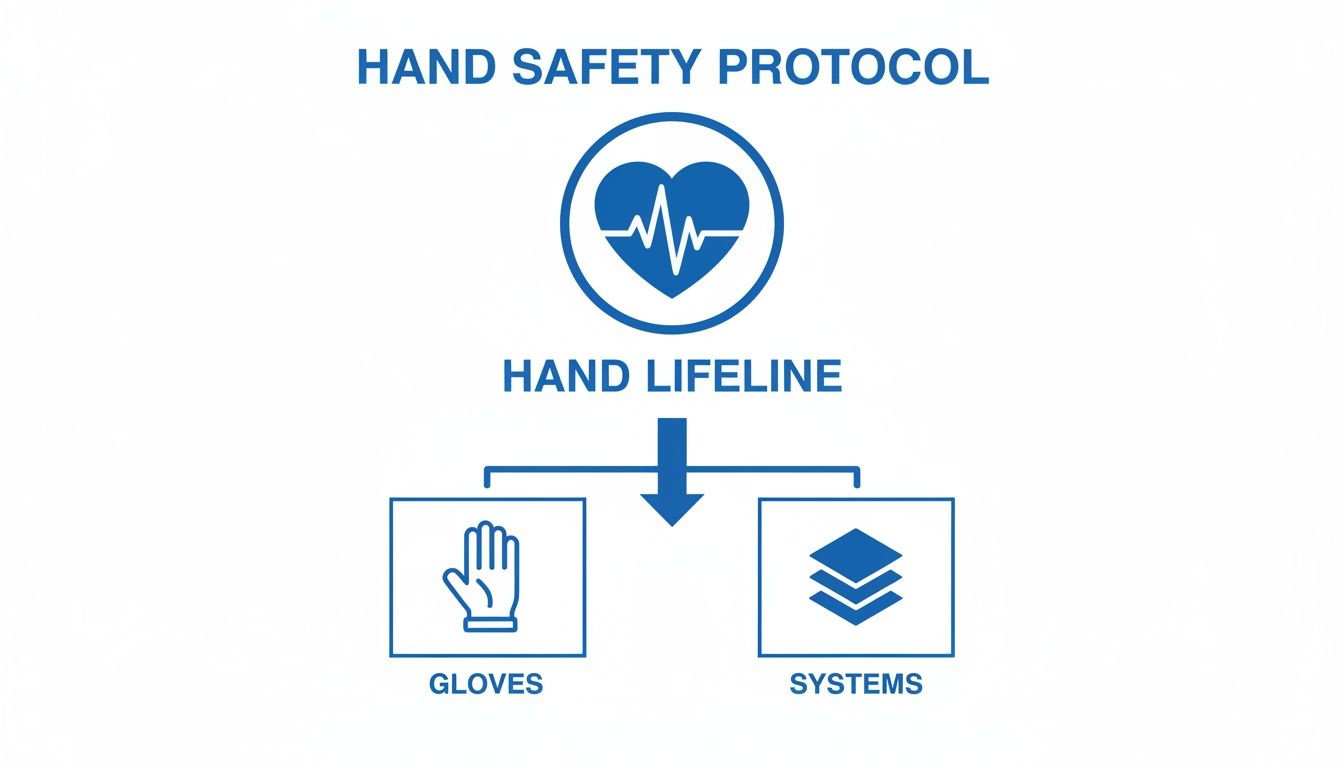
This visual drives home the point that individual gloves are just components. They exist within a broader, critical system designed to keep you operational.
The Liner Glove: The Foundation
Think of the liner glove as your second skin. It is the first and most important layer for managing moisture, worn right against your hand. Its main job is to pull sweat away from your skin, stopping that damp feeling that so quickly leads to dangerous cold.
You will wear these constantly, even inside your tent. For delicate tasks—fiddling with a GPS, adjusting a camera, or opening a food packet—you will often strip off your heavier outer layers and rely solely on the liner. That brief exposure is manageable because the liner acts as a barrier against immediate cold shock and wind.
You have two main choices for material:
- Merino Wool: A brilliant natural fibre. It keeps you warm even when it gets a bit damp and naturally resists odours, making it suitable for long days.
- Synthetics (Polyester/Polypropylene): These are champions at wicking moisture. They also dry incredibly fast, which makes them a reliable choice for high-output activities where you know you will be sweating.
The right liner is the starting point for your entire handwear strategy. It is a detail people often get wrong, but it is critical for success.
The Mid-Layer: The Workhorse
The mid-layer is your daily driver, your workhorse. This is the glove you will probably have on for the bulk of your active time, whether you are pitching a Hilleberg tent in a biting wind or wrestling with ski bindings. It has to strike that tricky balance between providing solid insulation and leaving you with enough dexterity to handle your kit.
This layer is typically a softshell or fleece glove. Softshell gives you good wind and water resistance whilst still being breathable—vital when you are working hard. Fleece offers excellent warmth for its weight but will not do much to fend off the elements on its own.
On a typical polar training day, we might ski for hours with just a liner and a mid-layer on, keeping the heavy shell mitts packed away until we stop. This active regulation stops you from overheating and building up sweat, which is the real enemy out here.
It is crucial to pick a mid-layer with a durable palm, perhaps reinforced with leather or a tough, grippy synthetic. This is the layer that takes a beating from ice axes, ski poles, and ropes. It is not just about warmth; it is about function and durability.
The Shell Mitt: The Ultimate Defence
Finally, the shell mitt. This is your ultimate defence, your storm shelter for when the environment throws its worst at you. It is designed to fit easily over both your liner and your mid-layer glove. Its one and only job is to provide absolute protection from wind and water.
Mittens are always warmer than gloves. Simple physics: your fingers share the same space, generating and retaining heat together. For extreme cold, like a Last Degree expedition where temperatures can sit around -35°C , a high-quality mitt is not just nice to have—it is completely non-negotiable.
Look for shells made with proven waterproof, breathable membranes like GORE-TEX or Pertex Shield. These fabrics block moisture from the outside whilst letting some of the water vapour from your sweat escape. This layer needs to be tough, simple, and easy to pull on and off, even when your hands are cold and clumsy. A simple wrist leash, or 'keeper', is another non-negotiable feature. It will stop a sudden gust of wind from snatching your most critical piece of insulation.
To help you visualise how these layers work together, here is a quick breakdown of the system.
Expedition Glove Layering System At a Glance
| Layer | Primary Function | Common Materials | Typical Use Case (Example) |
|---|---|---|---|
| Liner | Moisture Wicking & Dexterity | Merino Wool, Synthetic Blends (Polyester) | Operating a camera or GPS, quick snack breaks. |
| Mid-Layer | Primary Insulation & Durability | Fleece, Softshell, Leather | Skiing, setting up camp, handling ropes and tools. |
| Shell | Weather Protection & Maximum Warmth | GORE-TEX, Pertex Shield (often with down/synthetic fill) | Extreme cold, high winds, heavy snow, or during rest stops. |
Mastering this three-layer approach is a core skill. It gives you the adaptability you need to stay effective, transforming your handwear from a simple accessory into a key piece of your expedition equipment.
Understanding Materials and Insulation in Your Gloves
A high-performance mountain glove is much more than what you see on the surface. Its real capability, the thing that keeps you safe and functional, is hidden inside – in the layers of materials working together as a system. Getting to grips with what these materials are, and why they have been chosen, is the first step to making a smart, safe choice.
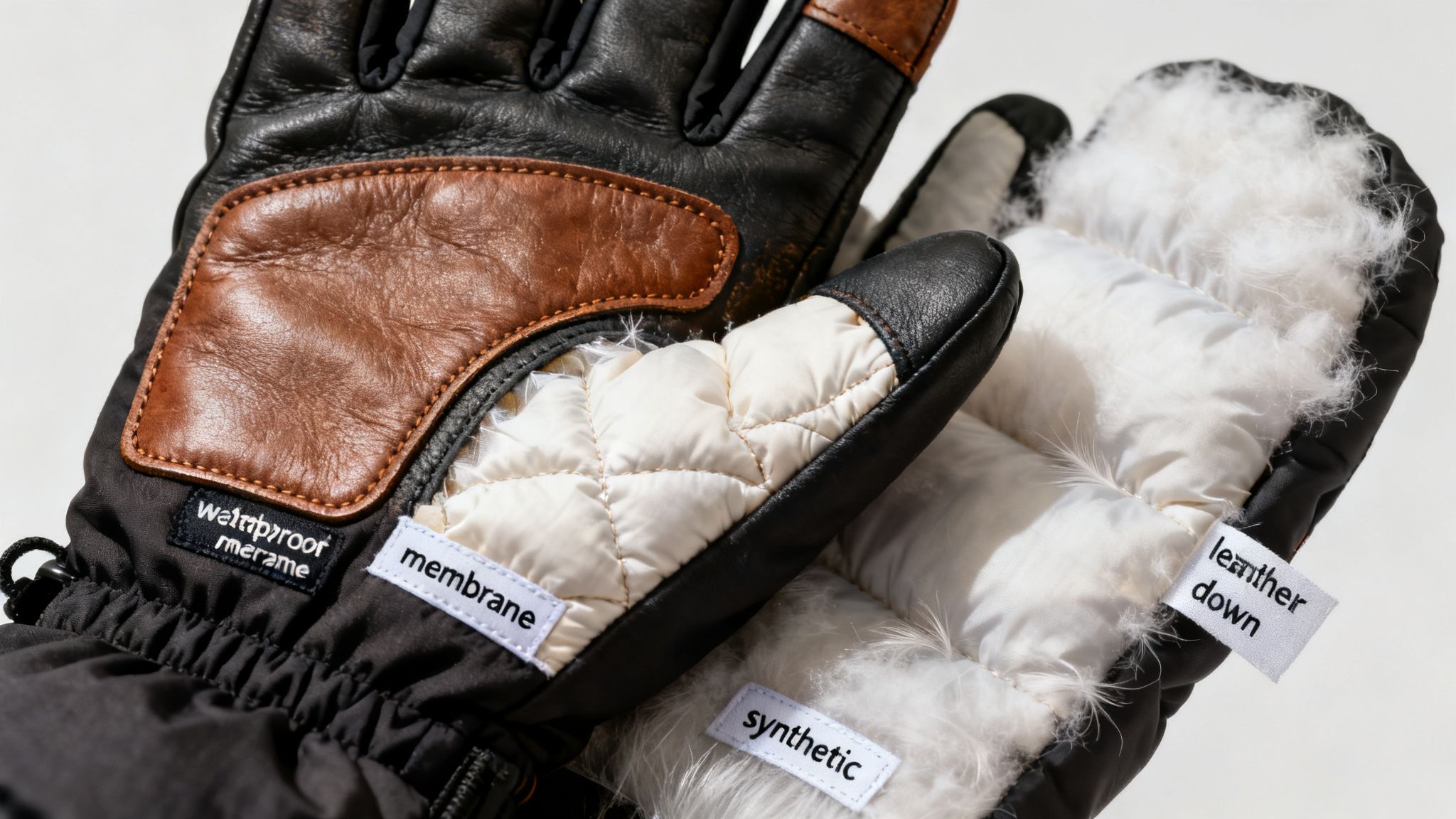
This is not about marketing; it is about applied science in places where things can go wrong very quickly. Whether you are on the wind-blasted Greenland ice cap or facing the raw cold of a Svalbard winter, the materials in your gloves are what allow you to operate.
The Critical Role of Waterproof Breathable Membranes
One of the biggest dangers in the cold is not the air temperature. It is the moisture you create yourself. Sweat that has nowhere to go will cool and eventually freeze, creating a direct line for the cold to reach your skin. This is precisely why waterproof and breathable membranes like GORE-TEX are non-negotiable.
Picture a GORE-TEX membrane as a fortress wall punched with microscopic holes. These pores are about 20,000 times smaller than a droplet of water, so rain and melted snow simply cannot get through. But here is the clever part: they are also 700 times larger than a molecule of water vapour. That means sweat can escape from the inside with ease.
This one-way street for moisture is the absolute key to preventing cold injuries. A glove that is just waterproof will trap sweat, turning its insulation into a useless, soggy mess. A glove that is only breathable offers no defence against the elements. It is the combination of both that elevates a glove from a simple hand covering to a life-preserving piece of kit.
Down vs Synthetic Insulation: A Calculated Choice
The engine of any winter glove is its insulation. The choice boils down to two main players: natural down and synthetic fills. Each has its own distinct personality, with strengths and weaknesses that make it right for some conditions and dead wrong for others.
Natural Down Insulation
- Unmatched Warmth-to-Weight: Nothing packs more warmth for less weight and bulk than down. It is why expedition-grade mitts, like the Mountain Equipment Redline Mitt, rely on it for the brutal, dry cold of Antarctica.
- Superior Packability: Down scrunches down to almost nothing, freeing up precious space in your pulk or rucksack.
- Major Weakness: Its Achilles' heel is moisture. When down gets damp, it clumps together, loses all its fluffy loft, and provides next to no insulation. It also takes a very long time to dry out in the field.
Synthetic Insulation
- Reliability When Wet: Synthetic fills like PrimaLoft are the workhorses. They keep a huge chunk of their insulating power even when soaking wet, making them a much safer bet for the damp, raw cold you will find in Scotland or during our winter expedition experience training in Iceland.
- Faster Drying Time: Synthetics dry out far quicker than down, which is a massive plus on multi-day trips where drying your kit is a nightly battle.
- The Trade-off: The price for this reliability is weight and bulk. Synthetics are heavier and less compressible than down for the same level of warmth.
The choice is tactical. For the extreme, dry cold of a South Pole journey, down is often the clear winner. But for mixed conditions where dampness is a constant threat, synthetic insulation provides a vital safety margin. If you want to dive deeper into the core principles, it is worth reviewing some general insulation strategies for winter conditions.
Shell Fabrics and Palm Materials
The outer shell is your glove's first line of defence. It needs to be tough enough to handle scrapes from rock, ice, and equipment, all whilst blocking wind and shedding water. Materials like DRILITE® are a common choice for their durable, weather-beating properties.
The palm, however, is where the real work happens. It needs special attention.
A glove's palm is its interface with the world. It must provide grip for an ice axe, durability for rope work, and dexterity for fine-motor tasks. Choosing the right palm material is as important as choosing the right insulation.
Goatskin leather is the gold standard for serious mountain gloves. It delivers a fantastic blend of toughness, grip, and flexibility, even moulding to your hand over time. The only catch is that it needs a bit of looking after to keep it water-resistant. Synthetic palms, on the other hand, offer great grip with less maintenance but cannot match the long-term durability of high-quality leather.
How to Select the Right Fit, Dexterity and Durability
A poorly fitting glove is not just uncomfortable; it is a liability. Like choosing an ice axe or a pair of skis, the decision has to be deliberate and focused on the mission ahead. It is about ensuring a critical tool performs without fail when everything is on the line.
Fit, dexterity, and durability are not just marketing terms. They are the core attributes that determine whether your hands remain functional assets or become vulnerable points of failure.
This is a balancing act. Too tight, and you cut off circulation, leading to colder fingers and rapid heat loss. A tight fit also crushes the glove's insulation, making it useless. Go too loose, and you are left with a clumsy, inefficient tool that turns simple tasks—clipping a karabiner, adjusting a pulk harness—into frustrating ordeals.
Sizing for the System, Not Just the Hand
The first mistake most people make is sizing a glove for their bare hand. You have to size for the entire system.
When you are trying on a mid-layer or a shell glove, you should already be wearing the liner you plan to use with it. The fit needs to feel snug, but never restrictive.
A simple field test works well: make a full, tight fist. You should not feel any uncomfortable pressure across your knuckles or the back of your hand. Next, stretch your fingers out straight. The material should not feel like it is straining at the fingertips.
A critical part of a good fit is allowing for a thin layer of trapped air. This air is an excellent insulator. A glove that is too tight squeezes this layer out, killing its thermal performance. Always aim for a small amount of space at the fingertips—around 5-10 millimetres —to create this vital pocket of warm air.
This small buffer also stops your fingertips from making direct contact with the cold outer shell of the glove, a phenomenon known as contact cooling. In extreme cold, this single detail can be the difference between functional fingers and the first signs of frostnip.
Dexterity: Function Under Pressure
Dexterity is simply your ability to get things done. On an expedition, that means everything from operating a stove to navigating with a map and compass. Poor dexterity does not just slow you down; it increases frustration and ultimately your risk by making crucial tasks take longer in the cold.
Look for gloves with a pre-curved or articulated fit . This design mimics the hand’s natural resting shape, which drastically reduces the effort needed to grip a ski pole or an ice axe. Over an 8-hour day on skis, covering 15-20km, this ergonomic advantage means less hand fatigue and more conserved energy.
The Mountain Equipment Tupilak Glove, for example, is built around this principle for technical climbing. Its construction allows for precise tool handling without giving up essential insulation. A bulky, poorly fitting glove, on the other hand, forces your hand muscles to constantly fight the material itself—a complete waste of energy.
Durability: The Mark of Professional Kit
Expedition kit takes a constant beating. Durability is not a luxury; it is a non-negotiable requirement. A glove failing midway through a journey is not an option.
You need to look for signs of robust construction that prove the gear is built for sustained use in harsh environments.
Key indicators of a durable glove include:
- Reinforced Stitching: Look closely at the seams, especially around the fingers and palm. Double-stitching is a good sign that the glove can handle abrasion and stress.
- High-Wear Area Overlays: The palm, thumb, and index finger see the most action. A quality mountain glove will have reinforced overlays here, often using tough goatskin leather or other durable synthetics.
- Quality Palm Material: As we have mentioned, goatskin leather gives you an excellent blend of durability and grip. It stands up to repeated friction from rope work and handling sharp kit far better than most synthetic alternatives.
Think of your handwear like any other piece of critical equipment. The Citadel Mitt, designed for the brutal cold of polar travel, prioritises insulation and bombproof construction over fine dexterity. Its durability ensures it will perform, day in and day out, for the entire duration of a long, unsupported journey. This task-specific philosophy is central to building a reliable kit list. You select the tool that is perfectly suited for the job at hand.
Mastering Fieldcraft for Handwear Care and Maintenance
Your relationship with your kit does not end the moment you buy it. In many ways, that is just the beginning. True expertise shows itself in the field, where a small failure can spiral into a serious problem. A mountain glove is not just an accessory; it is a life-preserving tool, and treating it with respect ensures it performs when everything is on the line.
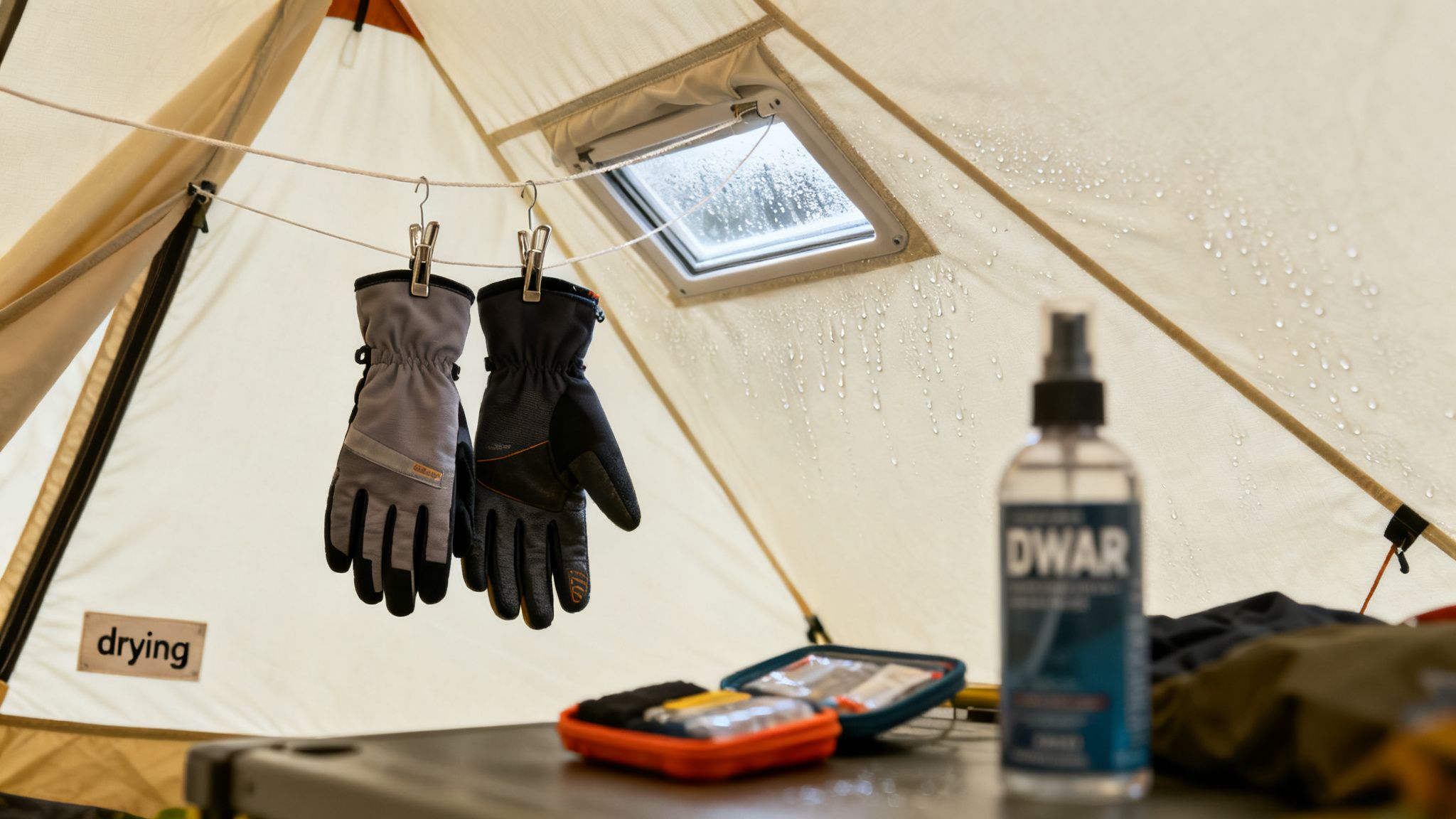
This ethos of self-sufficiency and meticulous care is a core part of the Pole to Pole philosophy. Looking after your equipment is not just about making it last longer—it reinforces the mindset that you are an active, responsible participant in your own safety system.
Field Drying Techniques
Damp gloves are an unavoidable reality on almost any multi-day trip. How you deal with them makes all the difference, because drying them improperly can permanently ruin the insulation and waterproof membranes inside.
The cardinal sin of glove care is to place them directly on a stove or too close to a fire. The intense, direct heat will delaminate the waterproof membrane, melt synthetic fibres, and cause leather to shrink and crack. Patience is the only answer.
Instead, let your own body do the work. The most reliable method is to tuck damp gloves inside your sleeping bag with you overnight. If they are very wet, put them in a dry bag first, but for general dampness, just placing them near your core will slowly and safely dry them by morning. During the day, you can stick them inside your jacket for the same effect.
Cleaning and Reproofing Protocols
Out on the trail, your gloves will get covered in dirt, grime, and sweat. This is not just a cosmetic issue. Clogged pores in a membrane suffocate its breathability, whilst the oils from your skin can slowly degrade the materials from the inside out.
- Synthetics: Hand wash them in lukewarm water using a specialist technical cleaner. Steer clear of standard detergents, as they often leave behind residues that destroy the DWR (Durable Water Repellent) coating. Gently squeeze out any excess water—never wring them out—and let them air dry naturally.
- Leather: For leather palms, a simple wipe with a damp cloth is usually enough. Once they are fully dry, work in a leather conditioner or a wax-based proofer. This step is essential; it nourishes the material, keeps it supple, and restores its water resistance.
You will know it is time to re-apply a DWR treatment when water stops beading up and rolling off the outer fabric. When the fabric starts absorbing moisture and looking dark—a phenomenon known as "wetting out"—it is time to use a spray-on or wash-in product to bring that performance back.
Preventing Loss and Making Field Repairs
Losing a glove in high winds can go from an inconvenience to a critical incident in seconds. This is what keeper leashes are for. Always use them. If your expedition-grade gloves somehow did not come with any, make your own. Just loop them around your wrists so you can take your gloves off for a quick task without a gust of wind stealing one.
For small rips and tears, a field repair kit is invaluable. A small patch of tenacious tape or similar gear repair tape can seal a hole, preventing insulation from escaping and stopping the damage from getting any worse.
Demand for reliable gear is growing. You can explore more about these market trends and their drivers here.
Your Expedition Handwear Questions Answered
We receive a lot of questions about handwear. People often ask about a specific glove model or a particular scenario, but experience has taught us the best answer is rarely about a single piece of kit. It is about how that kit fits into a wider system and, just as importantly, your mindset.
This section tackles the most common questions we hear, drawing on years of leading expeditions to give you direct, field-tested advice.
Which Mountain Equipment Glove Is Best for a South Pole Expedition?
For a 'Last Degree' South Pole expedition, where you will face consistent temperatures between -25°C and -40°C , a dual-system is not just a good idea—it is non-negotiable. Your main handwear has to be a full expedition mitt like the Mountain Equipment Citadel or Redline Mitt. These are built with serious high-loft insulation and a tough, windproof outer shell.
But that is only half the story. You must pair this with a thin, moisture-wicking liner glove. The big mitt provides the raw thermal protection you need for 8-10 hour skiing days, whilst the liner lets you briefly slip the mitt off for fiddly tasks—like adjusting bindings—without risking immediate frostbite. There is no single "best" glove, only a best system for the environment you are in.
How Do I Stop My Hands from Getting Sweaty and Then Cold?
This is a classic problem, and the solution is not in a piece of gear, but in how you use it. It is all about proactive moisture management. Start with a high-quality liner, either merino wool or a good synthetic, that actively pulls sweat away from your skin.
As you start working hard and feel your hands warming up, take your outer mitts off before they get too warm and start to sweat. For that period of high output, just rely on your mid-layer or liner. When you stop for a break or the pace eases, get the warmer layer back on immediately.
It is a constant process of tiny adjustments throughout the day. Whilst breathable membranes like GORE-TEX are a massive help, they cannot magically erase excessive sweat. Active, hands-on management will always be your best defence.
Your clothing is a tool to regulate temperature, not a static barrier. The goal is to maintain a stable, comfortable state, which requires constant, minor adjustments. Waiting until you are too hot or too cold is a reactive mistake.
Should I Choose Leather or Synthetic Palm Gloves?
This choice comes down to what you will be doing and how much abuse your gloves need to take.
For anything requiring serious durability and a reliable grip—think mountaineering with ice axes or a lot of rope work—gloves with a goatskin leather palm are simply better. Leather offers fantastic abrasion resistance, but it does need a bit of care. You will have to periodically treat it with a wax proofer to keep it performing at its best.
If you are on a polar skiing journey where your main point of contact is a ski pole grip, a reinforced synthetic palm is often perfectly adequate. They provide good grip with less maintenance, but they generally will not stand up to the same long-term punishment as leather. For technical alpine routes, leather is still the preferred choice of professionals.
What Is the Difference Between a Glove and a Mitt?
The fundamental difference is a straight trade-off: warmth versus dexterity.
A mitt keeps your fingers together in one large compartment. This simple design allows them to share body heat, making a mitt significantly warmer than a glove of the same thickness. It is the undisputed champion for extreme, sustained cold, like you would find in Antarctica or on 8,000-metre peaks.
A glove , on the other hand, gives each finger its own individual space. This gives you far better dexterity for handling gear like cameras, stoves, or navigation tools. The compromise is that each finger has to generate and hold onto its own heat, which makes gloves inherently colder than mitts.
Most effective expedition systems will include both. You might wear a dexterous mid-layer glove for the active part of the day, then pull on a heavy-duty mitt for rest stops or when the weather turns. That adaptability is what keeps you functional and safe.
At Pole to Pole , we believe that mastering your equipment is the first step towards mastering the environment. Our expeditions are built on a foundation of expert guidance, meticulous preparation, and the quiet confidence that comes from genuine experience.
Ready to test your limits and explore what is possible? Discover our upcoming expeditions and training programmes.