High Performance Team Development: An Expedition Leader's Guide
Developing a high performance team isn't about trust falls or motivational posters. It is a hard, operational discipline forged in environments where cohesive action is the difference between success and survival.
It means treating a team not as a collection of roles, but as a single, resilient unit built for sustained pressure. The focus has to shift from abstract exercises to tangible, competence building experiences.
Why Most Corporate Team Building Fails
Most corporate team building events fall flat. The forced fun, the awkward icebreakers, the one off away days… they rarely translate into meaningful change back at the office.
They are often a temporary distraction from the real issues, not a solution to the underlying dysfunctions that stop a group of talented people from becoming a truly high performance team. The core problem? These activities fail to replicate genuine pressure or create consequences that matter.
In the UK, employees spend an average of 52.8% of their working time collaborating in teams. That figure alone should tell us how critical team dynamics are to day to day business. It demands a more serious approach.
The Disconnect Between Intent and Impact
Traditional team building usually misses the mark because it operates in a vacuum, completely disconnected from the daily operational realities of the business. An afternoon solving a puzzle in a hotel conference room does not prepare a team for a critical project deadline when systems are failing and stakeholders are demanding answers.
The stakes are not comparable.
This is where a different philosophy, born from decades of military and polar exploration expertise, offers a far more robust framework. In these worlds, high performance is not a 'soft skill'; it is the absolute bedrock of mission success and survival.
We don't fight nature, we live in it. This principle applies as much to navigating a corporate landscape as it does to a Svalbard ice cap. True high performance teams learn to work with their environment, not against it.
A Rigorous, Expedition-Led Approach
Imagine preparing your team for its next product launch with the same rigour an expedition crew uses to prepare for a Last Degree attempt on the South Pole, pulks weighing 45kg. Every piece of equipment is checked. Every protocol is rehearsed. Every team member understands their role with absolute clarity because they know the consequences of failure are real.
This is the very essence of effective high performance team development .
The parallels are direct and powerful:
- Navigating a project with a vague brief is like attempting a traverse in a whiteout with an unreliable compass.
- Managing team conflict over resources is akin to rationing food and fuel on the polar plateau when a storm extends your journey by three days.
- Making a critical decision with incomplete data mirrors choosing a route through a crevasse field based on satellite imagery and gut instinct, as Shackleton did crossing South Georgia.
Understanding why most corporate team building fails is the first step. The next is to explore truly high impact corporate team building events that genuinely build cohesion and motivation. The goal is to move beyond superficial activities and create shared experiences that build real operational resilience, forging a team that thrives under pressure, not despite it.
Diagnosing Your Team's True North
An expedition never begins without a meticulous check of conditions, equipment, and capabilities. No polar explorer worth their salt would leave base camp without knowing the precise state of their supplies and the fitness of their team. That same operational rigor is absolutely essential for any leader who is serious about building a high performance team .
You cannot plot a course forward until you have an accurate fix on your current position. This means going beyond the usual strengths and weaknesses list and conducting a clear eyed diagnosis of your team’s operational readiness. It is about finding the ground truth, not just hearing what is comfortable.
From Vague Briefs to Whiteout Conditions
Think of a team trying to navigate a project with a vague brief and shifting goalposts. They burn energy on rework, communication gets fragmented, and frustration builds.
This is the corporate equivalent of attempting a traverse in a whiteout with a dodgy compass. The team is moving, sure, but without a shared, accurate picture of the landscape, their effort is wasted and potentially dangerous. A proper diagnosis pinpoints these specific points of friction. It is not about judging people; it is about checking the integrity of the systems they have to operate within.
Key diagnostic indicators to look for include:
- Psychological Safety: Can a team member voice a concern about a deadline or challenge a senior leader’s idea without fear of reprisal? In an expedition, this is what allows a teammate to say, "I think we need to stop and re check the route," potentially saving everyone from a serious mistake. This is a principle both Jason Fox and Aldo Kane champion.
- Role Clarity Under Stress: When the pressure mounts, do roles become clearer or more confused? On a polar journey, when a storm hits, everyone knows their exact job, securing the Hilleberg tent, starting the stove, checking the comms. There is no ambiguity.
- Communication Protocols: Does information flow freely and accurately, or does it get filtered and warped along the way? A top team has established protocols for sharing critical data, just as an expedition crew has a clear system for weather updates and position reports.
Uncovering the Ground Truth
To get a truly accurate picture, you have to go deeper than surface-level chats. A couple of techniques, adapted from military and expeditionary environments, are particularly effective here.
The first is the structured debrief . This is not a casual chat over coffee; it is a disciplined, blame free review of a recent project or challenge. Modelled on post mission reviews, it focuses forensically on what happened, why it happened, and what must change for next time.
A team's true capability is not revealed when things are going well, but when the plan breaks down. How they communicate, adapt, and solve problems under pressure is the most accurate measure of their performance.
The second is using carefully designed anonymous surveys . These are not morale polls. They are tools to probe for specific operational weaknesses. Questions should be direct, asking about clarity of objectives, the quality of feedback, and how safe people feel raising difficult issues. This gives you the unvarnished data needed to understand the subtle cracks in the team's foundation. To learn more about the specific metrics that indicate team health and resilience, explore our detailed Pole to Pole metrics explainer.
This diagnostic phase is all about creating a precise, operational understanding of your team's current state. It is the essential inventory check before any journey begins. Only with this clarity can you design a development programme that addresses the real needs, not just the ones you thought you had.
Designing Your Training Expedition
Once you have an honest diagnosis of your team’s capabilities, it is time to move from assessment to action. This is where the real work begins: designing a development programme with a clear purpose. Forget about generic packages. This is about building a bespoke training expedition that hits the specific needs you have uncovered.
Every proper expedition has a mission. A clear objective. Your training should be no different. The design needs to mirror the natural flow of an expedition, starting with skill building and getting acclimatized at 'base camp' before pushing towards a final, challenging objective that tests everyone under real pressure. This layers the learning, building a solid foundation before things get complex.
From Theory to Tangible Application
The best learning happens when theory is put into practice almost immediately. A classroom session on decision making is fine, but it becomes truly powerful when followed by a practical navigation challenge where those same principles have to be applied to find a grid reference against the clock.
This mix of concept and real-world application is at the heart of our high performance team development philosophy. For example, during our 'Offsite On Purpose' programmes in Iceland, a morning session on communication protocols could be followed by an afternoon exercise where the team has to build a complex shelter at our Academy in Sweden ( 64° 25' 24" N ). The catch? The leader can only communicate instructions over a crackly radio.
It is this process, from assessment right through to planning, that makes the training design sharp and effective.
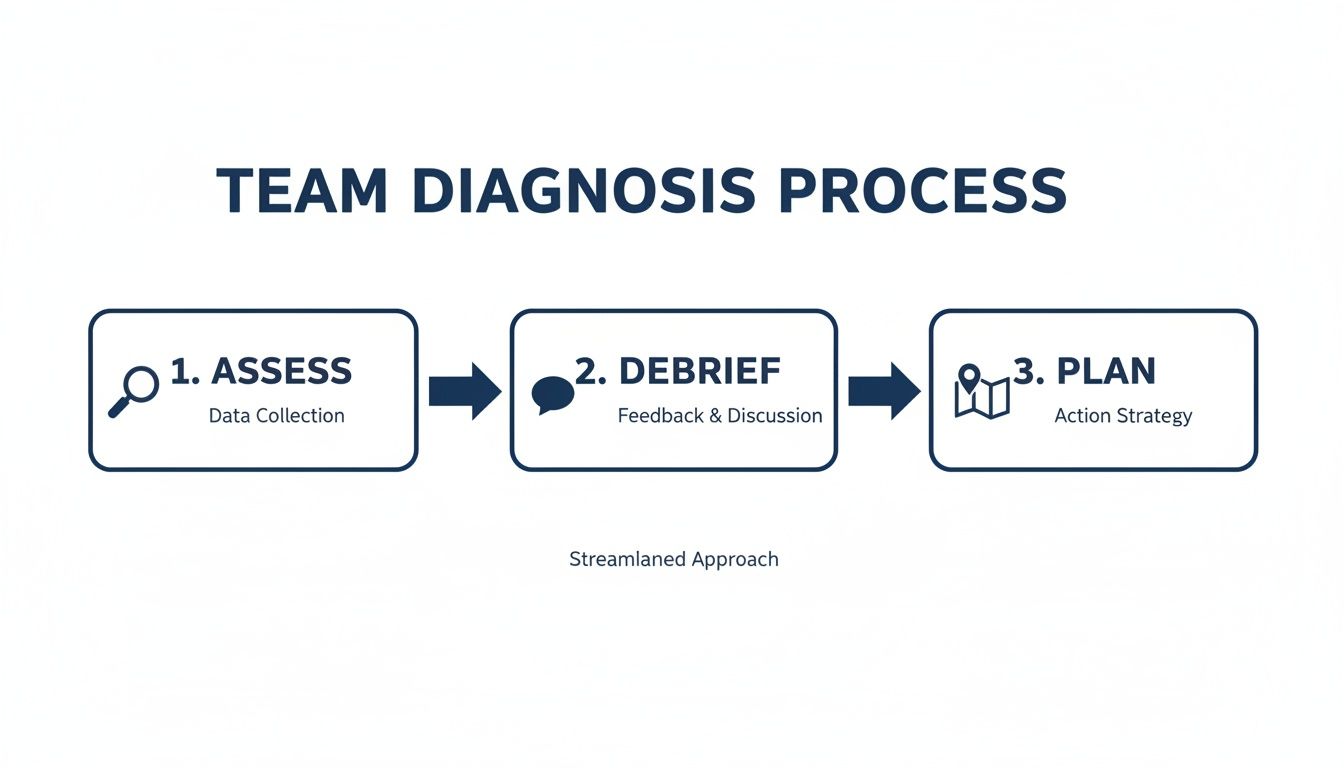
The flowchart shows a simple but powerful sequence: assess where the team is now, debrief to really understand what you have found, and only then plan the intervention.
The idea is to create experiences with just enough pressure to force true collaboration. It is about stripping away the usual corporate comforts and making the team rely on each other, their skills, and their collective will to get the job done. That is where genuine team bonds are forged.
Crafting Mission-Oriented Objectives
Your objectives need to be specific and measurable, tying directly back to your initial diagnosis. Vague goals like "improve communication" are useless. You need something concrete.
A much better objective sounds like this: "Improve communication clarity under pressure, measured by the team's ability to complete a multi stage task with intentionally limited information, reducing unforced errors by 50% compared to the baseline exercise."
Now you have a clear target. An expedition based approach provides a powerful framework for this, as it forces teams to work together in unfamiliar, demanding environments. The core components often translate abstract business challenges into tangible, physical tasks.
Here is a breakdown of how expedition skills map directly to corporate competencies.
Core Components of an Expedition-Based Training Programme
| Expedition Skill | Corporate Parallel | Objective |
|---|---|---|
| Camp Construction | Project Execution & Resource Management | To build a functional shelter within a set time, using limited materials, demanding clear roles and efficient workflow. |
| Navigation & Route Finding | Strategic Planning & Decision Making | To navigate unfamiliar terrain to a specific point, forcing the team to interpret data, make collective decisions, and adapt to changing conditions. |
| Casualty Evacuation Drill | Crisis Management & Leadership Succession | To respond to a simulated emergency, testing the team’s ability to remain calm, delegate tasks, and adapt when a key member is removed. |
| Fuel & Ration Management | Budgeting & Financial Discipline | To complete a multi-day objective with finite resources, teaching prioritisation and the consequences of poor planning. |
| Crevasse Rescue Scenario | Problem-Solving & Trust | To execute a technical rescue, building deep trust and demonstrating the importance of clear communication and technical competence under high stakes. |
Each exercise is designed not just to teach a skill, but to reveal how the team operates under strain. The environment itself becomes a tool for learning.
By designing a series of challenges that build in complexity, you create a powerful story for the team. Each success builds confidence and reinforces the lessons from the last. It is a methodical approach that ensures by the time they face their final 'summit' objective, they are no longer just a group of individuals. They have become a crew.
To see how we put this philosophy into action, take a look at our Pole to Pole Academy's Offsite On Purpose programmes.
Executing in The Field and The Office
A plan is just a map. Execution is the journey itself, where theory slams into the hard reality of terrain, weather, and human dynamics. This is where the real work of high performance team development gets done, where skills are forged in the moment and mindsets genuinely shift.
We are moving beyond discussion. This is about creating scenarios that demand competent action, not just conversation. Whether you are in the wilderness or a boardroom, the environment becomes the classroom and pressure is the teacher. It is not about if the team completes the task; it is about how they do it.
Competence Before Confidence
A core principle in any serious development programme is competence before confidence . False confidence, the kind built on easy wins or hollow praise, shatters at the first sign of real trouble. True, resilient confidence is different. It is the quiet byproduct of mastering fundamental skills when it actually matters.
On an expedition, this is visceral. You do not trust your tent mate because they say they are a team player. You trust them because you have watched them, over and over, nail their routines flawlessly as a storm bears down and the temperature plummets to -25°C (-13°F) . You have seen them handle the stove safely, melting snow for water without wasting a single drop of precious fuel.
This translates directly to the office. Trust is not built in a workshop talking about values. It is built when your colleague delivers their part of a critical project on time and to standard, especially when everything is going sideways.
Your exercises, therefore, must build this foundational competence:
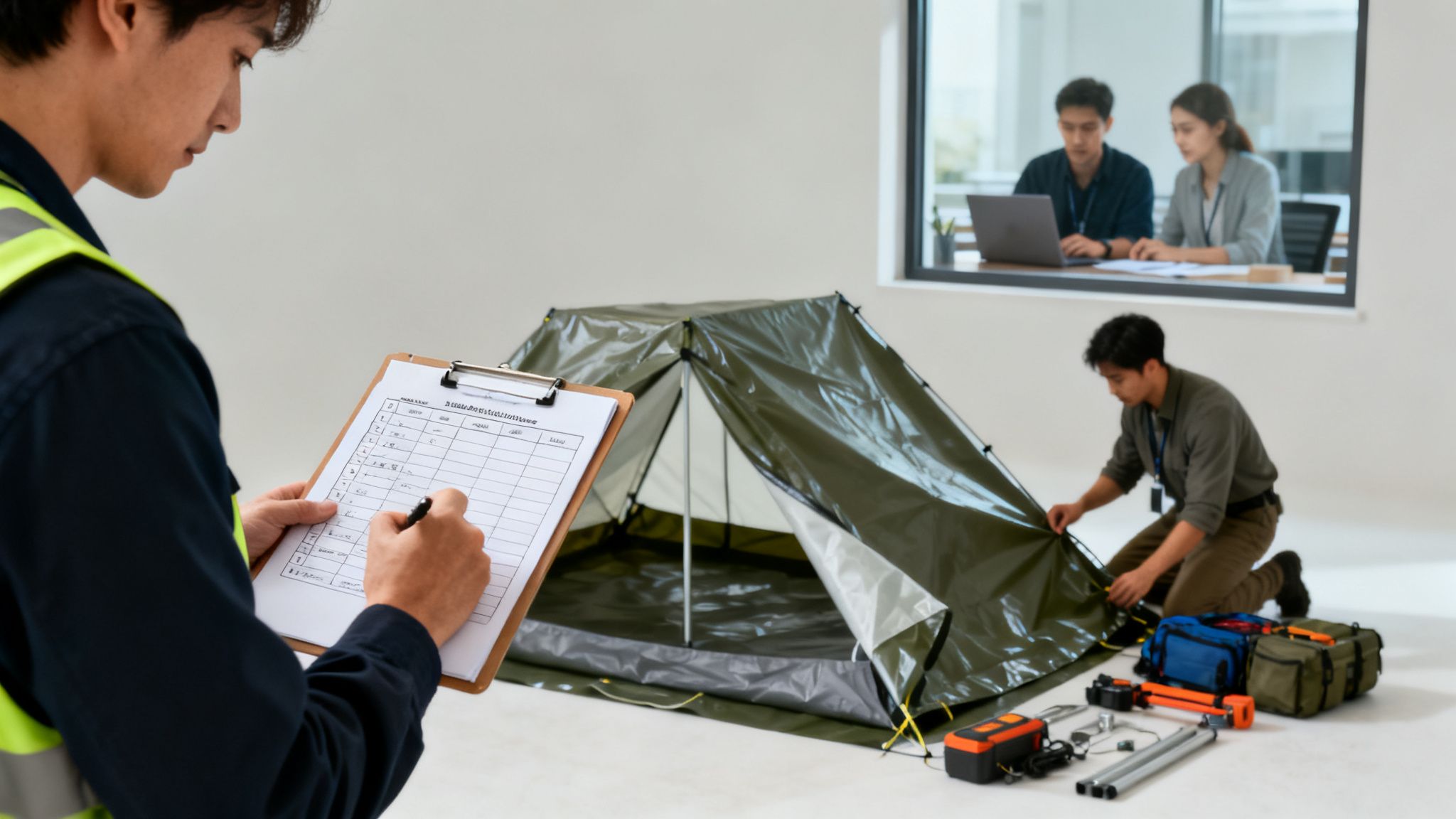
- Field Exercise: Task a team with building a robust emergency shelter from a simple tarpaulin and ski poles as the weather deteriorates. The goal is not a perfect structure. It is about seeing how they manage resources, allocate roles, and communicate when comfort is low and urgency is high.
- Office Analogue: Throw them a complex, multi stage problem with a tight deadline and deliberately ambiguous information. The team first has to figure out a process for clarifying the data before they can even begin to solve the core issue.
The Leader’s Role In Execution
During the execution phase, the leader’s role has to shift from director to facilitator and observer. It takes immense discipline to know when to guide and when to step back and just watch. The temptation is always there to jump in and solve the problem for the team, but doing so robs them of a critical learning opportunity.
Sir Ranulph Fiennes understood this balance perfectly on his expeditions. His leadership was not about having all the answers. It was about holding the frame so the team could find their own. He focused on morale and purpose, letting the experts on his team solve the immediate technical challenges. For a team to develop, it must be allowed to struggle and, at times, fail in a safe environment.
Effective execution almost always comes down to precise role definition, something that becomes crystal clear in demanding environments. For a powerful example, look at mastering team roles for high-stakes performance, which shows just how critical functional clarity is when the outcome truly matters. The leader’s job is to create the conditions for that clarity to emerge.
The objective of a field exercise is not the task itself. The objective is to see what happens to the team whilst they are performing the task. The communication, the friction, the emergent leadership, that is the real material you will work with in the debrief.
This process builds an unshakeable foundation of trust that travels back to the workplace. When you have navigated a genuine challenge with someone, relying on their competence to get through, you look at them differently. Explore some of our expedition grade team trust building exercises to see these principles in action. The goal is simple: move beyond theory and forge real, operational bonds through shared, meaningful challenges.
The Debrief and Sustaining Performance
The expedition is not over when you reach the objective. Not really. The real value is unlocked afterwards, in the disciplined quiet of the debrief. This is where raw experience is forged into lasting operational capability. Forgetting this step is like finding a new route to the pole and then burning the map.
Too often, a project wraps up, and everyone just scatters to the next task. All that momentum, all those hard won lessons, simply evaporate. A proper debrief, modelled on military after action reviews, is the critical process that stops this waste.
It is a forensic examination of performance under pressure, not a comfortable chat about what went well. The goal is to get past superficial observations and build a clear, objective picture of how the team really worked when it mattered most. This is the bridge between the field and the office. It is how you guarantee the investment in training translates into a permanent upgrade.
A Forensic, Three-Stage Process
The structure is simple in design but powerful in practice. It moves through three distinct phases, each one building on the last. The only rule? It must be a blame free environment where total honesty is the only currency.
- What Happened? First, a factual, chronological reconstruction of events. This is about establishing a shared, objective timeline without emotion or finger pointing. "On day two, at 1400 hours, we realised the navigation data was incorrect." Simple. Factual.
- Why Did It Happen? Now you dig in. The team analyses the root causes behind the key events. Why was the data incorrect? A preparation failure? A communication breakdown? This part demands deep candour to get past the easy, surface level excuses.
- What Will We Do Differently? This is the most crucial step. The team translates the lessons into concrete, actionable protocols for the future. "From now on, all critical data will be cross checked by two separate team members before any major decision is made."
This rigorous process is the engine of genuine high performance team development . It creates a feedback loop that drives relentless improvement.
Sustaining Momentum Back in the Office
The energy and clarity from an intense programme can vanish the moment a team walks back into the daily rhythm of emails and meetings. The real challenge is to embed the new behaviours and protocols into the very fabric of the team's working life.
This is not about grand gestures. It is about small, consistent changes. Recent research shows UK management practices are improving, with leadership scores rising from 0.51 in 2020 to 0.57 in 2023 . This is a signal that businesses are getting serious about building more resilient teams, the kind of progress that reflects the very principles we hone on expeditions. You can read more on these productivity findings here.
It proves a simple point: strong leadership, refined through disciplined practice, has a direct impact on a team’s ability to sustain its performance.
Sustaining high performance is not the result of a single event. It is the product of new habits, consistently applied. The expedition is the catalyst; the disciplined follow through is what makes it stick.
Here are a few strategies to keep the momentum going:
- Establish New Communication Rhythms: Start a short, daily stand-up meeting, just like a morning camp brief, to align on priorities and flag obstacles. Keep it tight, no more than 15 minutes .
- Adopt New Decision Making Protocols: Use the protocols you developed during the debrief for your next business challenge. When a critical decision comes up, formally apply the "cross check" rule or whatever new system you agreed on. Make it real.
- Schedule Regular After Action Reviews: Make the debrief a standard part of your business culture. After every significant project milestone or sprint, conduct a structured review. This normalises the process of forensic self assessment until it becomes second nature.
By integrating these expeditionary disciplines, the programme becomes far more than a memorable offsite. It becomes the new baseline for your team’s operational capability, ensuring they are better prepared for whatever comes next.
Frequently Asked Questions
You are probably wondering how hauling sleds in the cold translates to better performance in the boardroom. It is a fair question. We have pulled together the most common queries we get from leaders and teams looking to move beyond theory and into real operational excellence.
How Is This Different From ‘Normal’ Team Building?
Let us be blunt: most corporate team building is a temporary diversion. Trust falls and escape rooms do not forge resilience for when the pressure is really on. They are abstract exercises, disconnected from the realities of high stakes work.
An expedition approach is fundamentally different. We do not talk about teamwork; we create an environment where it is the only path to success. Instead of manufactured games, teams face challenges with real, tangible consequences. Success hinges on absolute clarity in communication, robust decision making under strain, and flawless execution.
We focus on building genuine competence. That competence is what fosters deep, unshakeable confidence and trust, not the other way around.
Do We Really Have to Go to the Arctic?
Whilst an environment like Svalbard is an incredible catalyst for change, the 'expedition' is a mindset first and a location second. The principles are completely transferable.
The core idea is to remove a team from its normal context, forcing a reliance on each other and their core skills. This can be achieved through an intense, scenario-based workshop in a conference centre or a demanding multi day trek much closer to home.
The backdrop can be a glacier or a dedicated training facility. What matters is creating the psychological and operational pressure that reveals a team’s true dynamics and forges new, more effective ways of working together.
What’s the Single Most Critical Factor for High Performance?
After decades of leading teams in military and polar environments, the answer is clear: psychological safety . It is the shared belief that you can take risks, speak up, challenge an idea, admit a mistake, without fear of being shut down or penalised.
On an expedition, it is the freedom to voice a concern about the route without being seen as weak. In the office, it is the ability to ask a "stupid" question or challenge a senior leader's proposal without negative fallout.
Without this foundation, communication breaks down. People withhold critical information to protect themselves. The team stops learning, stops adapting, and ultimately fails under pressure. Every other element of high performance is built on this bedrock of trust.
If you do not have psychological safety, you do not have a team. You have a group of individuals managing their own personal risk. That is the polar opposite of elite performance.
How Do You Actually Measure the ROI?
This is not about a post-event ‘feel-good’ survey. The return on investment is measured by observable changes in your team's behaviour and tangible improvements in your operational outcomes back at work.
We see our clients achieve:
- Reduced project completion times because their communication protocols become ruthlessly efficient.
- Fewer costly mistakes as a result of a clear, tested process for making decisions under pressure.
- Higher employee retention and engagement , because the team is more cohesive, purposeful, and trusts its leaders.
- Faster problem solving , as people learn to tackle conflict constructively without needing to escalate it to management.
Ultimately, the return is a team that operates with the resilience, clarity, and shared purpose of a successful expedition crew. It is a lasting upgrade to your organisation’s operational capability.
Ready to build a team with true operational resilience? Explore the expedition led programmes at the Pole to Pole Academy and see what your team is truly capable of. Explore your possible today.