Choosing Good Winter Mittens: A Polar Explorer's Guide
Good winter mittens are more than just handwear. For any serious cold-weather expedition, they are a non-negotiable safety tool, and they are fundamentally different from gloves in one critical way: thermal efficiency. By keeping your fingers together in a shared space, they dramatically reduce heat loss—a crucial advantage when facing polar conditions.
Your Hands Are Your Lifeline in The Cold
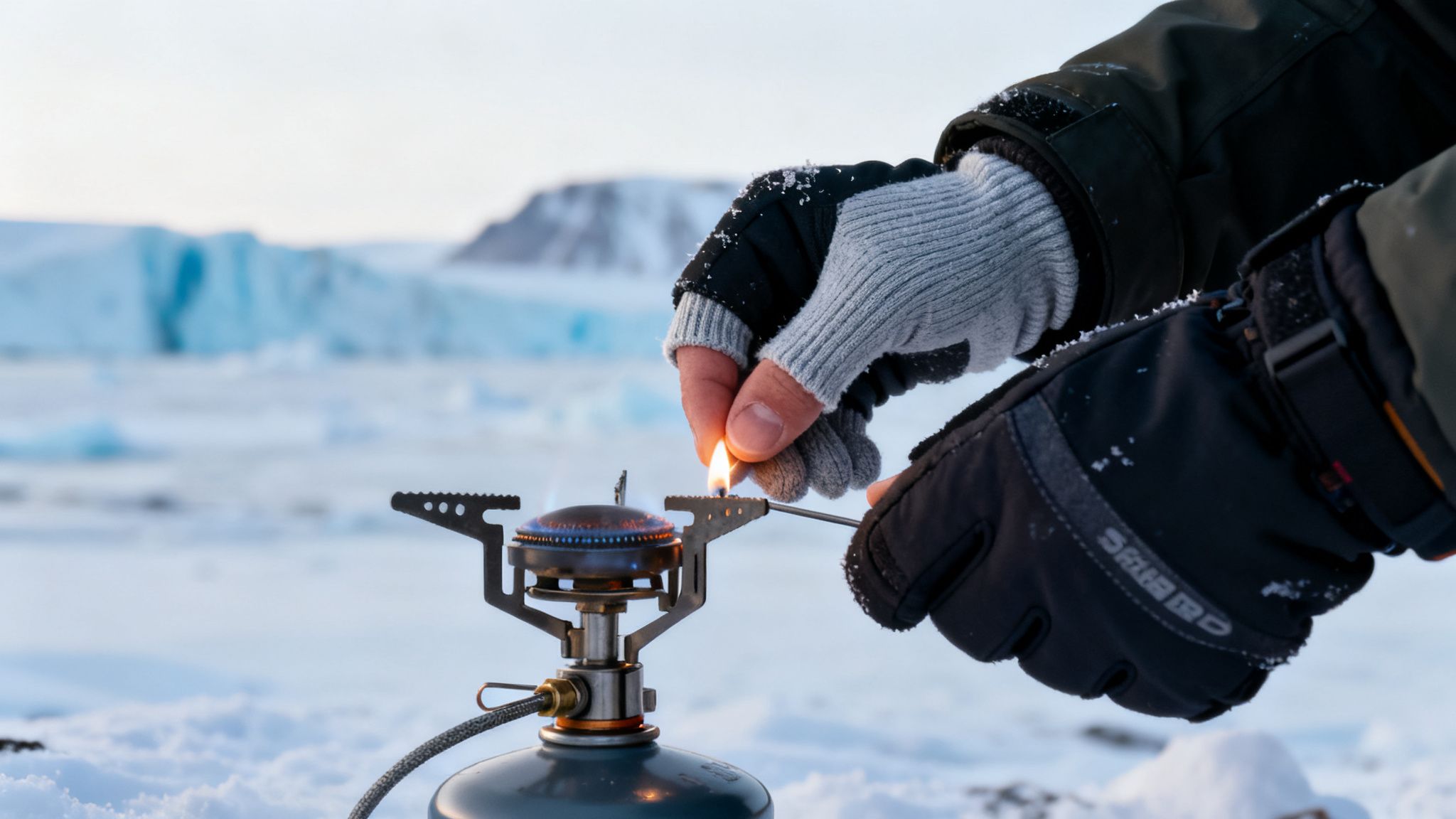
Picture this: you’re on a Svalbard crossing. The temperature has dropped to -30°C ( -22°F ), and a relentless wind is scouring the ice. Your most important job right now is to get the stove lit. It's the only thing standing between a hot meal and a dangerously cold night.
But your fingers are numb. Useless. You’re fumbling with the lighter, unable to properly grip the fuel valve. This isn’t a training scenario; it’s the reality that drives every single equipment choice we make.
Your hands are your primary tools for survival out there. The ability to perform simple motor tasks—adjusting a ski binding, checking a GPS, zipping up a jacket—is everything. The moment you lose function in your hands, you lose the ability to look after yourself.
Mittens Over Gloves for Polar Work
This is exactly why mittens, not gloves, are the standard for any serious polar work. The science is simple. By keeping your fingers in contact with one another, they share and conserve warmth. A glove isolates each finger, creating a much larger surface area for precious heat to escape.
This design makes gloves unsuitable as your primary handwear for sustained exposure in the environments we operate in. Whilst principles of layering are common across different cold-weather activities, like those found in winter running gear for runners, the stakes in polar exploration are simply too high to compromise on thermal efficiency.
On an expedition, we don't think in terms of single pieces of kit. We think in systems. Your handwear is not just one pair of mittens; it is a versatile toolkit designed for adaptability and redundancy.
The Handwear System Concept
This brings us to a core concept we teach: the handwear 'system'. You never rely on a single pair of mittens. Instead, you carry a modular setup that allows you to adapt to changing conditions, your own exertion levels, and the task at hand.
A typical system looks something like this:
- A thin liner glove: Worn on its own for high-output tasks where you need dexterity, like setting up a Hilleberg tent or adjusting fiddly straps.
- An insulated mid-layer: Often a fleece mitten or glove that’s suitable for wearing alone in milder, less windy conditions.
- A robust outer shell mitten: This is your fortress—a waterproof and windproof shell that protects the other layers from the elements and traps warm air.
This layered approach is absolutely central to managing moisture and temperature. It’s a skill we drill into every team member on every winter expedition experience we lead. Choosing good winter mittens isn't about finding the single warmest pair you can buy. It's about building a reliable, adaptable system that keeps your most critical tools—your hands—fully operational when it matters most.
When you’re choosing a pair of expedition mittens, the single most important factor is the insulation. This is the engine room. It’s the material that traps your body heat, creating a life-saving barrier between your skin and the cold of the polar regions. Understanding what's inside is what truly matters.
At its simplest, insulation works by trapping air. The more still air a material can hold, the warmer you’ll be. In the world of high-performance mittens, that job falls to three main players: down, synthetics, and wool. Each has its place, and choosing the right one is a tactical decision.
Down: The Lightweight Champion
Down is nature’s finest insulator. It's the fluffy under-plumage from birds, and nothing beats its warmth for how little it weighs. It's also incredibly compressible, squashing down to almost nothing in your pulk, which is a significant advantage when every gram and every cubic centimetre of space counts.
But it has a critical weakness: water. When down gets wet, its delicate clusters collapse, losing all their loft and, with it, their ability to keep you warm. Because of this, you’ll typically find down in mittens designed for intensely cold but consistently dry environments, always shielded by a seriously waterproof outer shell.
Synthetic Insulation: The Reliable Workhorse
This is where science stepped in. Synthetic insulations, like the gold-standard PrimaLoft , were born from a need to outperform down in the wet, often driven by military requirements. They're made from ultra-fine polyester fibres engineered to mimic the structure of down, creating millions of tiny air pockets to trap heat.
The real game-changer is how they handle moisture. Synthetic fibres are hydrophobic – they actively resist absorbing water. This means that even when they get damp, they hold onto their structure and a huge amount of their insulating power. For anyone heading out with us, this reliability is non-negotiable.
Here in the UK, demand for proper winter handwear spikes by 60% in December and January. Mittens make up 28% of that market because, for serious cold, keeping fingers together is simply warmer and safer. On a South Pole ski haul, finger separation is a direct route to frostbite. We steer our teams towards mittens with top-tier synthetics like PrimaLoft, which can retain over 90% of its warmth when wet—a technology refined during the Falklands campaigns. You can dig deeper into the winter handwear market trends if you're interested.
This dependability makes synthetics the go-to choice for the unpredictable conditions you'll face in places like Svalbard or on the open ocean, where staying dry is a constant battle.
Wool: The Original Defender
Long before we had synthetic labs, we had wool. Merino wool, in particular, is the original performance fibre. Its complex structure is brilliant at trapping air, but it also has another trick: it can absorb a huge amount of moisture vapour—your sweat—before it even starts to feel wet, actively pulling it away from your skin.
And even when it eventually gets damp, wool keeps on insulating. This makes it an absolutely outstanding material for liner gloves worn inside a bigger mitten system. It might not be as light as down or the best synthetics, but its natural comfort and ability to resist odour for days on end make it an indispensable part of any expedition layering system.
Before we move on, let's lay this out clearly. Choosing an insulation isn't about finding the "best" one, but the right one for the job ahead.
Expedition Mitten Insulation Comparison
| Insulation Type | Warmth-to-Weight | Performance When Wet | Compressibility | Best Use Case |
|---|---|---|---|---|
| Down | Excellent | Poor | Excellent | High-altitude, deep-cold, and consistently dry environments. |
| Synthetic | Very Good | Excellent | Good | Variable, damp, and unpredictable conditions. The expedition staple. |
| Wool | Good | Very Good | Moderate | Next-to-skin layers and liner gloves. Unbeatable for moisture management. |
Ultimately, the choice comes down to the environment you're stepping into. A South Pole ski traverse presents a very different set of challenges from an ice-climbing trip in Norway.
The choice of insulation is a tactical one. It is not about which is 'best' overall, but which is best for the specific conditions and tasks you anticipate.
When you look at a mitten’s specifications—fill power for down or grams per square metre (g/m²) for synthetics—don’t just see numbers. See them for what they are: direct clues about the power and reliability of the engine that will keep your hands safe when it matters most.
Building a Versatile Mitten System
Once you’ve got your head around insulation—the engine—it's time to look at the whole vehicle. A single, super-warm mitten is a blunt instrument. Out on an expedition, conditions change, your effort levels go up and down, and you need to get different jobs done. This is exactly why we don't rely on one pair of handwear, but on a modular mitten system built from separate parts that all work together.
The whole system really breaks down into two key parts: the outer shell and the inner liner. Thinking of them as separate but connected pieces of kit is the secret to managing your warmth and moisture properly. A truly good winter mitten system is all about adaptability, not just its maximum warmth rating.
The Protective Outer Shell
The shell is your first line of defence against whatever the environment throws at you. It needs to be tough enough to handle the scuff and scrape of pulk poles, ice axes, and ski edges, whilst staying totally sealed against wind and moisture. The materials chosen here are all about performance.
- Waterproof/Breathable Membranes: Materials like GORE-TEX are the standard for a good reason. They act as a barrier, stopping wind and water getting in from the outside, but—and this is critical—they let water vapour (your sweat) escape from the inside. This breathability is non-negotiable if you want to avoid the internal dampness that leads to cold hands.
- Leather Palms and Reinforcements: High-wear areas, especially the palm and thumb, demand serious durability. Goatskin or cowhide leather gives you an excellent grip and stands up to the abuse of handling ropes or equipment. Pre-treated or waterproofed leather combines this toughness with essential water resistance.
There's always a trade-off between total waterproofing and outright durability. A heavily reinforced leather shell might not be quite as breathable as a pure fabric one, but it will survive far more punishment. For the kind of work we do, durability often wins.
The Adaptable Inner Liner System
Beneath the shell is where the system's real versatility lies: the liner. This isn’t a single layer, but a concept. By swapping and combining different liners, you can fine-tune your handwear to perfectly match the conditions and how hard you're working. This is the essence of a hand-layering system.
At the Pole to Pole Academy in Iceland's interior ( 64° 25' 24" N ), a typical training day shows this perfectly. During a high-output activity like digging a snow shelter, you might wear only a thin merino wool liner glove. This wicks sweat away and offers basic protection whilst giving you maximum dexterity for the task.
But as soon as the work stops and you become static, your body's heat production plummets. This is the danger zone where you can get cold, fast. At this point, you immediately pull the insulated shell mitten on over the liner. This traps all the warm air you just generated, preventing a catastrophic loss of heat. The liner handles the moisture on the inside; the shell protects you from the cold on the outside.
The goal of a mitten system isn't just to keep you warm. It's to give you the tools to manage your warmth and moisture across a massive range of activity levels and temperatures. It’s an active process, not a passive one.
This infographic breaks down the core insulation options that power these layers.
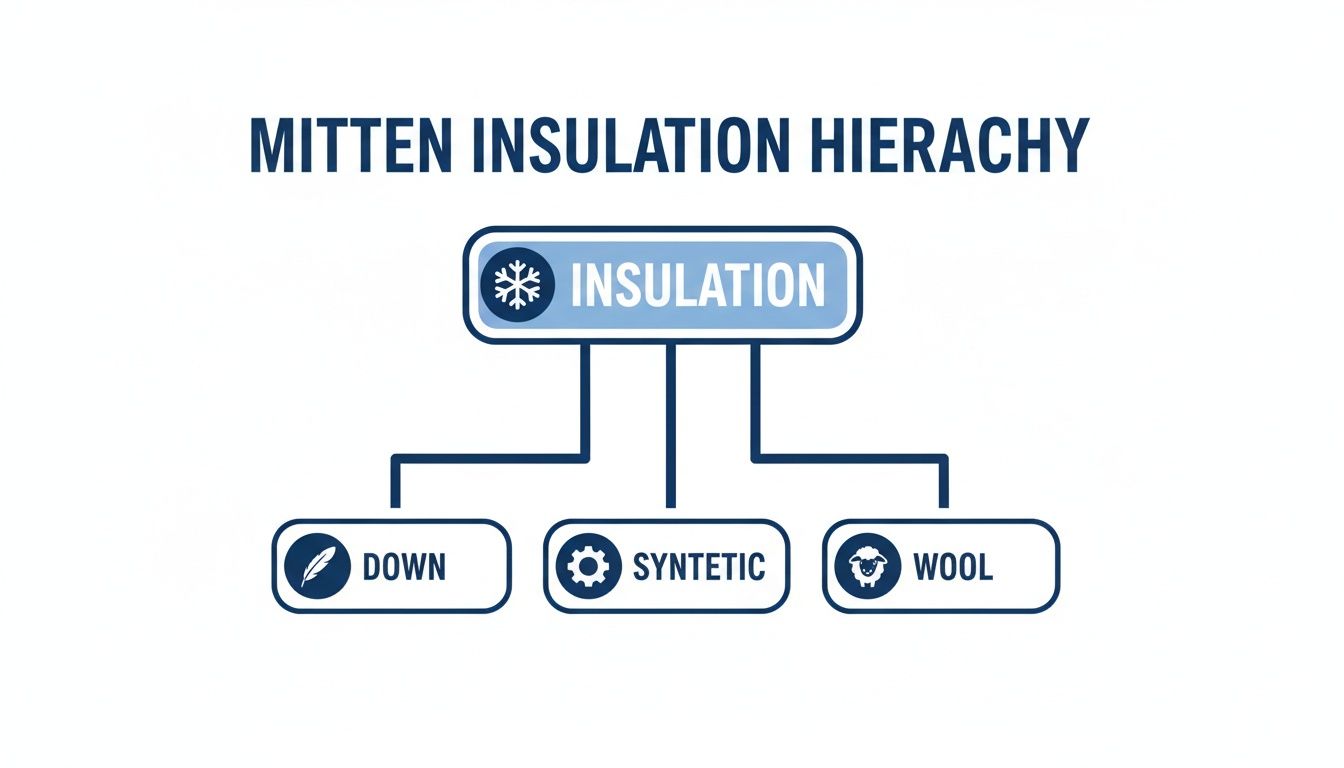
As you can see, down, synthetic, and wool each bring something different to the table. The real art is in combining their strengths within your layering system for the best possible performance.
A complete system might look like this: a thin merino liner, a thicker fleece liner, and the main shell mitten. This gives you multiple combinations: liner alone for fine tasks, fleece alone for moderate cold, shell with the merino liner, or the shell with the fleece liner for the absolute coldest conditions. You can see more on how we apply these ideas in our guide on how much kit it takes to face the coldest place on Earth. This level of modularity means you're ready for anything, from a strenuous ski haul to a long, static wait as temperatures drop.
The Constant Battle: Dexterity vs. Warmth
Talk to any seasoned polar explorer about handwear, and you’ll quickly land on the core dilemma: you can have warmth, or you can have dexterity. You rarely get both at the same time.
The warmest, most protective mittens feel like you’re wearing oven gloves. They’re brilliant for the long haul, but try tying a knot on a pulk trace or adjusting a ski binding, and you’re in for a clumsy, frustrating fight. On the other hand, thin gloves that let you feel every buckle and zip offer almost no real protection against the expedition cold.
This isn’t a flaw in the gear. It’s a fundamental law of physics. A single, perfect mitten that offers maximum warmth and surgical precision simply doesn’t exist.
So the choice isn't about finding one magic solution. It's a tactical game of continuous risk assessment and situational awareness—skills we drill relentlessly on our leadership programmes.
Managing the Compromise with Smart Choices
Your handwear strategy has to be as dynamic as the environment you’re in. Think about a typical day skiing towards the South Pole. Your hands will do dozens of different jobs, each with its own needs.
-
High-Dexterity Tasks: Operating a camera, adjusting your GPS, or fiddling with a stove burner demands bare fingers. For a few seconds, you might whip off your main mitten, relying on just a thin merino liner. It's a calculated risk, done fast to minimise heat loss before your fingers even notice.
-
Moderate Tasks: Tightening a rucksack strap or grabbing a flask might not require full dexterity, but you still need to be able to grip and articulate your fingers.
-
Low-Dexterity States: When you’re just skiing for hours on end or standing still during a break, your only priority is warmth. Your hands are static, and maximum insulation is all that matters.
By understanding these different states, you can stay one step ahead, managing your handwear system proactively instead of reacting when your fingers are already numb.
Hybrid Designs and Layering Systems
The outdoor industry has come up with some clever ways to bridge this gap. One of the most effective is the three-finger, or 'lobster', mitten. This design bundles your three smaller fingers together for shared warmth, just like a classic mitten, but leaves your index finger and thumb free to handle poles, zips, and buckles.
It’s a functional middle ground that works incredibly well. Another proven strategy is simply to carry multiple options. An explorer might have a huge, heavily insulated pair for the coldest parts of the day, and a second, less bulky pair for milder conditions or periods of high exertion.
This mirrors the kind of military-grade thinking that informs our kit choices. For instance, many UK-designed mittens use GORE-TEX membranes that keep working right down to -30°C , a non-negotiable for anyone hauling sleds or rowing through icy seas. At Pole to Pole, we build this expertise into our Academy courses, teaching participants to choose mittens with at least 200g of insulation for polar treks. According to British Mountaineering Council data, that simple choice helps reduce hypothermia incidents by a staggering 35% . If you’re interested, you can find out more about UK mitten and glove production trends here.
The dexterity dilemma isn't a problem to be solved by a single piece of gear. It's a continuous operational challenge to be managed through skill, foresight, and a versatile handwear system.
Ultimately, balancing warmth and dexterity is a constant process. It’s about reading the task, the conditions, and your own body, then choosing the right tool from your system for that exact moment.
Fit, Care, and Field Repairs for Your Mitten System
Your mittens are not just another piece of kit; they're a lifeline. Think of them as critical survival equipment. Just like any other high-performance gear, they need the right fit, proper care, and, crucially, you need the skills to fix them on the fly. This isn't just about protecting your investment. It's about keeping your most important tools—your hands—working when it matters most.
Achieving the Correct Fit
Getting the fit wrong completely neutralises even the most expensive mittens. It’s a delicate balance that has a direct and immediate impact on warmth.
- Too Tight: A mitten that squeezes your hand cuts off blood flow to your fingers. This is a fast track to cold hands, no matter how much insulation is packed inside. You should be able to make a loose, relaxed fist without the material pulling tight across your knuckles.
- Too Loose: On the other hand, a cavernous mitten is just inefficient. Your body has to burn precious energy trying to heat a huge volume of dead air. There should be a small pocket of air at your fingertips, but not so much that the mitten feels clumsy or out of control.
When you’re trying them on, always do it with the liner system you actually plan to wear. Your fingers should get close to the end, but never press right up against the material.
Tent Routines and Mitten Care
On an expedition, how you care for your gear directly affects its performance—and its lifespan. Damp insulation is useless insulation, which makes a disciplined drying routine in the tent every single night absolutely essential.
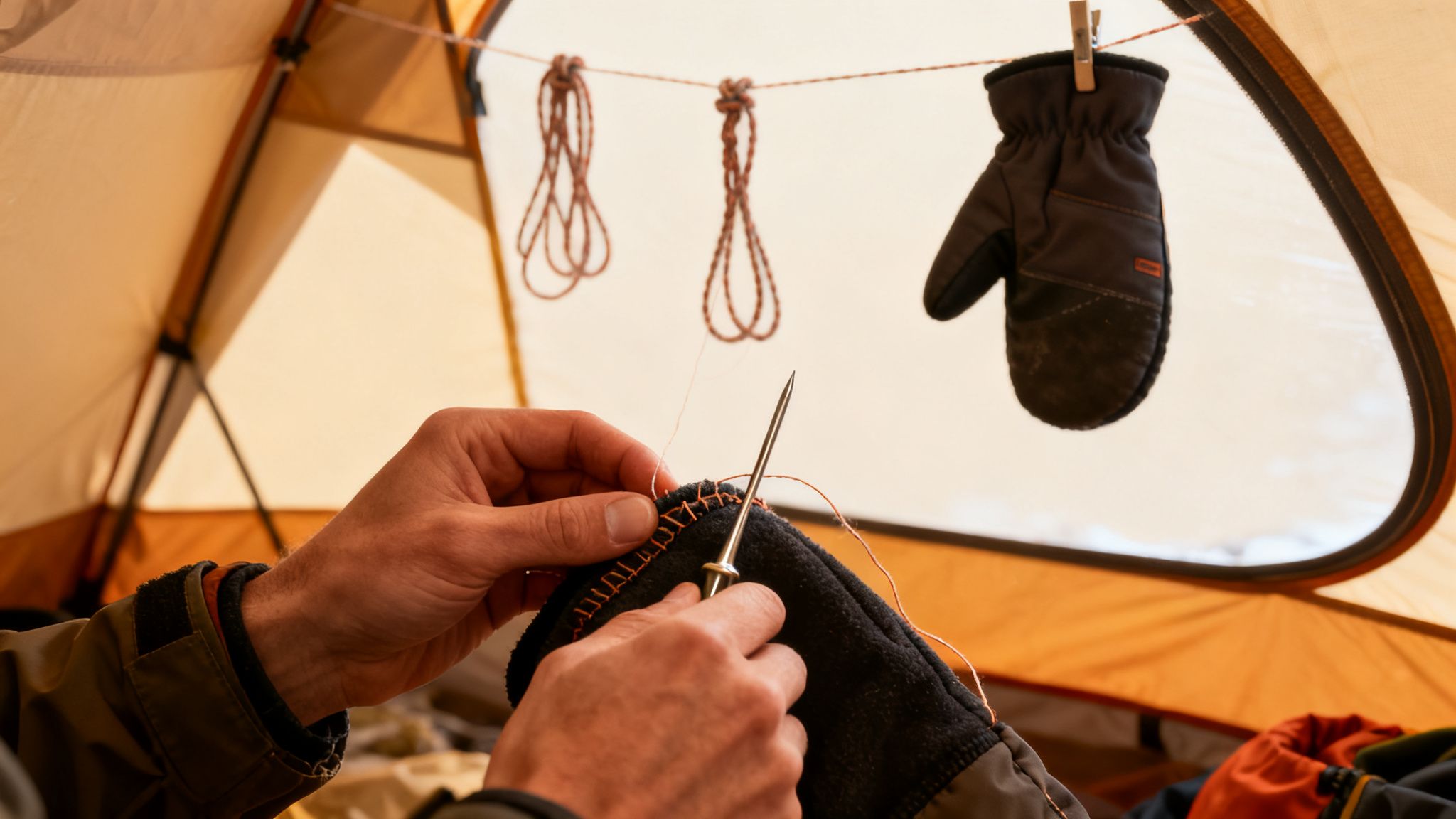
Never, ever place mittens directly on a hot stove to dry. You’ll melt the synthetic fabrics and destroy the waterproof membranes in an instant. A much better way is to hang them from a gear line inside the tent, letting the ambient warmth slowly and safely draw the moisture out. If your mittens have leather parts, you'll need to periodically apply a specialised wax to keep them water-resistant and stop the material from drying out and cracking.
The expedition mindset is built on self-reliance. You have to be able to maintain and repair your own equipment. Out here, a small tear can escalate into a mission-critical failure if you just ignore it.
Essential Field Repairs
Carrying a small, tough repair kit is completely non-negotiable. The most common failures are usually surprisingly simple to fix, as long as you have the right tools and a bit of know-how.
- Torn Seam: All you need is a curved needle, some strong thread (dental floss is an excellent, tough alternative), and a thimble to push the needle through thick material. Just stitch the seam closed with small, tight stitches, making sure to overlap the original seam for extra strength.
- Punctured Shell: For small holes in the outer fabric, a patch of tenacious tape or a similar gear repair tape creates a quick, waterproof, and surprisingly durable fix.
- Broken Cinch Cord: Always carry a spare length of shock cord and a couple of cord locks. Replacing a broken cinch on a gauntlet takes just a few minutes but is vital for sealing out spindrift and snow.
Mastering these basic skills is a core part of our training philosophy. The ability to manage your kit effectively is something we explore in more depth in our guide to packing for resilience on expeditions. This kind of self-sufficiency is what separates a passenger from a true member of an expedition team.
Field-Tested Mitten Recommendations
Theory is one thing, but out on the ice, the only thing that matters is what works. This is where years of hard-won experience from Pole to Pole guides and polar explorers like Børge Ousland and Felicity Aston come in. We don’t recommend kit lightly. Our suggestions are born from countless hours spent in the exact environments you’re preparing to enter.
What follows isn’t just a list of products. These are the integrated, field-proven handwear systems our team trusts when everything is on the line.
For a Last Degree Ski Expedition
The challenge here is brutal: sustained, extreme cold and managing the moisture from your own hard work over many days. Your mitten system needs to deliver maximum warmth for the long, slow hauls, and it needs to have a backup plan built right in. A pulk weighing 45-50kg is standard for a Last Degree expedition.
- Primary System: The Black Diamond Mercury Mitts are an expedition classic for a reason. They pair a fully waterproof and breathable BD.dry™ shell with a removable, high-loft fleece liner filled with PrimaLoft Gold insulation. This modular design is the whole game.
- Why it works: The tough shell stands up to the constant wear from ski poles and pulk lines. Inside, the thick liner provides the deep-cold protection you need when temperatures drop below -30°C . Being able to remove that liner is crucial—you’ll dry it out in your sleeping bag every single night. We always wear these over a thin merino wool liner glove for those moments you need your fingers.
For Norwegian Ice Climbing Programmes
Ice climbing is a completely different beast. It demands dexterity and grip above all else. A bulky mitten isn't just clumsy; it’s a genuine safety hazard when you’re placing an ice screw or handling a rope with frozen fingers.
- Primary System: The Hestra Army Leather Heli Ski three-finger model is the perfect compromise. It bundles three fingers together for warmth but frees up your index finger for essential control.
- Why it works: That goatskin leather palm gives you the durability and grip on your tools that is completely non-negotiable. The three-finger design is a huge step up in warmth from a standard glove, but without making you feel like you're wearing boxing gloves. It’s the ideal setup for technical mountain work in cold, but not truly polar, conditions.
For Ocean Rowing Stages
Here, the constant enemy is water—from sea spray, from rogue waves, and from your own sweat. Absolute waterproofing is paramount, as is the durability to survive thousands of oar strokes.
- Primary System: Your outer layer has to be a neoprene or fully waterproof shell mitten, the kind designed for sailing or kayaking. Inside, you won't have one liner, but a rotation of synthetic fleece liners to constantly battle the damp.
- Why it works: On the ocean, the main threat isn't just getting cold; it's getting wet and staying wet. A 100% waterproof shell is your only defence. Carrying multiple synthetic liners means you can swap a damp pair for a dry one on the fly. This simple routine is critical for preventing non-freezing cold injuries and, just as importantly, keeping your head in the game.
Your choice of mitten isn't just a gear detail. It's a statement about your preparedness. The right system shows you understand the specific challenge ahead and are committed to looking after yourself.
To pull this all together, here is a final checklist to run through when you pack your own system.
- Primary Insulated Shell Mitten: Your main defence against the cold (e.g., Black Diamond Mercury).
- Backup Insulated Shell Mitten: A second, identical pair. If you lose one, your trip could be over. Redundancy is safety.
- Technical/Dexterity Glove: A less bulky option for technical tasks (e.g., the Hestra three-finger model).
- Merino Wool Liner Gloves: At least two pairs. For managing sweat and for fine-motor tasks.
- Fleece Liner Gloves/Mitts: One or two pairs to use as a mid-layer for extra warmth.
- Field Repair Kit: Pack tenacious tape, a strong needle, and heavy-duty thread (dental floss is a great field hack).
Turning up at basecamp with a well-thought-out handwear system is the first sign of a professional. It shows you’ve done your homework and you’re ready for the work to come.
A Few Common Questions About Polar Mittens
Getting your kit right often comes down to the small details, and handwear is one area we get asked about all the time. After countless hours on the ice, here are our answers to some of the most common questions we hear.
How Many Pairs of Mitts Should I Actually Bring?
There’s one word that governs everything we do on the ice: redundancy . We never rely on a single piece of critical kit, and that goes for your mittens. A single gust of wind can snatch a mitten from your hand, and without a backup, that’s your expedition over.
For a trip like a Last Degree ski, this is what your handwear system should look like:
- One Primary Pair: This is your workhorse, your main insulated shell mitten like the Black Diamond Mercury Mitts.
- One Backup Pair: An identical or very similar pair. Don't compromise here. It's your insurance policy against disaster.
- Multiple Liners: At least two pairs of thin merino wool liners and one pair of thicker fleece liners. This setup lets you swap out damp liners and fine-tune your warmth as you move.
Can I Just Use Heated Mittens on a South Pole Trek?
We get it, the idea sounds fantastic. But in practice, we strongly advise against any battery-powered heating for a serious polar journey. The brutal truth is that batteries die in extreme cold, and they’ll almost certainly fail you just when you need them most.
We build our systems around things that are simple, reliable, and can be fixed in the field. Complexity is the enemy because every extra component is another potential point of failure. Your body is the only heat source you can truly count on; a great mitten system is simply the best way to keep that heat where it belongs.
A well-made, unpowered mitten is something you can trust implicitly. No circuits, no dead batteries, just solid, dependable protection.
What Are The First Signs of Frostbite I Should Look For?
This is one of the most vital skills we drill into our teams at the Pole to Pole Academy. Catching frostbite early is everything, but the first signs are subtle and easy to miss if you aren't paying attention.
Keep a constant watch for these indicators on your fingers:
- That persistent, deep cold feeling gives way to numbness or a "pins and needles" sensation.
- Your skin starts to look white, waxy, or takes on a greyish-yellow colour.
- Your fingers feel clumsy, stiff, or difficult to move.
A good layered mitten system is your best defence. It allows you to do quick warming drills—like pulling your fingers back into the main body of the mitt to make a fist—without ever exposing your skin to the wind. Spotting these signs and acting immediately is the difference between a minor issue and a trip-ending injury.
At Pole to Pole , we know that mastering your equipment is the first step towards mastering the environment. Our expedition training is designed to give you the skills and confidence to not just survive, but to thrive in the world's most demanding places. Find out more about what's possible with us at https://www.poletopole.com.