How to Build Mental Resilience Under Pressure
You don't just have mental resilience. You build it.
It's a skill, just like tying a knot or reading a compass. It is a deliberate process of exposing yourself to controlled stress, learning to reframe your thoughts, and regulating your body’s response so you can perform when the pressure is on.
The Unseen Skill Behind Every Successful Expedition
Picture it. The world goes white. You’re near Templefjorden in Svalbard, and a sudden whiteout has swallowed the horizon whole. The wind is so loud you cannot hear yourself think. Panic is an option. It is just not a very good one.
The skill that gets you through this is not about physical strength. It is the quiet, internal shift that lets you keep functioning when the world outside descends into chaos. That is mental resilience.
Too many people think resilience is about gritting your teeth and pushing through pain. It is a dangerous way to look at it. Real resilience is a competence, built piece by piece through practice. It is less about being unbreakable and more about being flexible.
From the Boardroom to the Ice Cap
Think about the pressures of work versus the stress of an expedition. They are two sides of the same coin. An overflowing inbox and a looming deadline create a constant, low-grade hum of anxiety. An equipment failure at -25°C or a wrong turn in a crevasse field triggers a sudden, sharp spike of adrenaline.
Both scenarios tax the exact same internal systems. Learning to handle one makes you better at handling the other. Our whole philosophy at Pole to Pole is built on this idea: you do not fight the environment; you build the competence to operate within it. This works just as well in a high-stakes negotiation as it does on a polar plateau.
Genuine resilience is not the absence of difficulty. It is the presence of a practised response, allowing for calm, clear-headed action when circumstances are at their worst.
Learning from the Masters of Preparation
We look to explorers like Ranulph Fiennes and Børge Ousland not just for their endurance, but for their obsessive preparation. Their success was decided long before they ever stepped onto the ice. It was forged in meticulous planning, endless skill repetition, and by anticipating every possible point of failure.
They understood that the mind is just another piece of critical kit. It has to be prepared for the conditions it is about to face.
This guide is not about "toughing it out." It is a practical framework for building the psychological skills you need to operate effectively under real pressure. We are going to dismantle the entire process, turning a vague concept into a series of concrete, actionable steps.
You will learn the same techniques we teach at our Academy. The goal is to shift you from simply reacting to stress to responding with quiet confidence. This is how you learn to function when the world goes white.
The Core Principles of Expedition Resilience
True resilience out in the field is not some fuzzy, abstract idea. It's a skill. A trainable, practical skill built on principles that have been tested where the margin for error is razor-thin. When you are in a polar environment, you do not have time for academic theory. You rely on what works, every single time.
The techniques we drill are stripped back to their bare essentials. They focus on three core pillars that have a direct, measurable impact on how you perform when the pressure is on. Think of them not as separate ideas, but as an integrated system. Master them, and you learn to manage your internal state so you can take control of the external situation.
The first step is understanding why they work.
Stress Inoculation Through Controlled Exposure
The human body is an adaptation machine. It gets stronger when you apply progressive, manageable stress. We do the exact same thing with the mind. We call it stress inoculation . It is the process of exposing yourself to controlled doses of difficulty to build up tolerance and competence, which stops you from getting overwhelmed when you face the real thing.
It is a methodical process. On our training ground in the Icelandic interior ( 64° 25' 24" N ), we do not throw people straight into a blizzard. That would be pointless. We start with manageable cold, focusing on perfecting a simple layering system (with our Fjällräven base layers) and a tent routine before the conditions get truly demanding. This builds a foundation of small wins and familiarity, inoculating you against the initial shock of a seriously harsh environment.
Cognitive Reframing of Your Internal Narrative
The stories we tell ourselves dictate our reality. This is never truer than during long, arduous, and frankly monotonous tasks. A ten-hour ski across a featureless white plateau can feel endless if your internal monologue is just, "this is a soul-crushing slog." Cognitive reframing is the conscious act of changing that story into something more functional.
Instead of obsessing over the immense distance left to cover, you reframe the task. The new story becomes: "Each pole plant is progress I can measure. Every hour is another five kilometres done. I am simply executing a repeatable process." This simple shift from an emotional mindset to a mechanical one transforms an overwhelming challenge into a series of small, achievable actions. It is a fundamental skill for keeping momentum when your motivation inevitably fades.
For a deeper dive into the fundamental principles and actionable strategies for developing inner strength, consider exploring how to build resilience and thrive under pressure.
Physiological Regulation to Master Your Physical Response
Your body’s reaction to stress is automatic, but it does not have to be uncontrolled. Adrenaline, a racing heart, and shallow breathing are fine for a short burst of action, but they are a disaster during complex tasks that need fine motor skills and a clear head. Physiological regulation is all about mastering your physical response to that stress.
This is where simple, drilled-to-death techniques become critical.
- Box Breathing: A slow, four-second inhale, four-second hold, four-second exhale, and four-second hold. We drill this until it is second nature. Using it during a tense crevasse negotiation or when a stove malfunctions at -25°C lowers the heart rate and allows the prefrontal cortex—the thinking part of your brain—to stay in charge.
- Adrenaline Management: You learn to recognise the physical tells of an adrenaline spike and consciously slow down your movements and breathing to counteract it. This stops you from fumbling with critical kit, like a GPS or a stove pump, at the exact moment you can least afford a mistake.
These principles—born in extreme environments—are directly transferable to the pressures of modern professional life. They provide a practical framework for managing stress, whether you are facing a polar storm or a boardroom crisis.
Core Resilience Pillars for Expedition and Professional Life
The table below breaks down how these core pillars translate from the ice cap to the office, showing their universal application in high-stakes environments.
| Resilience Pillar | Expedition Application (Pole to Pole Example) | Corporate/Professional Application |
|---|---|---|
| Stress Inoculation | Progressively increasing daily ski distances and exposure to cold to build physical and mental endurance before the main expedition. | Using mock presentations or role-playing difficult client conversations to build confidence and reduce anxiety before a high-stakes meeting. |
| Cognitive Reframing | Shifting focus from "we have 100km to go" to "let's nail this next 50-minute leg." Breaking down an overwhelming goal into manageable chunks. | Re-framing a project setback from "we've failed" to "what have we learned, and what's the immediate next step?" |
| Physiological Regulation | Using controlled box breathing to calm the nerves and maintain fine motor skills whilst navigating a tricky crevasse field in low visibility. | Employing a simple breathing exercise before a critical negotiation or public speaking event to lower heart rate and improve clarity. |
Ultimately, the environment changes, but the human response to pressure remains the same. Mastering these pillars provides a robust toolkit for thriving, no matter the challenge.
The need for this kind of structured mental training is becoming painfully clear, far beyond the world of expeditions. Work-related stress, depression, and anxiety now account for an estimated 17.1 million lost working days each year in the United Kingdom.
With recent figures showing that a staggering 91% of UK adults have felt high or extreme pressure in the past year, developing a toolkit to withstand chronic stress is no longer just a good idea—it is essential. You can review the full report and statistics about work-related stress in the UK. These principles form the very bedrock of that toolkit.
A Practical Resilience Training Programme
Knowing the theory is one thing. Putting it into practice is another entirely. Building real mental resilience is not passive; it is an active process that demands consistent, deliberate work. It is not about grand, heroic moments, but the disciplined, day-by-day accumulation of small, controlled exposures to stress.
This programme is designed to be progressive. It starts with foundational drills you can weave into your daily life, building a base before you even think about bigger challenges.
The whole process boils down to a simple, repeatable loop: expose, reframe, and regulate . You introduce a controlled stressor, consciously change the story you tell yourself about it, and then use physical tools to manage your body’s reaction.
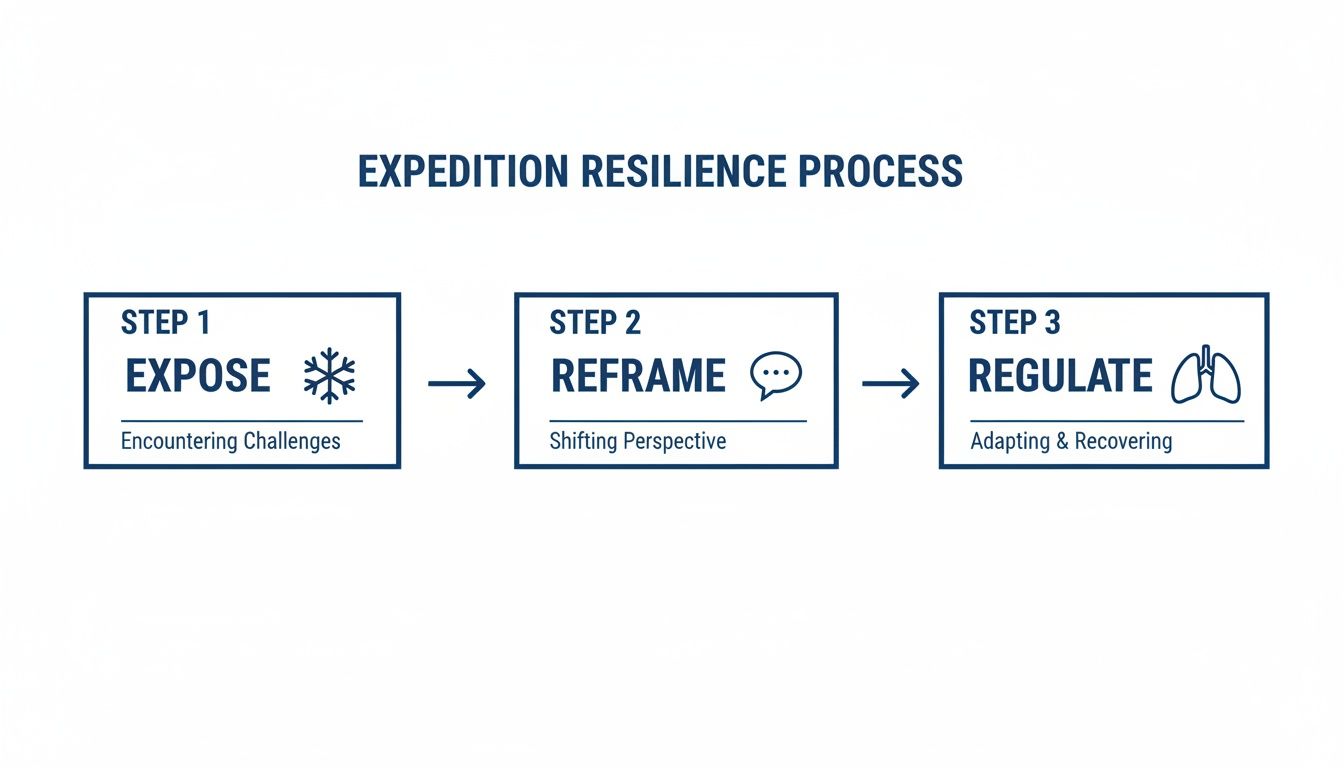
This three-step cycle is the engine of resilience. It is how you turn raw experience into genuine adaptation.
Weeks 1-2: Foundational Physiology
The first two weeks are all about mastering your body's immediate stress response. The aim here is to build a robust physiological foundation, conditioning your nervous system to handle sharp shocks without spiralling. Think of it as learning to control the machine before you take it into rough terrain.
Your primary tool is cold water immersion . Start small. A 30-second cold blast at the end of your normal shower. The goal is not just to grit your teeth and endure it; it is to control your breathing throughout. Fight that initial gasp reflex and force a slow, deliberate exhale. From there, build up gradually towards a consistent two or three minutes each day. For those serious about building resilience under pressure, adding a cold plunge and sauna routine can be a powerful way to hit the physiological and psychological 'reset button'.
Alongside this, bring in disciplined breathing protocols. Practices like the Wim Hof Method or simple box breathing are brilliant for training your ability to consciously dial down your autonomic nervous system. Just five minutes each morning is all it takes to start. The final piece is uncompromising sleep hygiene . This is non-negotiable. A consistent sleep and wake time is the bedrock of mental endurance, because it is when all the physiological recovery happens.
Weeks 3-4: Controlled Stress Exposure
Once you have that physiological baseline sorted, you can start layering in controlled, practical stressors. These are micro-challenges, designed to test your new skills in a low-stakes environment. The trick is to engineer difficulty—to force yourself to operate just outside your comfort zone.
Here are a couple of examples of what this looks like in practice:
- Weighted Hike in Poor Conditions: Pick a local 15km (roughly 9-mile ) route you know. Do it with a weighted pack, starting at 10kg . The crucial part? Deliberately go on a day with poor weather—rain, wind, cold. Your objective is not just to finish. It is to meticulously manage your kit, your navigation, and your internal state whilst you are uncomfortable.
- Time-Pressured Skill Practice: Choose a core skill, like map-and-compass navigation or setting up your Hilleberg tent. Set a timer and practise it in your garden or a local park. The goal is flawless completion under a self-imposed, tight deadline. This directly simulates the need for precision when you are tired and feeling the pressure.
These drills are not about making yourself miserable for the sake of it. They are about practising something we call comfort discipline . This is the conscious act of resisting the urge for immediate relief. When you are cold and wet on that hike, the temptation to stop and bail is immense. Comfort discipline is the practised ability to acknowledge that feeling, accept the discomfort, and keep functioning effectively. You can read more about how we prepare both mind and body for these scenarios in our guide on training for the unknown.
Weeks 5-6: Cognitive Rehearsal
This final preparatory phase is entirely mental. This is where you rehearse for failure, systematically preparing your mind for when things inevitably go wrong. An expedition rarely fails because of one single catastrophe; it is almost always a chain reaction of small, unmanaged problems. Cognitive rehearsal is about breaking that chain before it even starts.
Visualisation is not about daydreaming of success. It is about mentally walking through the process, especially the points of failure, and scripting your response ahead of time.
Spend a bit of time each week on these exercises:
- Failure Scripting: Pick a challenge and identify three potential points of failure. For a ski trip, it might be a broken binding, a lost glove, or a simple navigational error. Write down, in detail, your immediate action drill for each scenario. What are the first three things you will do? This pre-loads a calm, logical response so you do not have to invent one under stress.
- Setback Journaling: At the end of each week, reflect on a minor setback you experienced—in training or just in daily life. Analyse your immediate emotional reaction, and then consciously reframe it. What did you learn? What weakness did it expose that you can now work on? This simple habit turns every frustration into a data point for improvement.
Applying Resilience in a Corporate Team
Individual resilience is the bedrock, but it is collective resilience that sees a team through when the pressure is on.
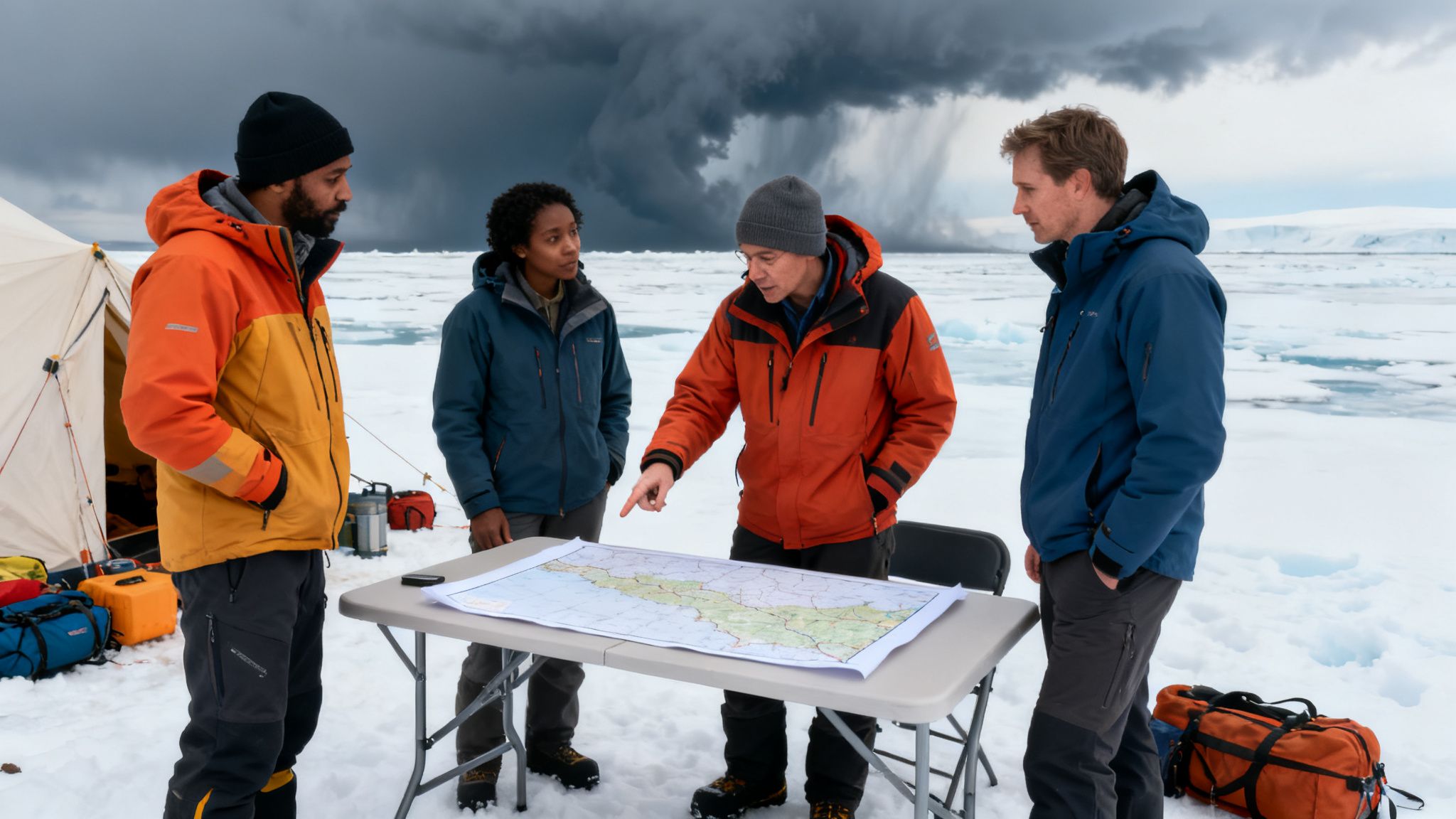
The principles that keep a four-person ski team functioning in a Svalbard whiteout are the exact same ones that help a leadership team navigate a volatile market. It is the same human dynamics at play, just a different kind of storm.
Think of an expedition as a business project stripped bare. You have a clear objective, limited resources, and an unpredictable environment where a bad call has immediate, tangible consequences. This is why we created our ‘Offsite On Purpose’ programmes —to use the stark clarity of the Arctic as a real-world training ground for corporate teams.
The goal is to forge a unit that can operate under genuine pressure, moving beyond abstract trust falls to the kind of bond that only comes from shared, structured hardship.
From Arctic Storms to Market Shifts
Picture this common expedition scenario. It is late afternoon, the temperature is plummeting, and you are still five kilometres from the planned campsite. The barometer tells you a storm is rolling in.
Do you push on, risking exhaustion and getting caught out? Or do you make camp now in a less-than-ideal spot, conserving energy but losing ground on your objective?
There is no single right answer. The important part is how the team arrives at a decision. It boils down to a few critical actions:
- Honest Communication: Every single member must feel they can voice their physical state and assessment of the risk without fear of judgement. The strongest skier might want to push on, whilst the most experienced navigator sees trouble brewing. Both voices are vital.
- Data Over Ego: The team has to weigh the objective facts—barometer readings, distance left, available light, team energy levels—over wishful thinking or individual pride.
- Unified Commitment: Once a decision is made, that is it. The entire team commits to it, one hundred percent, regardless of their initial preference. A resentful, divided team is a liability.
This exact framework applies to a business project facing an unexpected market shift or a competitor's surprise launch. Do you stick to the original plan or pivot? The process of assessing the data, hearing out conflicting views, and then committing to a unified course of action is identical.
The Arctic just has a way of stripping away the noise and making the consequences of poor group dynamics impossible to ignore.
Forging Cohesion Through Shared Experience
People like Jason Fox and Aldo Kane, who have operated in some of the most demanding environments on Earth, will tell you that elite teams are not built on friendship. They are forged in shared struggle. They are built on a deep, proven trust in each other’s competence and decision-making under fire.
This is the core idea behind our corporate programmes.
When you put a team in a situation where they must collectively manage real risk—pitching a tent in a gale, navigating as a group, melting snow for water at -20°C —it builds a unique kind of psychological cohesion. Trust moves from an abstract concept to a lived, proven reality.
In high-stakes environments, trust is not a feeling. It is a conclusion based on demonstrated competence and reliability under pressure. A team that has navigated a glacier together has a fundamentally different from understanding of mutual support.
This hands-on experience in building mental resilience is more critical than ever in the professional world. Poor workplace mental health costs UK employers an estimated £51–£56 billion every year, with staff turnover and presenteeism making up most of that figure. With 28% of all sick days attributed to poor employee mental health, the ability to withstand pressure is now directly linked to an organisation's bottom line.
Building resilience is no longer a soft skill; it is a core operational necessity.
The lessons learned managing group fatigue on a long ski day translate directly to managing team burnout during a crunch project quarter. The quiet confidence gained from solving a real problem in a harsh environment is a powerful asset to carry into the next professional challenge.
How to Measure Your Resilience Development
Resilience is not just a feeling; you can actually track it. And if you do not measure it, you cannot manage it.
Moving beyond a vague sense of being ‘tougher’ allows you to see what is genuinely working. It mirrors the objective, no-nonsense debriefing process we use after every single training day at the Pole to Pole Academy.
This turns resilience from an abstract idea into a skill you can sharpen. You would not head into the high Arctic without a map to track your progress. Your mental preparation deserves the same discipline.
Go Beyond Subjective Feelings
At first, progress can feel intangible. Maybe you notice you are less reactive to a stressful email, or a brutal training session does not wipe you out for the entire evening. These are good signs, but they are not data.
To build a truly robust mental skillset, you need objective metrics. You need proof of progress over time.
The key is to create a dead-simple system for logging your training and its effects. It does not need to be complicated, but it absolutely must be consistent. This log is what transforms scattered activities into a structured programme with clear, actionable feedback.
Key Metrics for Your Resilience Log
A good resilience log tracks two things: hard data and your own observations. This combination gives you the full picture, showing not just what happened, but how you responded and adapted.
Think about tracking these core metrics:
- Heart Rate Variability (HRV): This is a powerful, objective window into your nervous system's recovery. A higher HRV generally means your body is bouncing back well from stress. Tracking it each morning shows you how effectively you are adapting to stressors like cold water immersion.
- Time to Recovery: After a planned stress exposure—a tough hike, a public speaking event—time how long it takes for your heart rate and any feelings of anxiety to return to your baseline. The goal is simple: see that window get shorter over time.
- Micro-Challenge Success Rate: Keep a basic tally. How many of the weekly micro-challenges you set for yourself did you actually complete? Did you manage 7/7 cold showers? Did you finish the weighted pack march as planned? This tracks your discipline and consistency.
Think of your Resilience Log as your personal debrief. It needs to capture the drill, your immediate cognitive reaction, and a quick post-event analysis. This process is the single most effective tool for making genuine, objective progress.
Building Your Resilience Framework
Keep your log simple. A dedicated notebook or a basic spreadsheet is all you need.
Structure your entries to capture the essentials without it becoming a chore. A straightforward framework might include columns for the date, the specific drill, your immediate thoughts during it, and a reflection on your performance afterwards. To see more on how we apply this data-driven mindset, you can explore our breakdown of the Pole to Pole metrics that matter.
This kind of systematic tracking is vital in today's high-pressure world, particularly for younger professionals. Recent data shows a worrying generational divide, with young people facing disproportionate levels of stress and often feeling unsupported.
Mental ill health is now a leading cause of work-limiting conditions for those under 45 . The need for effective, alternative ways to build resilience has never been more obvious. This is precisely the gap our expedition-based approach is designed to fill, providing tangible skills that translate directly from the ice back to the office.
From Theory to the Ice
You do not just ‘achieve’ mental resilience. It is not a summit you reach once and then you are done. It is more like maintaining your kit – a constant, ongoing process.
The principles we have covered – structured process, controlled exposure, physiological regulation – are not just for life on an expedition. They apply just as much to the pressures of any high-stakes environment.
Think of this training programme as a framework, a map. Its real power is not in ticking a box to say you have finished it, but in using it consistently. The true test of your resilience will not be some single, dramatic moment of survival. It is found in the discipline to do the smallest, most manageable drill when you least feel like it.
That is where you forge real progress.
The goal is not to conquer the elements, whether on a glacier or in a boardroom. It is to build the inner fortitude to move through them with competence and quiet confidence. That is resilience.
This guide gives you the map, but you have to take the journey. It starts with the first controlled breath in a cold shower. The first pre-scripted response to a potential failure. The first honest team conversation under real pressure.
If you are ready to move from reading to doing, we invite you to explore further.
See how these principles come to life on our Pole to Pole Academy courses. Test your skills on a real-world challenge like the Svalbard crossing. Or discover how our ‘Offsite On Purpose’ programmes can build that collective strength within your own organisation.
The first step is always the hardest. Take it.
Burning Questions on Mental Resilience
We get a lot of questions about how to build mental resilience in the real world. Here are a few of the most common ones we hear, answered from the perspective of what actually works out on the ice or in the boardroom.
I am Starting from Zero. Where Do I Begin?
The best place to start is with the smallest possible thing you can do every single day. For most people, that is cold water exposure .
Just end your daily shower with 30 seconds of cold water. That is it. But here is the key: do not just grit your teeth and bear it. Your only job is to control your breathing. Fight that instinctive gasp for air and force a slow, steady exhale. This simple act is profound – it is basic training for your nervous system, teaching it to stay calm under physiological shock. It is the foundation for everything else.
Mental Toughness vs. Mental Resilience – What is the Real Difference?
This is a crucial distinction, and one that trips people up. Mental toughness is often about endurance – just putting your head down and ploughing through pain. It has its moments, but it's a rigid strategy. Rely on it too much, and you will burn out.
Mental resilience , on the other hand, is about being flexible. It is the ability to take a hit, absorb the shock, learn from it, and bounce back to your baseline without losing momentum. Think of it like this: a tough object is hard to break, but a resilient object bends under pressure and snaps right back to its original shape. Resilience is dynamic, adaptive, and far more sustainable over the long haul.
Mental toughness is about weathering the storm. Mental resilience is learning to navigate inside it, conserving energy, and emerging stronger on the other side. We train for resilience because endurance without adaptability is a fragile way to operate.
How Does This Training Help Me in My Day Job?
The carry-over is incredibly direct. Your nervous system does not really distinguish between the stress of a looming project deadline and the stress of a descending blizzard. The response is the same.
Learning to control your breathing when your stove sputters out at -25°C builds the exact same neural pathways you need to stay calm during a tense negotiation with a client. The cognitive reframing you practise on a long, monotonous polar trek is the same skill you will use to break down a huge, overwhelming corporate project into small, manageable chunks.
You are essentially stress-inoculating yourself. The discipline and self-awareness you forge in these controlled, uncomfortable environments become your default setting in any high-stakes situation. You are training for the boardroom just as much as you are training for the ice cap.
At Pole to Pole , we believe building this resilience is the most critical preparation for any significant undertaking. To move from theory to practice and apply these principles in the world's most formative environments, explore our expeditions and training programmes at https://www.poletopole.com.