10 Expedition-Grade Team Trust Building Exercises That Forge Real Bonds
Trust in a team is not a metric achieved in a conference room with abstract challenges. It is forged under load, in conditions where reliance on one another is not a concept, but a necessity for progress and safety. On a polar plateau, with visibility dropping and temperatures at -25°C, trust in your rope-mate’s navigation is absolute. This calibre of trust, tested, earned, and visceral, translates directly to high-stakes business environments.
This article moves beyond conventional HR activities to detail ten expedition-grade team trust building exercises . These are methods grounded in the realities of military and polar exploration, where effective teams are a matter of survival, not just performance. We will break down why these approaches are fundamentally different from typical corporate team-building, focusing on creating genuine, resilient cohesion that functions under real pressure.
Modern approaches to team cohesion increasingly leverage engaging, hands-on activities, drawing inspiration from various experiential learning examples to create more impactful and memorable outcomes. Our focus, however, is on the specific demands of high-consequence environments.
For each exercise, we will provide a comprehensive guide covering the objective, necessary equipment, step-by-step facilitation, and ideal group parameters. You will learn to assess risk, adapt the challenge for corporate, expedition, or remote teams, and lead effective debriefs. The goal is to provide a practical framework for leaders seeking to build teams with unbreakable trust, ready for any challenge.
1. Shared Extreme Environment Exposure
Standard office-based team trust building exercises often fall flat because the stakes are artificial. Shared Extreme Environment Exposure flips this script by placing teams in genuinely demanding, yet meticulously controlled, natural environments. This method accelerates the formation of authentic trust by stripping away workplace hierarchies and forcing reliance on fundamental human skills: communication, mutual support, and shared problem-solving under real physiological and psychological stress.
This is not a manufactured challenge; it is a real one. When a team has to navigate together in a whiteout, manage their energy whilst pulling a 45kg pulk, or simply erect a Hilleberg tent in a biting wind at -20°C, trust becomes a tangible necessity, not an abstract concept. The shared vulnerability and collective achievement forge bonds that are nearly impossible to replicate in a conference room. The discomfort is purposeful, creating a powerful shared memory of overcoming adversity.
"True character isn't built in comfort. It's revealed and refined when facing genuine challenge. In these environments, you can't fake competence or commitment; your team learns to trust what's real."
This approach, popularised by military special forces selection and now central to high-impact corporate development programmes like those run at the Pole to Pole Academy (64° 25' 24" N) in Sweden , is one of the most effective team trust building exercises for leadership teams seeking profound results. The key is expert facilitation, ensuring that the environmental stress is a catalyst for growth, not just hardship. The goal is to build resilience and cohesion, using the environment to understand how clear thinking underpins performance. For a deeper insight into this, you can explore the connection between mental clarity and extreme environments and how it translates back to the workplace.
2. Rope Course and Physical Challenge Courses
Whilst shared exposure to genuine extreme environments provides unparalleled depth, Rope Courses and Physical Challenge Courses offer a more structured and accessible alternative. These team trust building exercises use purpose-built physical obstacles like climbing walls, zip lines, and suspended rope elements to create a controlled environment where trust is not optional, but essential. The progressive difficulty of the course ensures that teams must rely on communication, peer support, and active encouragement to succeed.
The power of this method, popularised by organisations like Outward Bound, lies in making trust a physical reality. When a colleague is literally holding your safety line, workplace hierarchies and politics dissolve, replaced by a fundamental need to depend on one another. Successfully navigating a high-ropes element becomes a shared victory, solidifying bonds through tangible, cooperative achievement. The challenges are designed to stretch participants beyond their comfort zones in a physically and emotionally safe setting.
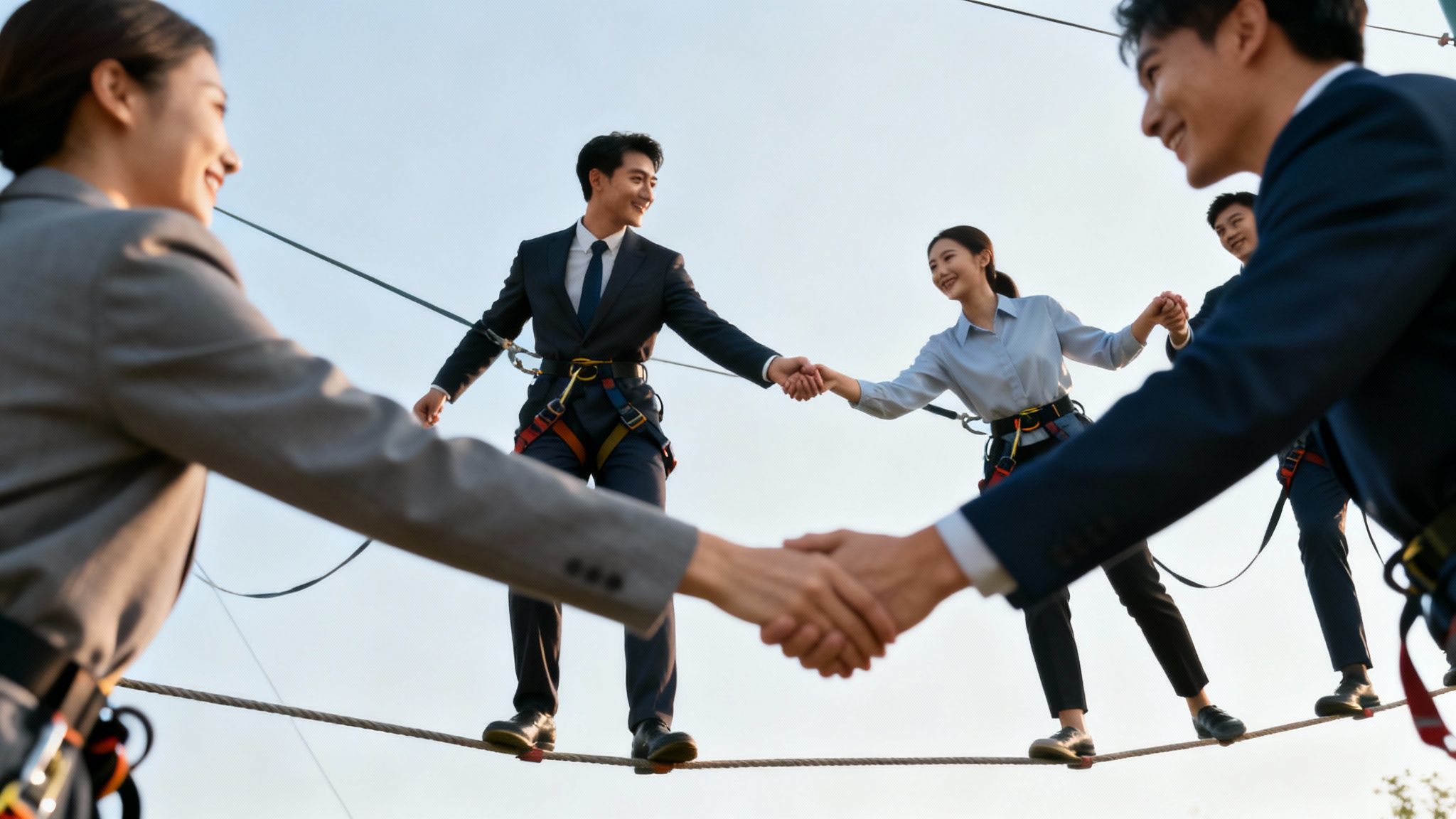
"A challenge course doesn't build character, it reveals it. It forces a team to confront how they communicate under pressure, how they support the hesitant, and how they celebrate collective success. The lessons are felt, not just heard."
This approach is highly effective for teams needing to break down communication barriers and build foundational trust. Its success depends entirely on expert facilitation that connects the physical activity back to workplace dynamics. The facilitator's role is to ensure participants understand that spotting a teammate on a climbing wall uses the same principles as supporting a colleague through a difficult project. The debrief is as critical as the activity itself, translating the felt experience into actionable workplace behaviours. These courses provide a powerful, kinesthetic way to learn and internalise the mechanics of team trust.
3. Communication-Only Blindfolded Challenges
Most workplace communication is layered with non-verbal cues: body language, facial expressions, and shared visual context. Communication-Only Blindfolded Challenges systematically remove these layers, forcing a team to rely exclusively on the precision of spoken language. This method is a powerful diagnostic tool and training ground for trust, revealing how clear, calm, and concise instruction builds confidence, whilst ambiguous or panicked communication erodes it almost instantly.
The premise is simple: one or more team members are blindfolded and must complete a physical task, guided only by the verbal instructions of their teammates. Whether navigating a simple maze of office chairs, assembling a small structure from component parts, or locating a specific object in a room, the blindfolded person must place absolute trust in their guide. This creates a state of controlled vulnerability, where the guide bears direct responsibility for their partner’s success and psychological safety, making it one of the most effective team trust building exercises for clarifying communication protocols.
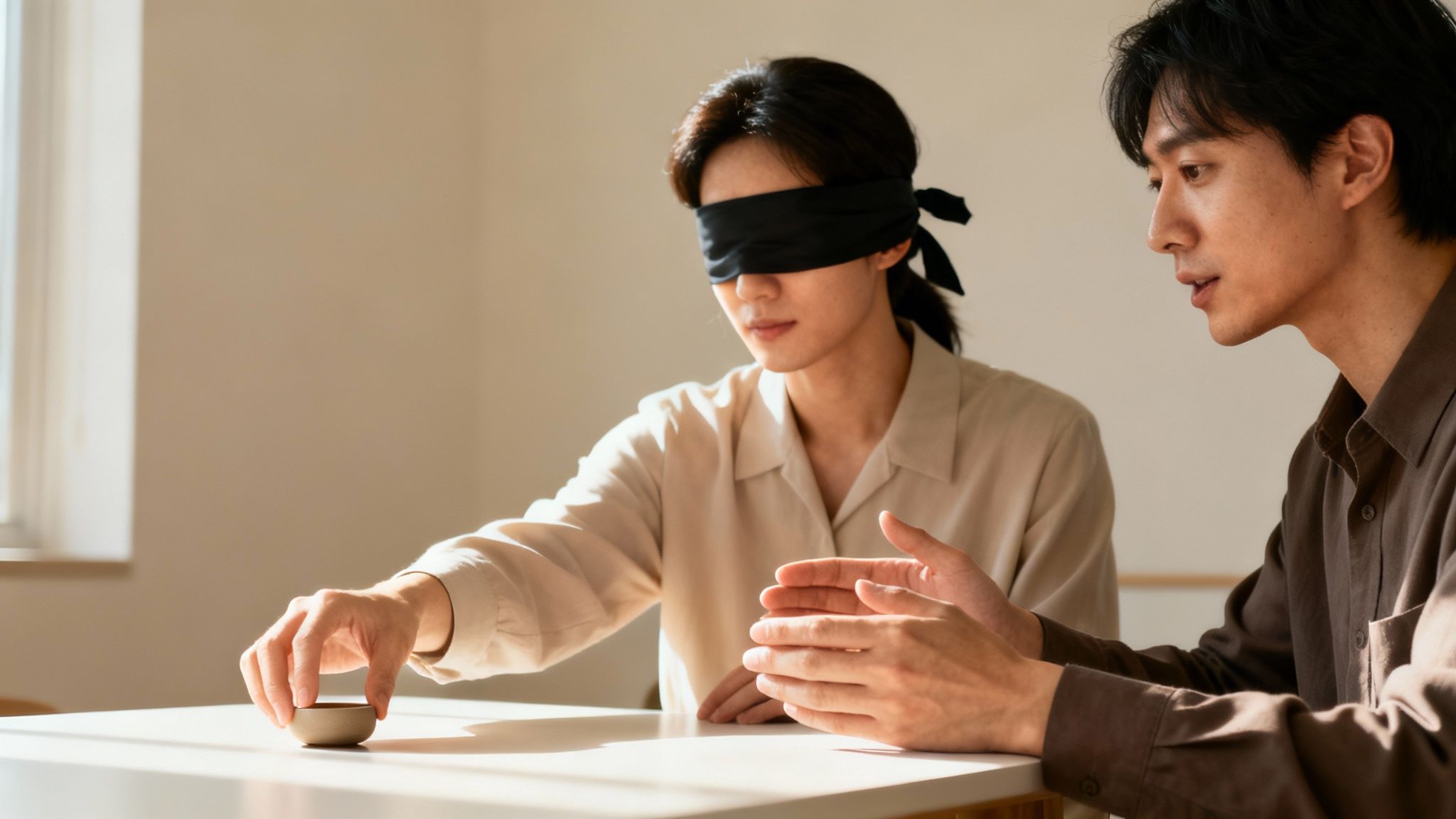
"In a whiteout, you can't see your own skis, let alone your teammate three metres away. Your world shrinks to the sound of their voice. You learn very quickly that trust isn't a feeling; it's a function of clarity."
This methodology, a staple of corporate training workshops and adventure-based learning, directly simulates high-stakes, low-visibility scenarios found in military operations or polar expeditions. The immediate feedback is undeniable: when instructions are poor, the person stumbles; when they are precise, the task is completed efficiently. The key is to start with simple pair work, rotating roles so everyone experiences both guiding and being guided. A robust debrief after the exercise is critical to connect the lessons learned about specific language, tone, and active listening directly back to project management and team collaboration in the professional environment.
4. Expedition-Style Team Navigation and Route Planning
Corporate decision-making often happens in a vacuum, insulated from immediate, tangible consequences. Expedition-Style Team Navigation and Route Planning eradicates this buffer by placing a team in a wilderness environment where their collective planning and navigation choices directly determine their progress, comfort, and safety. This is not a theoretical case study; it is a live-fire exercise in consequence management, forcing a team to build trust through shared accountability and collaborative problem-solving.
When a group must collectively interpret a map in fading light, agree on a bearing across a glacier, or re-route due to unexpected terrain, trust in each other's judgement becomes critical. Individual strengths and weaknesses in spatial awareness, risk assessment, and communication are laid bare, creating an authentic platform for building reliance. The process transforms strategic planning from an abstract boardroom activity into a visceral, shared experience where the outcome is felt in every step taken. This is a core component of programmes run by Outward Bound and military leadership development courses.
"Navigation isn't just about reading a map; it's about reading the room. When the consequences are real, a team quickly learns who to listen to, how to debate, and when to commit. That's trust in action."
This method is one of the most powerful team trust building exercises because it directly mirrors the high-stakes decision-making required of leadership teams. Under the watchful eye of expert guides who manage ultimate safety, the team is empowered to own its choices. Daily leadership roles can be rotated, ensuring every member experiences the weight of responsibility. The debriefs are not about right or wrong turns, but about the team dynamics that led to them. To grasp the level of detail required, you can understand the complex logistics behind planning an expedition, which provides a framework for these powerful learning journeys.
5. Vulnerability-Based Leadership Storytelling Circles
Conventional team-building often avoids genuine discomfort, focusing instead on sanitised activities. Vulnerability-Based Leadership Storytelling Circles challenge this by creating a structured, safe space for leaders and team members to share personal stories of failure, challenge, or pivotal learning moments. This exercise builds profound trust not through manufactured success, but through reciprocal vulnerability and witnessed empathy, proving that strength lies in acknowledging and learning from missteps.
This isn’t about abstract corporate jargon; it's about human connection. When a leader shares a genuine story of a poor decision under pressure, a personal blind spot they discovered, or a moment of significant self-doubt, it dismantles the facade of infallible authority. This act gives permission for others to be open, creating a powerful loop of psychological safety. The trust forged in these moments is authentic, rooted in the shared understanding that leadership is a journey of imperfect progress, not a destination of perfection. As Jason Fox often remarks, understanding your own breaking points is the first step towards true strength.

"Vulnerability is not weakness; it's our most accurate measure of courage. When leaders are brave enough to share their struggles, they create cultures where it's safe for everyone to learn and grow."
Validated by research on psychological safety, this approach is one of the most impactful team trust building exercises for developing cohesive, high-performing teams. Success hinges on expert facilitation to establish clear rules: confidentiality, listening without judgement, and no unsolicited advice. The aim is to foster connection and normalise imperfection, creating a resilient team culture where feedback is valued and challenges are met with collective honesty, not individual posturing. For a deeper understanding of how this psychological safety is tested and built, you can learn about the mental resilience required in our advanced programmes which parallel these principles in demanding environments.
6. Mutual Dependency Tasks and Problem-Solving Challenges
Effective teams are not simply collections of individuals; they are interdependent systems where the success of one relies on the contributions of others. Mutual Dependency Tasks formalise this reality, creating challenges that are impossible to solve alone. These team trust building exercises are meticulously designed to require the complementary skills, unique knowledge, and combined efforts of every member, directly mirroring the complex collaboration required in high-stakes projects or expeditions.
From structured building exercises to tactical escape rooms and expedition logistics planning, the principle is consistent. By unevenly distributing crucial information or assigning roles that prevent any single person from dominating, teams must learn to communicate with precision and rely on the expertise of their colleagues. When a team has to assemble a complex piece of equipment with instructions split amongst three people, or navigate a route using fragmented map sections, trust ceases to be a feeling and becomes a functional necessity.
"Interdependence isn't a weakness; it's the architecture of high performance. When you create a scenario where no one has the full picture, you force the team to build one together. That's where real trust is forged."
This method is exceptionally powerful for revealing and improving a team's internal communication and collaboration patterns. It’s not just about solving the puzzle; it’s about how the team solves it. The time pressure, distributed knowledge, and shared goal create a perfect microcosm of a demanding work environment. The key is a focused debrief that examines how the team managed information, supported members with critical knowledge, and made decisions collectively under pressure, providing a direct link back to improving performance in their day-to-day roles.
7. Reciprocal Mentoring and Skill-Exchange Partnerships
Traditional training often flows in one direction, from expert to novice, reinforcing existing hierarchies. Reciprocal Mentoring and Skill-Exchange Partnerships dismantle this model by creating a structured framework where every team member is simultaneously a teacher and a student. This approach fosters deep-seated trust by levelling the playing field, forcing mutual vulnerability, and building profound respect for the diverse competencies within the team.
This is not just about cross-training; it’s about intentionally creating interdependence. When a seasoned mountaineer is mentored by a junior team member on GPS navigation technology, or a senior corporate leader learns about emerging digital trends from a new graduate, a powerful dynamic emerges. The act of teaching requires one to solidify their own knowledge, whilst the act of learning requires humility and an open mind. This two-way exchange ensures that trust is built on a foundation of recognised, mutual value, not just on seniority or a single area of expertise.
"When the expert becomes the novice, ego dissolves and genuine respect takes its place. This mutual reliance is the bedrock of cohesive teams, whether in a boardroom or at a base camp."
This method is central to the operational readiness of high-performing teams, from military units integrating new personnel to expedition crews preparing for varied challenges like rope work and maintaining a Primus stove. The key is a clear structure: define the specific skills to be exchanged, set clear learning outcomes, and schedule regular sessions. By focusing on both the skill transfer and the development of the relationship itself, this exercise transforms individual competencies into a formidable, trust-driven collective capability, making it one of the most effective team trust building exercises for long-term cohesion.
8. Shared Hardship and Discomfort Deliberately Introduced
Many corporate team building exercises lack impact because they are devoid of genuine consequence. The deliberate introduction of shared hardship creates a controlled, yet authentic, environment where professional masks fall away, forcing a team to rely on each other. By systematically introducing moderate physical discomfort like cold water immersion, sustained effort, or simulated sleep deprivation, you strip interactions down to their essential core: communication, empathy, and collective resolve.
This is not about punishment; it is a calculated method to expand a team's collective comfort zone and build genuine resilience. When a team endures a long, cold night with limited sleep or works together to complete a strenuous task whilst fatigued, the trust that emerges is earned, not simply discussed. This method, a cornerstone of military selection courses and programmes like Pole to Pole's winter survival modules in Svalbard, reveals true character and demonstrates who can be relied upon when pressure mounts. The carefully managed stress forges powerful, lasting bonds built on a foundation of shared experience and mutual support.
"Discomfort is a catalyst. It strips away the non-essential and reveals the truth of a team's capability. When you share a genuine struggle, you build a level of trust that no comfortable meeting room ever could."
For this to be one of the most effective team trust building exercises, expert facilitation is paramount. The discomfort must be purposeful and safely managed, with clear communication and achievable objectives. The goal is to show the team they are more capable than they believe, both individually and collectively. This creates a powerful reference point they can draw upon back in the workplace when facing high-stakes projects. To understand the principles behind this, you can explore how to harness physical and mental challenges to build true resilience.
9. Collective Decision-Making Under Uncertainty and Time Pressure
Effective teams are not defined by their ability to follow a plan, but by their capacity to adapt when the plan becomes obsolete. This exercise thrusts teams into scenarios where they must make consequential decisions with incomplete information and under severe time constraints. It is designed to build trust in collective judgement, leadership, and the group's ability to operate coherently when facing ambiguity.
This isn't a theoretical business school case study; it's a dynamic simulation of real-world crises. When a team must decide whether to reroute an expedition based on a fragmented weather report, manage a simulated medical emergency with limited resources, or navigate a sudden equipment failure, trust in each other's expertise and decision-making process becomes paramount. The pressure forces clear communication and reveals the underlying mechanics of how the team thinks, prioritises, and acts as a single, cohesive unit. These high-stakes team trust building exercises are foundational in military and aviation training for this very reason.
"In a crisis, you don't rise to the occasion; you sink to the level of your training. Practising decision-making under manufactured stress is how you raise that level, so that calm, clear judgement becomes your default."
Popularised by military command schools and aviation's Crew Resource Management programmes, this methodology is essential for any team operating where mistakes have genuine consequences. The key is to debrief the process , not just the outcome. How information was shared, how dissent was handled, and how the final decision was reached are more important than whether the 'right' choice was made. The exercise builds a team that trusts its own problem-solving architecture, a skill directly transferable from a simulated arctic blizzard to a corporate boardroom crisis.
10. Post-Challenge Collective Reflection and Meaning-Making
The physical challenge is only half the story; the real transformation is cemented in the reflection that follows. Post-Challenge Collective Reflection moves beyond a simple "what went well" debrief into a structured process of meaning-making. It provides a formal, facilitated space for a team to integrate a shared experience, articulate lessons learned about themselves and each other, and consciously decide how to carry new levels of trust back into their day-to-day working environment. Without this crucial step, even the most profound experience risks becoming just a good story, its potential for lasting change unrealised.
This process is about turning a shared memory into a shared operational philosophy. When a team has navigated a tough situation, whether on a Norwegian glacier or during a high-stakes project deadline, the after-action review is where trust is codified. By asking pointed questions in a safe environment, a skilled facilitator helps the team unearth the critical moments of reliance, vulnerability, and mutual support that occurred under pressure. This is a core component of programmes run by organisations like Pole to Pole and is a standard protocol in military special forces, where learning from every operation is non-negotiable.
"An experience without reflection is just an event. It's in the quiet, honest analysis afterwards that the raw material of adversity is forged into the alloy of genuine team trust."
This is one of the most critical team trust building exercises because it creates a direct bridge between the challenge environment and the corporate world. The key is timeliness and psychological safety. The reflection must happen soon after the event, whilst the memories and emotions are still vivid. It requires a space free from judgement where hierarchy is flattened, allowing for candid discussion. The objective is not to assign blame but to collectively build a new narrative of team capability, one founded on a proven, shared experience of overcoming genuine difficulty together.
Comparison of 10 Team Trust-Building Exercises
| Activity | Implementation complexity | Resource requirements | Expected outcomes | Ideal use cases | Key advantages |
|---|---|---|---|---|---|
| Shared Extreme Environment Exposure | Very high — logistics, medical and safety planning | Very high — travel, expert guides, medical screening, multi-day gear | Deep, durable trust; resilience; visible leadership under stress | Executive teams, high-stakes groups seeking transformation | Authentic shared adversity; lasting behavioural change |
| Rope Course and Physical Challenge Courses | Moderate — site setup and certified facilitation | Moderate — venue, equipment, trained instructors, 1–2 days | Rapid trust cues; improved communication and mutual support | Mixed corporate teams, large groups, confidence-building workshops | Accessible, scalable, immediate feedback on interdependence |
| Communication-Only Blindfolded Challenges | Low — simple setup and facilitation | Low — minimal equipment, short time blocks | Clearer verbal communication, empathy, perspective-taking | Remote teams, communication-focused sessions, quick interventions | Low cost, immediate diagnostic of communication gaps |
| Expedition-Style Team Navigation & Route Planning | Very high — multi-day planning, safety and logistics | Very high — guides, equipment, extended time, variable terrain | Functional trust, shared decision-making, sustained cohesion | Leadership teams, change management, high-stakes professionals | High authenticity; direct transfer to real-world group judgment |
| Vulnerability-Based Leadership Storytelling Circles | Low to moderate — skilled facilitation required | Low — space, facilitator, repeated sessions | Increased psychological safety, deeper interpersonal understanding | Remote or co-located leadership groups, culture initiatives | Cost-effective; builds empathy and lasting cultural change |
| Mutual Dependency Tasks & Problem-Solving Challenges | Moderate — careful design to ensure interdependence | Low to moderate — materials, facilitator, 1–3 hours | Demonstrated collaboration, role clarity, practical interdependence | Task-oriented teams, analytical groups, skeptics needing evidence | Fun, repeatable, reveals real collaboration patterns |
| Reciprocal Mentoring & Skill-Exchange Partnerships | Moderate — coordination over weeks/months | Low — time commitment, scheduling, simple resources | Cross-functional skills, sustained trust, role reciprocity | Cross-functional teams, onboarding, learning cultures | Builds utility-based trust; scalable and low-cost |
| Shared Hardship & Discomfort Deliberately Introduced | High — risk management and ethical safeguards | High — medical oversight, trained facilitators, contingency plans | Rapid hierarchy breakdown, strong bonding, resilience | Military, first-responders, elite leadership development | Efficient at accelerating authentic trust and revealing character |
| Collective Decision-Making Under Uncertainty & Time Pressure | Moderate to high — scenario design and facilitation | Moderate — simulation materials, facilitators, time | Stronger collective judgment, accountability, decision confidence | Crisis teams, operations, teams making high-stakes choices | Mirrors real workplace decisions; builds collective intelligence |
| Post-Challenge Collective Reflection & Meaning-Making | Low to moderate — skilled facilitation maximizes value | Low — facilitator time, private space, follow-up artifacts | Consolidated learning, cultural artifacts, sustained behavior change | Any team after experiential work, training programs | Multiplies impact of experiences; links emotion to future action |
From Exercise to Expedition: Integrating Trust Into Your Team's DNA
The team trust building exercises detailed in this guide, from Vulnerability Circles to Shared Hardship drills, are far more than just activities. They are diagnostic tools. Like a mountaineer checking their lines and anchors before a critical ascent, these exercises allow a team to test the integrity of its connections under controlled, simulated pressure. They reveal the weak points, the frayed edges of communication, and the knots of unresolved conflict before the storm hits. Completing a Blindfolded Challenge or a Navigation Exercise is not the end goal; the real work begins in the debrief and, crucially, in the days and weeks that follow.
The true value of these practices lies in their integration into the team's operational rhythm. The trust forged in a simulated high-stakes scenario is a currency that must be spent and reinvested daily. Every tight deadline, every difficult client conversation, every unexpected market shift becomes a real-world expedition. The principles of clear communication, mutual dependency, and collective decision-making, honed in a controlled environment, must now be applied when the consequences are real. The lessons from these exercises provide a shared language and a framework for navigating these challenges, transforming potential friction points into opportunities to strengthen team cohesion.
Beyond the Checklist: Cultivating a Culture of Trust
It is a common mistake to view team trust building exercises as a one-off solution, a box to be ticked on an annual offsite agenda. This approach misses the fundamental point. Trust is not an event; it is an environment. It's the cumulative effect of thousands of small, consistent actions over time. Legendary expedition leaders like Roald Amundsen or Sir Ernest Shackleton didn't build unbreakable team loyalty with a single activity. They built it through relentless preparation, transparent decision-making, and a demonstrated commitment to the team’s well-being, day after gruelling day.
Your team's journey should mirror this philosophy. The exercises here are the equivalent of Amundsen's team practising on the Hardangervidda plateau before heading south: they build muscle memory and reveal capabilities. The next step is to apply this training to your own 'Antarctica' - whether that's launching a new product, navigating an organisational restructure, or striving for a market-leading position. To successfully integrate trust into your team's DNA and move from mere exercises to impactful expeditions, exploring diverse corporate team building activities across Australia can provide valuable inspiration.
Making Trust the Bedrock of High Performance
Ultimately, the objective is to build a team where trust is so deeply embedded that it becomes instinctual. This is the critical infrastructure for genuine high performance, especially in high-stakes professions. It’s the unspoken understanding that allows a team member to act decisively, knowing their colleagues have their back. It’s the psychological safety that encourages someone to voice a dissenting opinion that could avert a crisis. This level of trust is not a 'soft skill'; it is the most critical and strategic asset a team can possess. It is the difference between a group of individuals working alongside each other and a truly cohesive unit capable of achieving extraordinary outcomes, whether on the Antarctic ice or in the boardroom. The journey from isolated exercise to an embedded culture of trust is the most important expedition your team will ever undertake.
When your team is ready to move from simulated challenges to a genuine, transformative experience, Pole to Pole provides the ultimate proving ground. Our programmes in Sweden and Svalbard are designed to forge elite teams by placing them in environments where trust is not just a concept, but a tool for survival and success. Discover how our expedition-based training can build the unbreakable trust your team needs.