A Guide to High Performance Team Building
True high performance team building is not about a one-off away day or a trust fall exercise. It is a deliberate, almost surgical process of diagnosing team dynamics, defining clear outcomes, and then designing interventions that work. It is about moving past the superficial to build genuine trust, resilience, and operational muscle.
Laying the Groundwork for High Performance Teams
Success on a polar expedition is decided long before the first ski touches the ice. It is forged in the planning room, where every contingency is mapped out and every team member’s role is defined with absolute precision. The same is true in any professional setting; building a high-performance team starts with a brutally honest look at its current state.
This diagnostic phase goes beyond surface-level metrics. We look for the subtle fractures in communication, the bottlenecks in decision-making, and the quiet erosion of trust that can sink an operation—whether that is a product launch or a crossing of the Svalbard archipelago.
From Vague Aims to Specific Objectives
Too often, organisations chase abstract goals like ‘better communication’ or ‘stronger collaboration’. These sound good, but they are impossible to measure and, frankly, ineffective. High-stakes environments demand specificity.
Instead of ‘better communication’, we define an objective like: ‘Implement a closed-loop communication protocol during high-stress project phases to reduce errors by 15%.’ This turns a vague wish into a measurable outcome tied directly to performance. The process is simple but critical: assess the team's current state, define clear objectives, and then plan the intervention.
This straightforward, three-stage flow underpins any team development programme worth its salt.
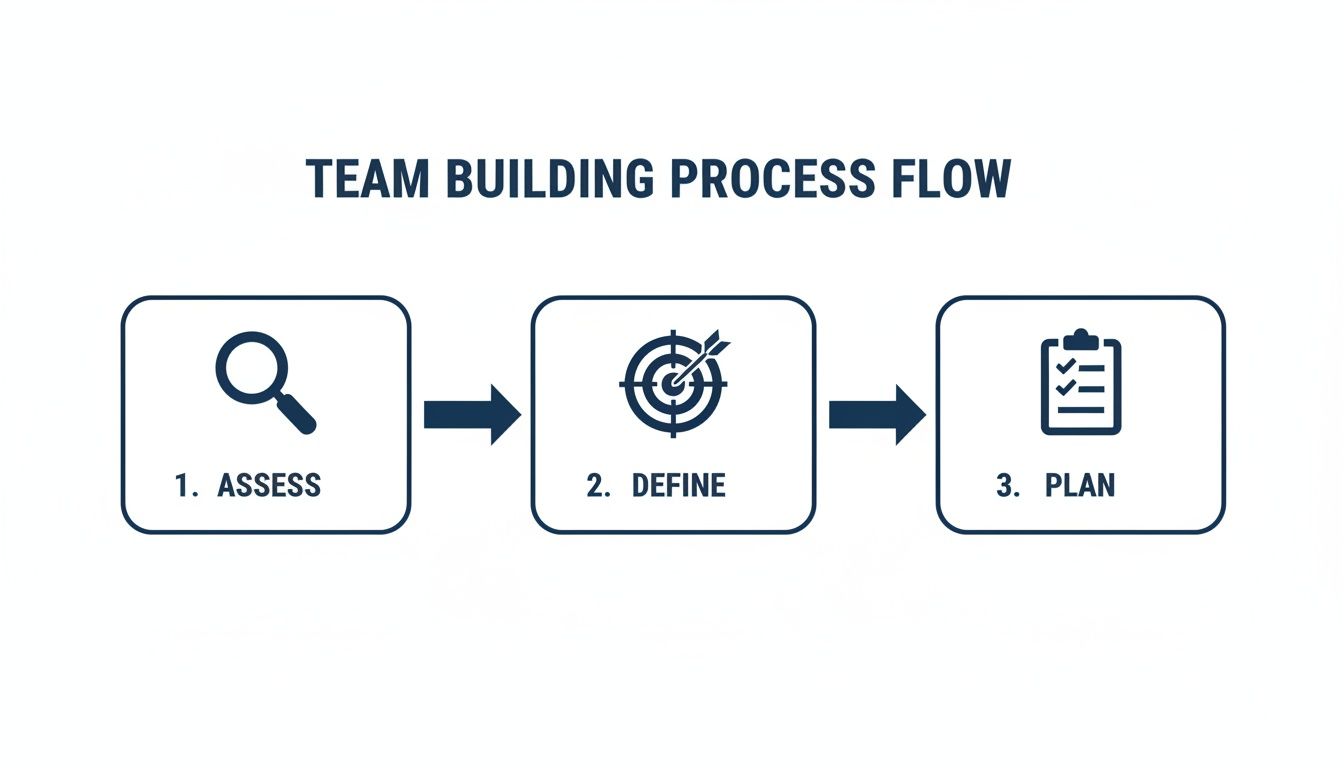
This structure ensures every activity that follows is a targeted solution, not just a generic exercise pulled from a manual.
Diagnostic Framework From Boardroom to Basecamp
The challenges faced in a corporate project and a high-stakes expedition are often two sides of the same coin. They just have different names. Understanding these parallels is key to designing training that genuinely prepares a team for pressure.
| Corporate Challenge | Expedition Parallel | Core Skill Developed |
|---|---|---|
| Project scope creep | Unforeseen weather changes | Adaptability & Contingency Planning |
| Team communication breakdown | Radio silence or unclear commands | Closed-Loop Communication |
| Siloed decision-making | Individual navigation errors | Collective Problem-Solving |
| Resource mismanagement | Inefficient fuel or food rationing | Strategic Allocation & Discipline |
| Low team morale/burnout | Expedition fatigue and doubt | Resilience & Mutual Support |
This framework shows how the crucible of an expedition can forge the exact skills needed to thrive back in the office. It is about creating a shared experience that makes abstract concepts like resilience tangible.
The Tangible Impact of Cohesive Teams
This is not just theory; the numbers back it up. UK-based research from McKinsey & Company has shown that high-performing teams can be 50% more productive than their average counterparts. What’s more, these teams finish projects 25% faster whilst making 50% fewer errors . In a polar environment, where one mistake can be catastrophic, those statistics hit home.
An expedition, just like a complex business project, is a series of calculated risks. Your ability to mitigate those risks is directly proportional to the strength, trust, and communication protocols of your team. Without a proper diagnostic, you are navigating without a compass.
This initial groundwork is the most critical part of the entire process. It is about knowing exactly where you are before you can even think about plotting a course. Just as a risk assessment for a journey to the South Pole informs every decision that follows, this diagnostic phase ensures the training is a focused intervention designed to build real capability.
For those wanting to dig deeper, exploring frameworks for Building High Performance Teams can offer valuable perspectives. Without this foundational step, any team-building effort is just an activity—not a strategic investment in performance.
Designing Programmes With Purpose
Most team-building days fail. They fail because the activity itself becomes the objective, rather than a tool to achieve something meaningful. A climbing wall or a trust fall is just a memorable moment, not a catalyst for real change.
A truly effective programme flips this on its head. It starts with the end in mind. The activities are chosen specifically to serve a pre-defined purpose, ensuring every single action links directly back to the outcomes we identified in the diagnostic phase.
This is the fundamental difference between a standard corporate offsite and what we call an ' Offsite On Purpose'. The environment itself is transformed into an instructor.
At our Sweden Academy, located at 64° 25' 24" N , the stark, beautiful, and unforgiving landscape strips away corporate pretense. Out here, job titles mean very little. Teams are forced to rely on the absolute fundamentals of collaboration, communication, and trust just to succeed.
The lessons are no longer theoretical; they are immediate, tangible, and unforgettable.
From Theory To Tangible Application
In a programme built with purpose, every task is a practical exam. We do not do generic challenges. We select specific scenarios designed to forge specific capabilities, mirroring the meticulous preparation that defined explorers like Roald Amundsen on the Hardangervidda plateau.
Here is what that looks like in practice:
- Decision-Making with Incomplete Information: A navigation exercise in whiteout conditions is not just about finding your way. It is a powerful lesson in trusting your instruments, communicating with absolute clarity under pressure, and making collective decisions when the path forward is completely obscured.
- Process Discipline and Accountability: The simple, repetitive task of melting snow for water with an MSR stove inside a Hilleberg Keron tent becomes a masterclass in process. One mistake, like spilling precious fuel, has immediate and serious consequences for the entire team. It brutally reinforces the need for focus, discipline, and mutual accountability.
- Role Clarity Under Stress: Assembling a camp after a long, exhausting day of skiing demands clear roles and flawless execution. It is a direct, physical parallel to a project team hitting a tight deadline, where success depends on each person knowing their function and executing it perfectly—a principle championed by leaders like Jason Fox.
This approach ensures that high performance team building is not just an abstract concept discussed in a breakout room. It becomes a lived, felt experience.
An expeditionary environment removes the luxury of ambiguity. Your team’s processes either work, or they do not. Your communication is either crystal clear, or you waste vital energy. The feedback is immediate, and the lessons are permanent.
Safety As The Foundation For Challenge
You cannot push a team to its limits unless you have built an uncompromising foundation of safety. This is not a contradiction; it is a prerequisite. Our expertise, honed over decades in military and polar operations, allows us to manage risk so effectively that teams can stop worrying and focus entirely on their performance.
This involves meticulous logistical planning. It means everything from selecting the right Fjällräven layering systems to maintain core body temperature to enforcing strict, non-negotiable protocols for travel and communication. We build competence long before we ask for confidence, making sure every person is proficient with their kit and understands the operating procedures inside and out.
It is this robust safety net that makes genuine growth possible. It creates the psychological space for people to step far outside their comfort zones, knowing that the ultimate risk is controlled.
They learn that preparation, discipline, and trust are not just corporate buzzwords. They are the essential components of survival and success. And that is the foundation upon which any effective leadership and team development programme must be built.
Building Psychological Safety Under Pressure
Psychological safety is the bedrock of any high-performance team. It is the unspoken trust that lets someone raise a tough question, admit they have made a mistake, or challenge a decision without fearing they will be humiliated or punished for it.
In a comfortable office, this is a nice-to-have. In the middle of a polar ice cap, it is a non-negotiable requirement for survival.
When the pressure is on, fatigue is setting in, and the stakes are high, psychological safety is often the first thing to go. This is precisely when you need it most. An expedition environment is a powerful crucible for forging this trust because the consequences of its absence are immediate and very real. A team member who hesitates to report the early signs of frostbite or questions a navigational choice can put the entire group in jeopardy.
This is why we build specific, structured mechanisms into our journeys to cultivate and protect this safety. It is never left to chance.
The Daily Debrief: A Non-Negotiable Ritual
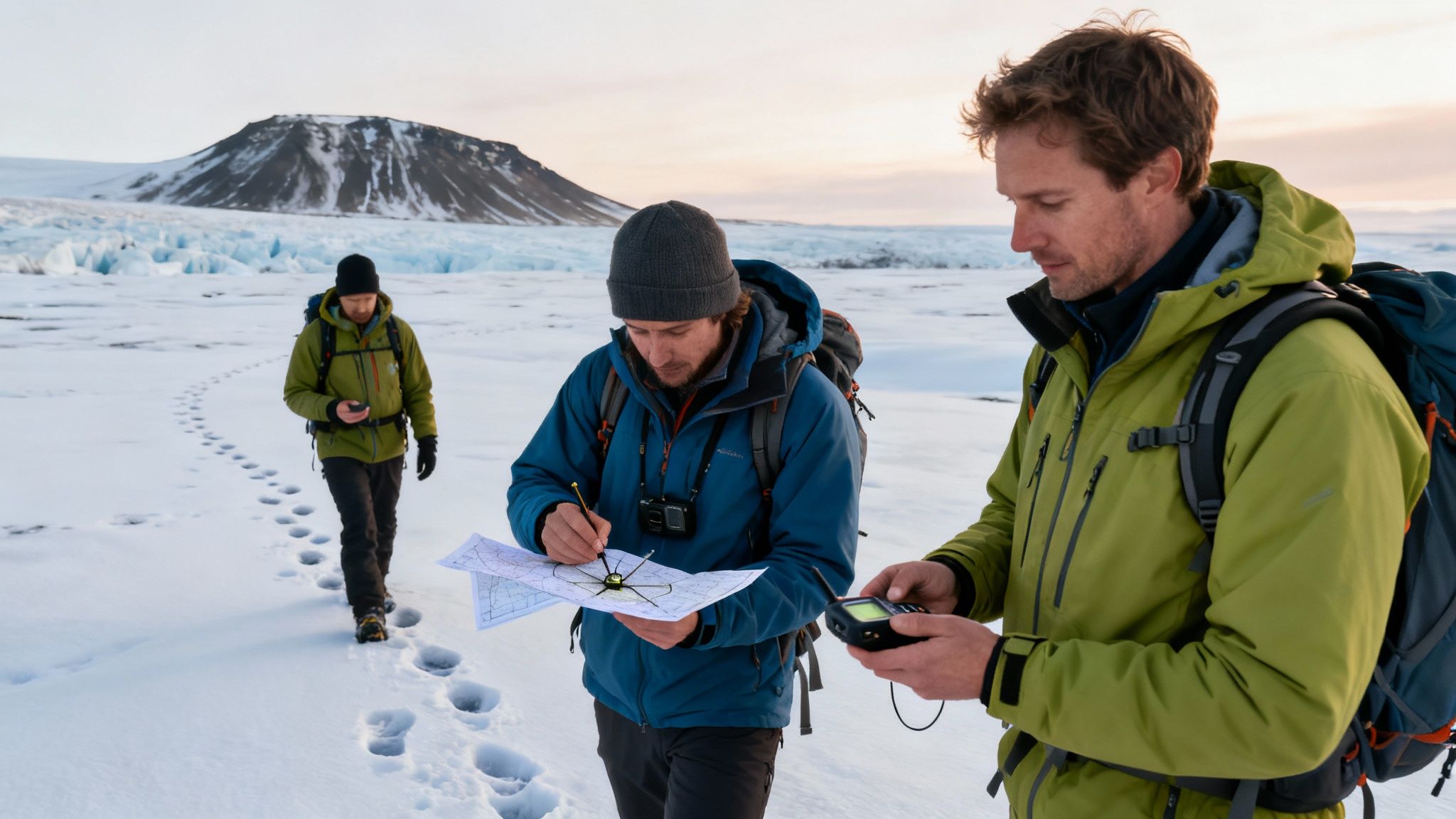
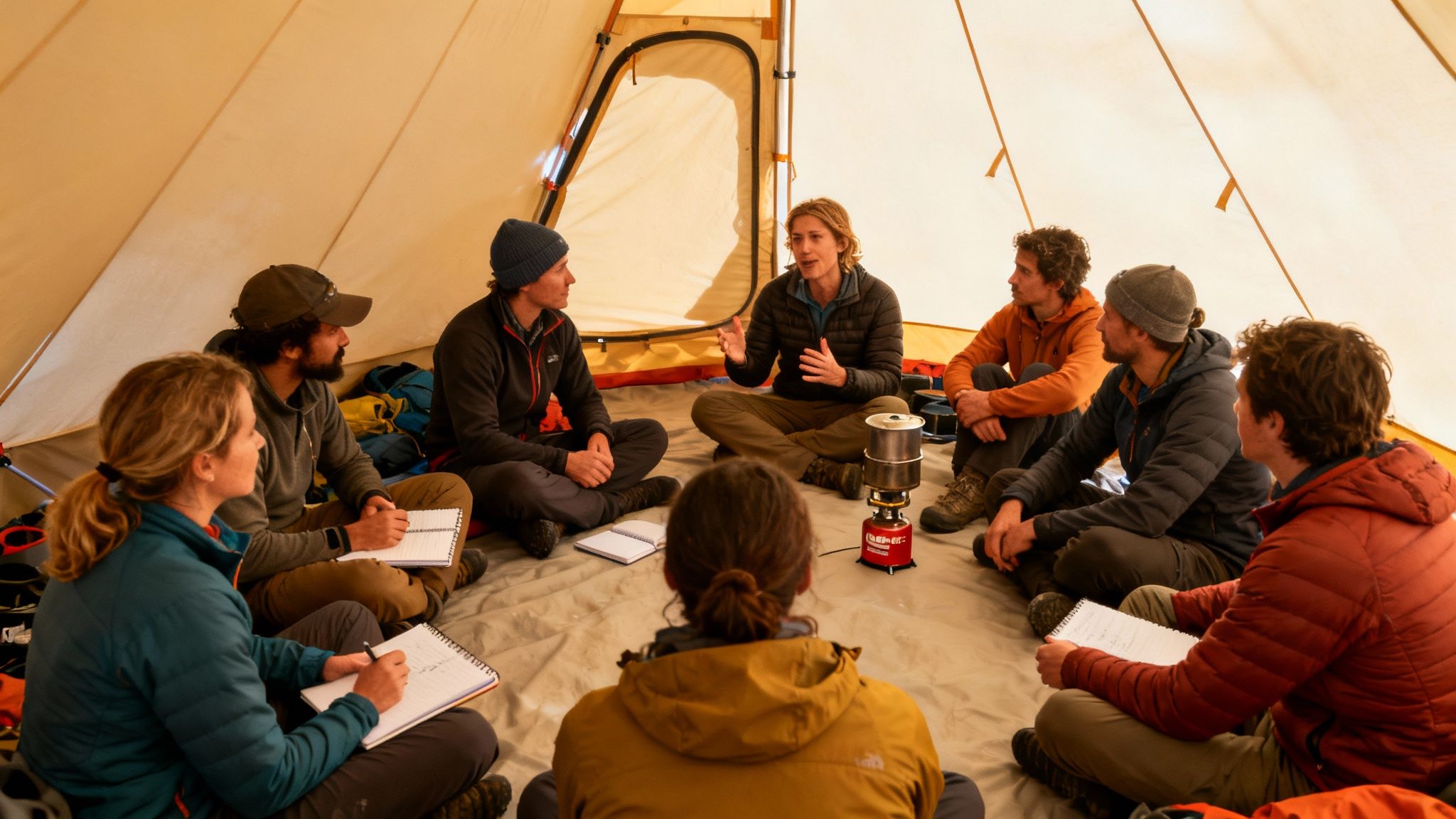
Every single evening, after 8-10 hours on skis and with the Hilleberg tents pitched, the team gathers for a structured debrief. This is not a casual chat around the stove. It is a mandatory check-in where every single member, regardless of seniority or experience, has an equal and protected voice.
We follow a simple, repeatable format:
- What went well today? This is about acknowledging success and reinforcing what works.
- What could be improved? We talk about the small things – inefficiencies in our tent routine or how we are packing the pulks.
- How is the team feeling? This is a frank assessment of morale, energy levels, and any personal concerns.
- What are the risks for tomorrow? A collective look at the weather forecast, the route ahead, and the state of our gear.
This ritual flattens hierarchy. It makes it completely normal to discuss problems openly and creates a habit of transparency that becomes invaluable when a genuine crisis hits.
Confronting Discomfort Constructively
Let us be clear: psychological safety is not about comfort. Quite the opposite. It is the vital ingredient that allows a team to confront uncomfortable truths and manage conflict constructively. When you are isolated, tired, and under constant stress, disagreements are inevitable. The difference between a high-performing team and a dysfunctional one is how they handle that friction.
Sir Ernest Shackleton's leadership during the Endurance expedition remains a masterclass in this. He actively managed dissent, made sure every man felt valued, and maintained morale through sheer force of will and empathy. He understood that a team’s psychological state was every bit as important as their physical supplies.
Psychological safety is not about avoiding hard conversations. It is about creating the deep-seated trust that ensures those conversations are productive, not destructive. It is the foundation for adapting strategy in real-time.
This is where teams learn the crucial difference between determination and stubbornness. Determination is pushing on towards a viable goal. Stubbornness is sticking to a failed plan out of pride. A psychologically safe team can make that distinction, allowing a member to say, "I think we need to reconsider our route," without it being heard as a personal attack. Admitting a mistake or asking for help becomes a sign of strength and commitment to the collective mission.
This operational foundation of trust is precisely what corporate teams take back with them. The data confirms its importance; research reveals that teams with high psychological safety are 27% more likely to report higher performance and 50% more likely to retain top talent . A cornerstone of this is effective communication skills training, which enables the open dialogue needed to build and maintain trust under pressure. It is this trust that transforms a group of individuals into a resilient, cohesive, and genuinely high-performance unit.
Embedding Lasting Behavioural Change
An expedition's true value is not measured in kilometres skied or peaks summited. It is measured in the behavioural shifts that make it back to the office.
The lessons learned managing a pulk weighing 50kg in driving snow are lost if they remain on the ice. The critical final stage of any high-performance team building programme is ensuring the experience translates into lasting organisational change.
This whole process starts by measuring the impact against the clear, specific objectives we set out in the diagnostic phase. We have to move beyond simple morale boosts to analyse tangible, operational improvements.
This is not about a feeling; it is about function. We need to examine both quantitative and qualitative data to paint a complete picture of what has actually changed.
Measuring the True Impact
To verify the return on investment, we need a framework that connects the expedition experience directly to workplace performance. This dual-pronged approach gives leaders a clear, undeniable view of the changes taking place.
Quantitative Metrics:
- Project Cycle Times: Have they decreased? By how much?
- Error Rates: Are there fewer mistakes in high-pressure project phases?
- Meeting Efficiency: Are decisions being made more effectively, with less time wasted?
- Employee Retention: Has turnover within the team dropped since the programme?
Qualitative Feedback:
- Structured Interviews: Candid one-on-one discussions to understand individual takeaways and perceived shifts in team dynamics.
- Anonymous Surveys: A safe way to gauge changes in trust, communication, and psychological safety.
- 360-Degree Feedback: Assessing how peers, subordinates, and leaders perceive behavioural changes in each other.
This level of detail does not just prove the value of the investment. It pinpoints which new behaviours are taking hold and which might need more reinforcement back in the workplace.
From Expedition Tent to Project Meeting
The biggest challenge is avoiding the 're-entry' problem, where that open, collaborative spirit forged in the field dissolves the moment everyone returns to their desks. To combat this, we provide concrete strategies to embed new habits into the daily workflow.
The 'tent meeting'—our structured daily debrief—is an incredibly powerful tool to bring back. We guide teams on how to integrate this exact model into their regular project meetings. It is about creating a non-negotiable space for every single team member to voice concerns, celebrate small wins, and flag potential risks without fear of reprisal. It transforms a standard status update into a genuine diagnostic and forward-planning session.
A team that has navigated together through a whiteout has a shared, visceral understanding of what clear communication and mutual trust actually mean. The goal is to make that visceral memory the new standard for how they operate every day.
Empowering team leaders is central to making this stick. They become the champions of the principles learned, tasked with actively defending psychological safety and modelling the transparent communication protocols they practised in the field. This also means establishing peer accountability systems where team members are encouraged—and expected—to hold each other to the high standards they achieved on the expedition.
A Case Study in Tangible Returns
This is not just theory. We worked with a UK-based financial services client whose derivatives trading team was struggling with siloed communication and slow decision-making under intense market pressure. After an intensive programme at our Sweden Academy, they did not just return with stories; they returned with a new operating system.
By embedding expeditionary debriefing techniques and peer accountability, they transformed their performance. The data from their experience reflects broader UK research, which showed a similar organisation achieving a 37% improvement in customer satisfaction and a 41% reduction in processing time . The client saw tangible results in their own metrics, linking the investment directly to improved employee engagement and, ultimately, better trading outcomes. For more details on these findings, you can explore the research on team development ROI.
This is the ultimate goal of high-performance team building: not just a memorable trip, but a permanent upgrade to a team’s core capability.
A Practical Toolkit for Team Leaders
Theory is one thing, but high performance is built in the field. This is where we move from principle to practice, with a set of tools and templates you can adapt for your own teams.
These are not abstract concepts pulled from a textbook. They are the field-tested protocols we use ourselves, whether we are running a programme at our Swedish academy or deep in the Antarctic interior.
The goal is simple: to give you a solid starting point for putting these ideas into action, right now. It is about translating the discipline of an expedition into your daily operations.
Diagnosing Team Needs: A Pre-Programme Questionnaire
Before you can move forward, you have to understand the terrain. A leader needs a brutally honest assessment of their team’s starting point.
The questions below are designed to cut through surface-level metrics and get to the heart of what is really going on with trust, communication, and resilience.
Pose these to your team. Make sure it is individual and confidential.
- On a scale of 1-10, how safe do you feel raising a dissenting opinion or pointing out a potential mistake in our team?
- Describe a recent situation where our team’s communication was excellent. What made it work?
- Describe a recent situation where our communication broke down. What was the primary cause?
- When under significant pressure, does our team become more cohesive or more fragmented? Give a specific example.
- What is the single biggest obstacle preventing our team from performing at a higher level right now?
The answers will give you a raw, unfiltered baseline. They will show you exactly where the fractures are. This is your diagnostic—the first step in any targeted high performance team building effort.
The Tent Meeting: A High-Impact Debrief Agenda
On expedition, the end-of-day debrief is a non-negotiable ritual. We call it the 'tent meeting'. It is the engine of continuous improvement and the main way we maintain psychological safety.
A reliable MSR stove might keep you warm, but this meeting provides the psychological fuel a team needs to push on. The structure is simple, direct, and shockingly effective back in the corporate world.
Daily Tent Meeting Agenda (15-20 Minutes):
- Objective Review: "Today's goal was X. Did we achieve it? Yes/No/Partially." (This keeps everyone focused on outcomes).
- What Went Well? "Identify one specific process or action that was efficient and effective." (This reinforces positive behaviours).
- What Can Be Improved? "Identify one friction point or inefficiency we can eliminate tomorrow." (This is all about marginal gains).
- Personal Check-in: "Rate your personal energy/morale from 1-5. Any issues affecting you?" (A crucial check on team welfare).
- Confirm Tomorrow's Plan: "Tomorrow's primary objective is Y. Are roles and responsibilities clear?" (This ensures total alignment).
This format strips away ego and corporate theatre. It forces a disciplined focus on what actually moves the needle on performance.
A Leader's Guide to Difficult Conversations
In high-stakes environments, avoiding difficult conversations is not an option; it is a liability. We borrow communication protocols from military professionals to handle these moments constructively.
The key is to separate the person from the problem.
The objective is not to win an argument but to solve a shared problem. Your protocol must reflect that. The moment it becomes personal, the team loses.
Use this simple framework to guide you:
- State the Shared Objective: Start by restating the team's common goal. "Our objective is to deliver this project successfully and safely."
- Present Factual Observation: Describe the issue using neutral, objective language. "I observed that the updated risk assessment was not circulated to the full team."
- Explain the Impact: Connect that observation back to the shared objective. "This creates a risk that team members are operating with incomplete information."
- Ask for Perspective: Open the floor for dialogue. "Can you share your perspective on what happened?"
- Agree on a Solution: Define the next step together. "Going forward, how do we ensure all critical updates are confirmed as received by everyone?"
This structured approach de-escalates emotion and channels the conversation towards a productive outcome. It is a vital skill for any leader serious about building a truly resilient team.
By applying these practical tools, you can begin to forge the discipline, transparency, and trust that define elite teams. For a deeper dive into the data that underpins these strategies, you can learn more about how Pole to Pole measures success and programme impact.
Common Questions About Expedition-Based Team Building
Even with a clear methodology, committing to an expedition-based programme brings up practical questions. They are valid concerns, and the answers come from years of leading teams through some of the most demanding places on Earth.
Is This Type of Team Building Suitable for All Fitness Levels?
Yes, absolutely. Our programmes are built around shared challenges and collective resilience, not individual athletic performance. The real goal is to forge a specific mindset, instil process discipline, and strengthen collaboration under real pressure.
Think about a Last Degree expedition to the South Pole. It demands a solid baseline of fitness and a serious amount of determination, for sure. But the team's ultimate success hinges on how well they work together, manage their energy, and support each other through exhaustion. The physical demand is just the crucible we use to forge these qualities; it is the mechanism for growth, not the final objective. We handle all the necessary training.
How Does a Polar Expedition Translate to an Office Environment?
The translation is surprisingly direct. An extreme environment is a great equaliser—it strips away corporate hierarchy and forces a team back to the first principles of what makes collaboration work. The lessons are not abstract; they are visceral and they stick.
- Resource Management: When you are dragging a 45kg pulk that holds everything you need to survive at -25°C , you learn the true meaning of meticulous resource management. That translates directly to managing project budgets and timelines with a new level of discipline back in the office.
- Trust and Communication: Try navigating through a whiteout where you can barely see the person in front of you. You build an absolute reliance on clear commands and unwavering trust in your teammates. That experience fundamentally changes how a team communicates during a complex project.
Teams come back with a powerful, shared reference point for what it means to overcome adversity. When a tough deadline looms at work, it is put into perspective by the memory of pitching a Hilleberg tent together in a blizzard. They have a deeper, more authentic understanding of each other's capabilities under pressure. For a closer look at the exhaustive preparation involved, you can read more about planning an expedition and the lessons learned.
What Is the ROI on Expedition-Based Team Building?
The return on investment goes far beyond a temporary morale boost. We are talking about a permanent upgrade to your team's operational effectiveness and its ability to adapt.
The ROI is found in enhanced leadership capacity, accelerated decision-making, and a significant, measurable increase in team cohesion and resilience. It is a long-term investment in the human capital at the core of your organisation.
Clients consistently report tangible outcomes: faster project completion cycles, lower employee turnover within the teams who participate, and a sharpened ability to react to sudden market shifts. The data backs this up, showing that cohesive teams are demonstrably more profitable and efficient.
How Is Safety Managed in Such Extreme Environments?
Safety is the absolute priority. It is woven into every single aspect of our planning and execution, forming the bedrock upon which every challenge is built. Our leadership team brings decades of combined military and polar exploration experience to the table.
We operate with a philosophy of competence before confidence . We do not ‘fight’ nature; we meticulously prepare teams to operate safely within it. This means using proven, field-tested equipment from brands like Fjällräven, maintaining rigorous safety protocols, and ensuring low guide-to-client ratios for direct oversight. This disciplined approach to risk management is, in itself, one of the most valuable leadership lessons a team can take away.
At Pole to Pole , we do not just guide expeditions; we build the teams that can withstand them. Whether you are looking to forge leadership resilience or build an unbreakable team, our Academy programmes are designed to deliver lasting change. Explore your team's possible with us.