Executive Guide: Executive Leadership Development Programmes for Leaders
Executive leadership development programmes are structured initiatives built to cultivate the skills, knowledge, and mindset senior leaders need to steer their organisations effectively. But let’s be clear: this is more than simple training. These programmes are a strategic investment in an organisation's most critical asset—its leadership core. They are designed to build resilience, sharpen decision-making, and foster a culture of high performance.
Why Leadership Development Is a Strategic Necessity
In an environment of constant change, the traditional leadership playbook is insufficient. Relying on past successes or static management theories leaves organisations vulnerable. A deliberate investment in executive leadership development isn’t a perk or a line item in the training budget; it’s a foundational pillar for enduring success and organisational agility.
The sheer scale of this investment underlines its importance. In 2023, UK organisations put approximately £7.5 billion toward leadership development. That figure highlights a clear understanding of its strategic value in a complex business world, reflecting a serious commitment to preparing leaders for the real pressures of modern work.
Forging Leaders Beyond the Comfort Zone
True leadership isn't honed in the comfort of a conference room. It's forged under pressure, when ambiguity is high and the consequences are real. Skills like decision-making, communication, and resilience aren't theoretical concepts; they are practical abilities refined through authentic, hands-on application. This philosophy—building competence before confidence—is central to creating truly effective leaders. We believe that understanding why challenge is key to personal development is the first step.
This approach moves beyond abstract models. It places leaders in situations where they must rely on their team, manage finite resources, and adapt to rapidly changing conditions—much like an expedition team navigating unpredictable terrain.
"The aim is not to fight the environment, but to learn to live within it, to understand its rhythms and demands. This mindset is as applicable to a team facing a sudden market shift as it is to one navigating a whiteout on the Greenland ice cap."
The Tangible Returns on Investment
Investing in your senior team yields concrete, measurable benefits that directly impact your organisation's health and performance. The right programmes are designed to build capabilities that translate directly back to the workplace. If you're looking to understand the different ways to cultivate future leaders, exploring various types of dedicated leadership development programs can provide valuable context.
Key outcomes of a well-executed programme include:
- Enhanced Resilience: Equipping leaders with the mental fortitude to guide their teams through uncertainty and pressure. This reduces burnout and sharpens strategic focus.
- Improved Talent Retention: A genuine commitment to the growth of high-calibre individuals is a powerful way to retain top performers who are looking for meaningful development.
- A Culture of Accountability: Fostering an environment where leaders take ownership, communicate with clarity, and inspire trust throughout the entire organisation.
Comparing Different Programme Models
Choosing an executive leadership development programme isn't a one-size-fits-all decision. The model you pick has to resonate with your organisation’s culture, your specific goals, and the real-world results you need to see. The options are broad, stretching from traditional classroom settings to dynamic, hands-on experiences out in the wild.
Getting to grips with the fundamental differences between these approaches is the first step. It's how you make a sound investment in your senior team. Each model comes with its own format, strengths, and ideal use cases.
Classroom and Online Learning
This is the most traditional route—think workshops, seminars, and lectures. Its digital twin simply moves the content online through modules and webinars. This approach is excellent for getting foundational knowledge and theoretical frameworks out to a large group efficiently.
It is best for rolling out specific technical skills or compliance training where consistent messaging is everything. The biggest drawback? The gap between theory and practice. Absorbing knowledge in a classroom does not always mean behaviour will change under real-world pressure.
Cohort-Based Coaching
This model gathers a small, hand-picked group of leaders to learn and grow together over several months. An experienced coach guides them as they tackle challenges, share insights, and keep each other accountable. It’s a powerful way to build a tight-knit community of peers.
Amongst the more modern approaches, cohort-based courses really shine. They foster deep engagement and a strong sense of community, creating a safe space for leaders to practise soft skills like communication, strategic thinking, and emotional intelligence. The main hurdle is often the logistics of scheduling and keeping everyone engaged over the long haul.
Blended Programmes
Just as the name implies, this model mixes and matches. It might pair self-paced online learning with an intense in-person workshop, or add experiential activities to a cohort coaching programme. This flexibility lets you build something that addresses multiple development needs at once.
A blended approach can offer the best of both worlds: the scale of online learning combined with the impact of face-to-face interaction. The secret to making it work is seamless integration. Each component has to build on the last, otherwise, it just feels disjointed.
This flowchart maps out the core reasons for investing in a programme, helping you see which model aligns with what you’re trying to achieve.
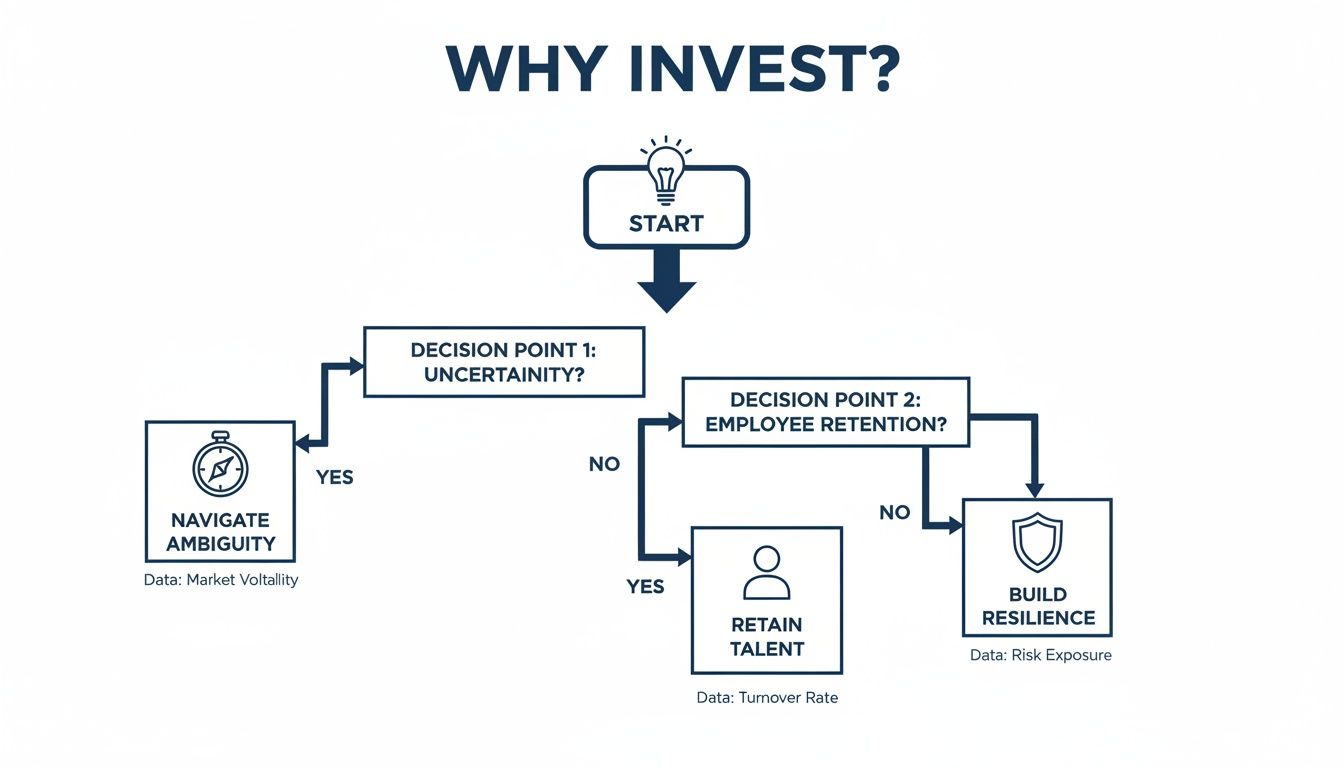
As the decision tree shows, a goal like building resilience points towards a very different kind of investment from one focused on navigating ambiguity.
Experiential and Adventure-Based Offsites
This is where leadership development gets real. We take it out of the boardroom and into a challenging, unfamiliar environment where leadership isn't just discussed—it's practised. Whether it’s navigating the Icelandic interior or managing camp logistics in Svalbard, teams face genuine consequences for their decisions, their communication, and their ability to work together.
This approach is unmatched for forging resilience, sharpening decision-making under pressure, and exposing a team’s true dynamics. It strips away corporate hierarchy, forcing people to rely on their character and competence. The lessons are deeply embedded because they are learned through doing, making this model perfect for senior teams that need to break through a performance plateau or align around a new vision.
We operate on a simple principle: competence must be built before confidence is earned. Placing leaders in an environment where they must manage genuine risk and uncertainty is the fastest way to build that competence.
To bring these differences into sharper focus, here's a quick summary of each model's key characteristics.
Comparison of Leadership Development Programme Models
The table below breaks down the primary programme types, their typical formats, and where they fit best depending on what your organisation is trying to achieve.
| Programme Model | Typical Format | Best For | Key Limitation |
|---|---|---|---|
| Classroom & Online | Workshops, lectures, e-learning modules | Disseminating theoretical knowledge and technical skills at scale | Difficulty in translating theory into real-world behaviour |
| Cohort-Based Coaching | Small group sessions over several months | Developing soft skills and building a strong peer support network | Requires significant time commitment and sustained engagement |
| Blended Programmes | A mix of online, classroom, and practical elements | Addressing diverse learning needs with a flexible, multi-faceted approach | Can feel disjointed if not properly integrated |
| Experiential Offsites | Immersive, hands-on challenges in unfamiliar environments | Forging resilience, team cohesion, and decision-making under pressure | Requires significant investment and commitment from participants |
Ultimately, the most effective executive leadership development programmes are the ones that move beyond just listening and into doing. Your choice of model should be a deliberate one, driven by a crystal-clear understanding of what you need your leaders to do differently when they get back to the office.
The Power of Practical Application
You cannot learn everything from a book.
Some leadership skills—unshakeable resilience, real team cohesion, clear-headed decisions when everything is on the line—are not absorbed in a classroom. They have to be earned through direct, hands-on experience. That’s where the real learning happens.
This is the whole idea behind experiential learning. It takes leadership development out of the abstract and into the real world. It puts teams in situations where theory gets tested, and the lessons are not just heard; they are felt. They stick.
Forged in the Icelandic Interior
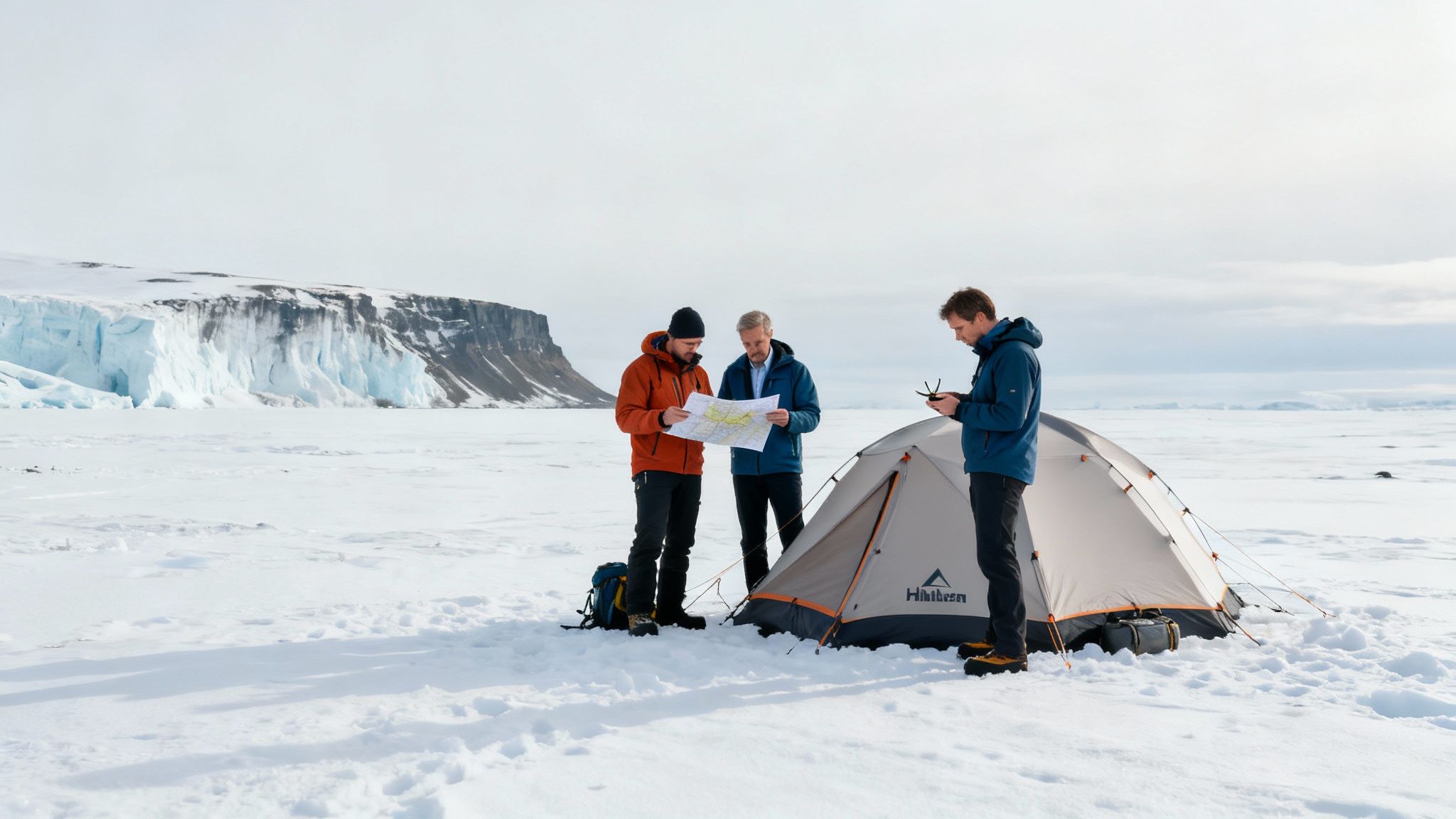
Imagine a senior management team, not in a sterile conference room, but deep in the Icelandic interior. The Pole to Pole Academy, located at 64° 25' 24" N , is a crucible for leadership. Out here, corporate hierarchies melt away. All that matters is competence, communication, and a shared will to get the job done.
The challenges are immediate and very real. This is not a simulation. When the temperature plunges to -20°C (-4°F) and your team has to set up a secure camp for the night, roles shift fast. The loudest voice in the boardroom might not be the most effective leader when it comes to putting up a Hilleberg tent in a rising gale.
This shift is intentional. We create a space where leaders must adapt their style to the immediate needs of the situation and the team. It is in these moments that true leadership character is revealed and refined.
These experiences are carefully designed to draw direct parallels to the business world. Navigating through a sudden whiteout becomes a powerful, unforgettable lesson in adapting to sudden market shifts. Every decision, from how to ration stove fuel to which route to take, has an immediate consequence, hammering home the importance of meticulous planning.
There’s a growing appetite for this kind of hands-on development. The UK executive education market is now worth USD 3.5 billion , as leaders look for practical ways to sharpen their strategic skills. This move towards experiential learning is a perfect match for the high-stakes environments where corporate teams can really test what they’re made of.
From Expedition Skills to Business Outcomes
The link between expedition skills and corporate leadership is not a stretch; it’s direct and powerful. The very same skills needed to succeed in a harsh, unforgiving environment are what define high-performing teams in any organisation.
Consider the practical applications:
- Managing Group Dynamics: Huddled in an isolated tent after a long day of skiing, honest communication isn’t just a nice-to-have. It’s essential. This builds the foundation for more open and effective dialogue back in the office.
- Decision-Making Under Pressure: When a storm front moves in faster than forecast, the team has to stay calm, assess the options, and commit to a plan. This hones the ability to make clear-headed decisions when faced with ambiguity.
- Resilience and Mindset: Skiing for eight hours whilst pulling a 45kg pulk builds more than just physical strength. It forges the mental grit to push past perceived limits and stay focused on a long-term goal.
These are not abstract theories. They are lived experiences that create lasting changes in behaviour. A leader who has successfully guided their team through a tough night on a glacier comes back to the office with a new perspective on what a "crisis" really looks like—and a deep, earned confidence in their ability to lead through it.
This is what it means to build leadership capability that actually endures. The Pole to Pole Academy’s Offsite On Purpose programmes are designed from the ground up to deliver exactly these kinds of outcomes.
Defining Objectives and Measuring Programme Success
Investing in an executive leadership programme without knowing how you’ll measure its success is like setting off on an expedition without a map. You are certainly moving, but you have no idea if it’s in the right direction.
To make sure the investment is worthwhile, you have to define what success looks like before the programme even starts. This means moving past vague goals like “improving leadership” and getting down to specific, tangible outcomes that you can tie directly back to the business. Without that clarity, even the most memorable programme is just a nice event, not a strategic tool for growth.
Establishing Clear Programme Objectives
Before you even think about looking at providers, your own leadership team needs to sit down and agree on what you’re actually trying to achieve. What specific changes in behaviour, skills, or business results do you want to see? Your goals need to be sharp and measurable.
Think in concrete terms. Are you trying to:
- Improve Team Communication: Reduce project delays between departments by a specific percentage.
- Increase Employee Engagement: See a measurable lift in your annual engagement scores.
- Accelerate Project Delivery: Shorten the average time it takes to get a project from idea to completion.
These objectives are the bedrock of your evaluation. They give you a framework to judge potential programmes against and a clear baseline to measure your return on investment later.
Key Performance Indicators to Track
Once you know your objectives, you need the right metrics to track your progress. A solid measurement plan does not just rely on numbers; it uses both qualitative and quantitative data to paint the full picture.
Qualitative Metrics:
These are about capturing changes in behaviour and perception. They often come from structured feedback and observation.
- 360-Degree Feedback: Running this before and after a programme gives you a view of a leader’s performance from their direct reports, peers, and managers.
- Behavioural Observation: Line managers can track specific, pre-agreed changes in how a leader interacts with their team and makes decisions day-to-day.
Quantitative Metrics:
These are the hard numbers that speak loudest in the boardroom. They connect the programme directly to business results.
- Promotion Rates: Track the career progression of people who went through the programme compared to those who did not.
- Staff Turnover: Measure retention rates within the teams of participating leaders. A 10% reduction in turnover in a key department can be a huge cost saving.
- Project Success Rates: Monitor how many projects led by participants are completed on time and on budget.
The real power comes from combining both. An increase in a team's project success rate (quantitative) becomes far more meaningful when it’s backed up by 360-degree feedback showing the leader has improved their ability to communicate a clear vision (qualitative).
Critical Questions for Potential Providers
With your objectives and KPIs ready, you’re in a strong position to evaluate potential partners. Your questions should be direct and focused on how their programme will help you achieve your specific goals. Get yourself armed with a checklist. You can explore our own detailed approach in our guide to Pole to Pole's performance metrics.
Ask them directly:
- Methodology: How, exactly, do your activities connect to our business objectives?
- Customisation: How will you tailor this experience to address the specific challenges of our leadership team?
- Instructor Credibility: What real-world leadership experience do your instructors have in high-stakes environments?
- Safety Protocols: What are your safety procedures and what is your track record?
- Measurement and Reporting: How will you help us measure the long-term impact of this programme once we’re back in the office?
A credible provider will welcome these questions. Their answers should be clear, confident, and grounded in experience. It will tell you everything you need to know about whether they are the right partner to deliver meaningful, lasting change.
Making the Impact Last
An intense, challenging programme is just the start. The real measure of its success isn't what happens in the field, but whether those lessons create lasting change back in the office. Without a clear plan to bring the experience home, even the most powerful moments can fade into a good story.
The true value is unlocked in the weeks and months that follow. This means thinking about the journey in three distinct phases: the preparation before you go, the experience itself, and the integration once you’re back. Each part has to build on the last to ensure the investment pays off.

Before You Leave the Office
Real implementation begins long before anyone packs a bag. This preparation is all about setting the right expectations and connecting the upcoming challenge to tangible business goals.
- Individual Goal Setting: Each leader needs to define two or three specific behaviours they want to work on. It makes the experience personal.
- Team Alignment Session: The whole group has to agree on a shared purpose. What problem are they collectively trying to solve?
- Logistical Briefing: Clear, honest communication about kit, fitness, and the environment is key. It removes anxiety and lets people focus on the real work.
During the Experience
Out in the wild, the focus shifts to action, reflection, and feedback. Facilitators are there to constantly draw parallels between immediate challenges—like navigating in zero visibility or managing group fatigue—and the pressures of the corporate world. The debriefs are constant, direct, and candid.
After the Programme Concludes
This is where it all comes together. The momentum from the expedition has to be channelled back into the organisation immediately, otherwise, it just evaporates. There is a reason the UK leadership development market is growing so fast, with a projected 9.4% CAGR . Companies know this structured follow-through is where the real value lies.
And the numbers back it up. Organisations that commit to proper development plans see a 23% lift in performance, and their best leaders are 2.4 times more likely to stick around. You can dig deeper into the trends shaping leadership development to see the full picture.
Here’s how to make sure the lessons stick:
- Post-Expedition Coaching: One-on-one sessions help leaders connect what they learned to the specific demands of their role.
- Peer Accountability Groups: Pairing participants up creates a support system for embedding new habits, with regular check-ins to keep them on track.
- Link to Performance Reviews: The behavioural changes and outcomes from the programme should be woven into formal performance management.
A Sample Offsite On Purpose Outline
To bring this to life, imagine a three-day programme in the Norwegian mountains, tracing the training routes of explorers like Roald Amundsen.
| Day | Morning Activity (08:00 - 12:00) | Afternoon Activity (13:00 - 17:00) | Evening Session (19:00 - 21:00) |
|---|---|---|---|
| 1 | Navigation skills & route planning. Focus on shared objectives and clear communication. | 10km ski with pulks. Focus on pacing, energy management, and team support. | Camp setup & stove routines. Debrief on decision-making and resource management. |
| 2 | Whiteout navigation exercise. Focus on trust, delegation, and leadership under pressure. | Emergency shelter construction. Focus on problem-solving and adapting to unforeseen challenges. | Debrief on group dynamics, feedback session, and linking field lessons to workplace scenarios. |
| 3 | Final 15km ski to extraction point. Focus on resilience and maintaining momentum. | Kit breakdown and final AAR (After Action Review). Consolidating key takeaways. | Strategy session on transferring learnings back to the organisation. Setting accountability goals. |
When every activity is designed with a purpose, you create a powerful experience that is built from the ground up for lasting impact.
Choosing the Right Partner for Your Leadership Journey
Picking a partner for your organisation’s leadership development is a high-stakes decision. Get it right, and you get deep, lasting change. Get it wrong, and you are left with a short-lived motivational buzz and not much else. The real goal is to find a provider whose entire philosophy lines up with what you are trying to achieve—someone who goes beyond transactional training to deliver a genuinely meaningful experience.
The market is crowded, but the best partners have a few things in common. You need to look past the glossy brochures and focus on the substance behind the promises. Real expertise is not just claimed; it's proven in environments where the consequences are real.
Differentiators of a Credible Provider
When you’re vetting potential partners, your questions should boil down to three non-negotiable areas. These are the things that separate the serious players from the rest and ensure you’re investing in a programme that is not just effective, but fundamentally safe and brilliantly executed.
- Instructor Expertise: Who is actually leading your team? Look for instructors with a background forged in the real world—think military special forces or professional polar exploration. People like Jason Fox or Aldo Kane understand decision-making when it truly matters. That’s a perspective you just cannot replicate in a classroom.
- Logistical Excellence: The success of any expedition lives or dies on its planning and execution. A credible provider will be completely transparent about their safety protocols, medical support, and what happens if things do not go to plan. Their logistics should be so seamless that your team can forget about them and focus entirely on the leadership challenges in front of them.
- A Proven Track Record: Ask to see case studies. Ask for references from companies that had similar goals to yours. A solid history of delivering genuine results for senior leadership teams is the clearest sign that a provider can walk the talk.
Ultimately, the best partner is one who sees the natural world as a classroom, not a battlefield. The philosophy should be about working with the environment, not fighting against it. This fosters a mindset of adaptability, respect, and quiet confidence—the true hallmarks of effective modern leadership.
By prioritising this blend of deep expertise, operational integrity, and a clear, respectful philosophy, you can confidently choose a partner to guide your team on a journey of real growth. The aim is not just to return to the office with new skills, but with a whole new perspective on what’s possible.
Questions We Hear Most Often
This is where we get straight to it, answering the honest questions leaders ask when they're thinking about investing in a high-impact development programme. We’ll cover the practical side of things: who this is for, how we keep everyone safe, and how you prove the value of it all.
Who Are These Programmes Really For?
Experiential programmes are most effective with senior leadership teams facing a specific kind of challenge. Think of a newly formed executive team that needs to build real trust, and fast. Or an established team that’s hit a wall and needs to find a new way forward. They are also incredibly powerful for organisations trying to navigate huge market shifts.
These are not for junior staff or for teaching basic technical skills. The idea is to take leaders who already have sharp business minds and drop them into a completely new environment. One where their usual habits and decision-making styles are put to the test under real pressure. That is where you see their true strengths—and the real opportunities for growth—come to the surface.
How Can You Guarantee Safety in Such Extreme Places?
Safety is the absolute bedrock of what we do. It is not just a box to tick; it’s the foundation. Without it, no real learning can happen. Our safety protocols are uncompromising, built from decades of real-world experience in military special forces and professional polar exploration.
It breaks down like this:
- World-Class Instructors: Every lead instructor comes with a deep well of experience from operating in high-stakes environments. This is not theoretical knowledge.
- Built-in Redundancy: We do not leave anything to chance. We carry multiple communication systems, from satellite phones to personal locator beacons, and have meticulously planned medical and emergency evacuation procedures.
- Kit That Works: We only use equipment that has been proven time and again in the field. Brands like Hilleberg and Fjällräven are our standard because we know they won’t fail when it matters most.
How Do We Justify the Cost and Measure the Return?
Measuring the return on this kind of investment starts long before anyone packs a bag. It begins with defining what success looks like for your business. Are you trying to cut staff turnover in a critical department? Do you need to slash cross-functional project delivery times? Or is it about lifting employee engagement scores across the board?
We work with you to lock in those specific KPIs from the start. Afterwards, we track them through a mix of hard data (like project success rates) and qualitative feedback (like 360-degree reviews).
Think of it this way: a leader who has guided their team through a simulated whiteout at -20°C (-4°F) comes back with a measurably better ability to make calm, clear-headed decisions during a corporate crisis. That's a skill with direct, tangible value you’ll see back in the office.
At Pole to Pole , we design experiences that forge resilient, adaptable leaders. We translate lessons learned in the world’s toughest environments into lasting impact for your business. Explore our "Offsite On Purpose" programmes to see how we build stronger teams.