How to Develop Mental Toughness for Any Challenge
Before you pack a pulk or check a forecast, the most important work has already begun. It happens between your ears. In polar exploration, physical fitness is merely the price of admission. The factor that will pull you through a ten-hour ski into a relentless headwind or a complete whiteout at 89° South is your mental toughness.
Mental Toughness is the Bedrock of Success
This is not the chest-beating bravado of adventure films. Real resilience is quiet and competent. It is the understated confidence of people like Børge Ousland, who prepared with meticulous detail for his solo Antarctic crossing, or Felicity Aston, who led the first all-female team across the same continent.
They did not succeed by 'conquering' nature. They succeeded because they had mastered themselves. They cultivated the internal control needed to operate effectively within it.
We don't fight nature—we live in it. This philosophy is central to our training. It shifts the focus from external dominance to internal mastery, which is the core of genuine mental strength.
This mental preparation is as tangible as choosing the right Fjällräven base layer or perfecting your stove routine. It is a set of skills you can build, test, and sharpen long before you set foot in Svalbard or the Antarctic interior.
Moving Beyond Abstract Grit
'Grit' is a popular word, but on its own, it is a fuzzy concept. How do you actually train it? At Pole to Pole, we do not leave it to chance. We break it down into skills you can practise.
- Emotional Regulation: Your ability to remain calm and think clearly when a critical piece of gear fails at -30°C. Panic is not an option.
- Sustained Focus: The discipline to keep making precise navigation checks, hour after draining hour, even when utterly exhausted and wanting only to stop.
- Problem-Solving Under Duress: Seeing a broken ski binding not as a trip-ending disaster, but as a mechanical puzzle that needs a calm, methodical solution.
- Unwavering Commitment: The deep drive that gets you out of a warm sleeping bag to face another day of hauling a 50 kg pulk across an endless expanse of ice.
These are not character traits one is born with. They are mental muscles.
Every challenge in our training programmes, whether training in Swede, trekking in arctic terrain or navigating polar regions is designed to strengthen you. The psychological pressure of a polar crossing is immense. Building this bedrock of mental toughness is the only way to be certain you are ready for what the ice truly demands.
The Four Pillars of a Resilient Mindset
To build mental toughness, you first need a working model. It is not enough to decide to be ‘tougher’; you need a map. The ‘4Cs’ model provides that map, breaking down a resilient mindset into four distinct, trainable pillars: Control, Commitment, Challenge, and Confidence .
On a polar expedition, these are not abstract ideas. They are the operating system that keeps you safe and moving forwards when every part of you is screaming to stop.
Control of Your Inner State
This is about emotional regulation. It is your ability to remain calm and think clearly when the world around you descends into chaos.
Picture this: you are skiing in a complete whiteout near the South Pole. Visibility is down to less than three metres. Panic is a natural reaction, but it is also a useless one.
Control is the practiced skill of noticing that anxiety rising, acknowledging it without judgement, and then deliberately slowing your breathing. It is about pulling your focus back to the immediate, manageable task—checking your compass, speaking clearly to your teammate, taking the next careful step. At our training center in Sweden, located at 64° 25' 24" N , we run simulations in these exact high-stress, low-visibility scenarios to build this mental muscle.
As Jason Fox, a man who understands operating under pressure, often emphasizes, "You can't control the storm, but you can control yourself." This is the essence of the first pillar.
Commitment to the Objective
Commitment is the deep-seated drive that keeps you going long after motivation has gone home.
After skiing for ten hours into a relentless, biting wind, your body is screaming for a break. The thought of spending another hour melting snow for water and forcing down a dehydrated meal can feel insurmountable.
This is where commitment kicks in. It is the non-negotiable discipline to stick to your tent routine, rehydrate properly, and prepare for the next day, because you know these small, tedious actions are what will ultimately get you to the Pole. It is a quiet, stubborn refusal to cut corners, especially when no one is watching.
The diagram below shows how mental toughness is the bedrock upon which all success is built.
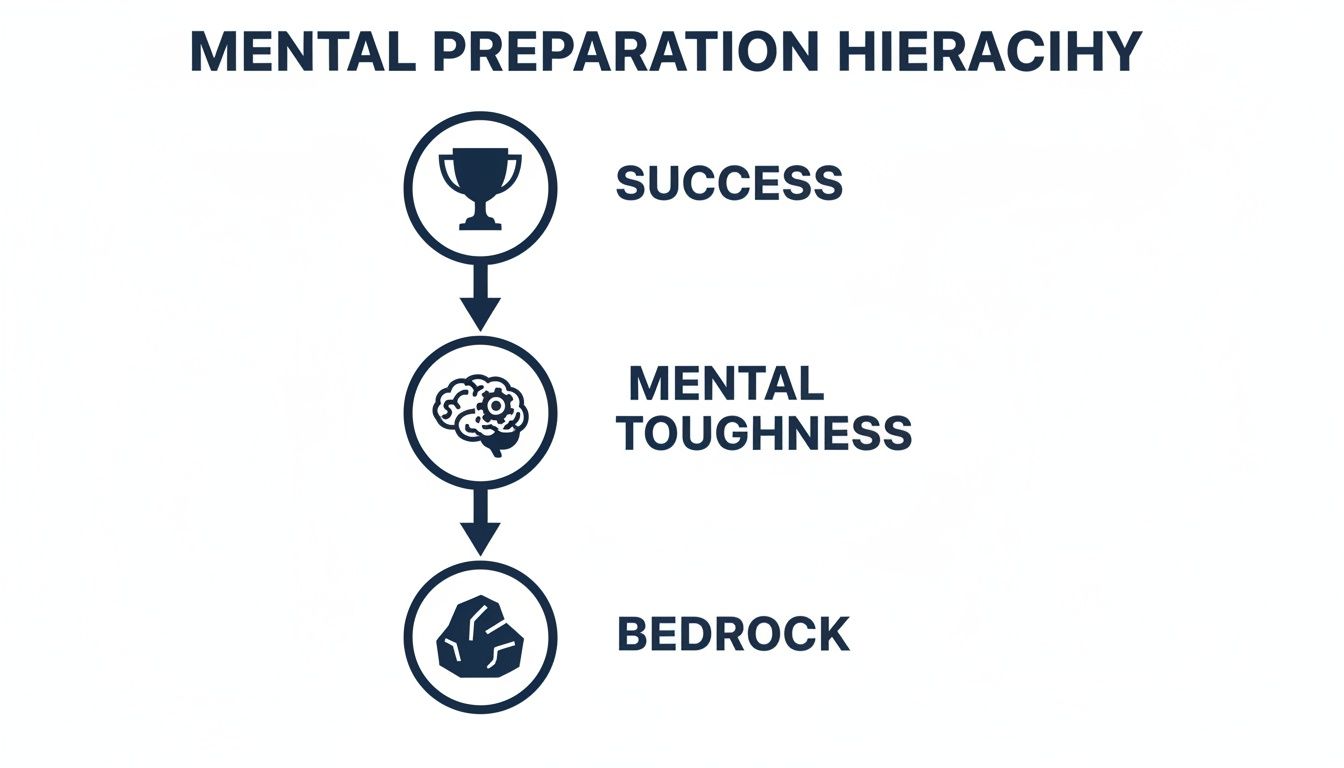
It is a simple but powerful visualisation: your mindset is the foundation for everything else you hope to achieve.
Challenge as an Opportunity
Things will go wrong. It is not a question of if , but when. A ski binding will snap, a stove will fail, or a storm will trap you in your tent for days. The third pillar, Challenge, is about how you frame these setbacks. Do you see them as disasters, or as problems to be solved?
A resilient mindset reframes a broken piece of kit from a trip-ending catastrophe into a practical test of your field repair skills. It is the ability to look at an unexpected obstacle, calmly assess your resources, and start working on a plan. This perspective is vital, because in a polar environment, your attitude has a direct impact on your survival. A key part of this is the ability to cultivate resilience when things do not go to plan.
Here is a quick breakdown of how the 4Cs play out in the field.
The 4Cs in an Expedition Context
| Pillar | Definition | Expedition Application Example |
|---|---|---|
| Control | The ability to manage emotions and thoughts, especially under pressure. | Remaining calm and methodical during a whiteout, focusing on navigation one step at a time instead of panicking. |
| Commitment | The dedication to see a goal through, despite difficulty or boredom. | Diligently completing your evening tent routine (melting snow, cooking, checking gear) after an exhausting 10-hour ski day. |
| Challenge | Viewing setbacks as opportunities for growth and problem-solving. | When a ski binding breaks, seeing it as a puzzle to solve with your repair kit rather than a reason to quit. |
| Confidence | A belief in your own ability to succeed, based on evidence and practice. | Trusting your ropework and your partner's skills whilst navigating a crevasse field, allowing you to move with focus. |
Each pillar supports the others, creating a powerful framework for enduring and succeeding in the world's harshest environments.
Confidence in Your Capabilities
The final pillar is Confidence. This is not about being arrogant or loud; it is a quiet, hard-earned trust in your training, your equipment, and your team.
When you are navigating a crevasse field in Svalbard, you need absolute faith in your rope work, your partner’s abilities, and the safety protocols you have practised a hundred times before.
This kind of confidence is forged through repetition and deliberate practice in tough conditions. You trust your layering system because you have pushed it to its limits in freezing temperatures. You trust your navigation skills because you have proven them time and again in confusing terrain. It is this earned competence that allows you to move with purpose and make clear-headed decisions when the stakes are highest.
These four pillars are not traits you are born with; they are skills you develop. Research consistently supports this. A landmark study of 9,000 pupils found that those in supportive, challenging environments scored significantly higher on the 4Cs model than the national average. This underscores a critical point: mental toughness is cultivated, not inherent. It is exactly why our training programmes are designed not just to teach physical skills, but to systematically build each of these four mental pillars.
Building Your Mental Armour Through Daily Practice
Mental toughness is not a switch you can flip the moment you step onto the ice. It is forged in the quiet, mundane moments of daily life, long before any expedition begins. Think of it as building mental armour, piece by piece, through disciplined habits that become second nature.
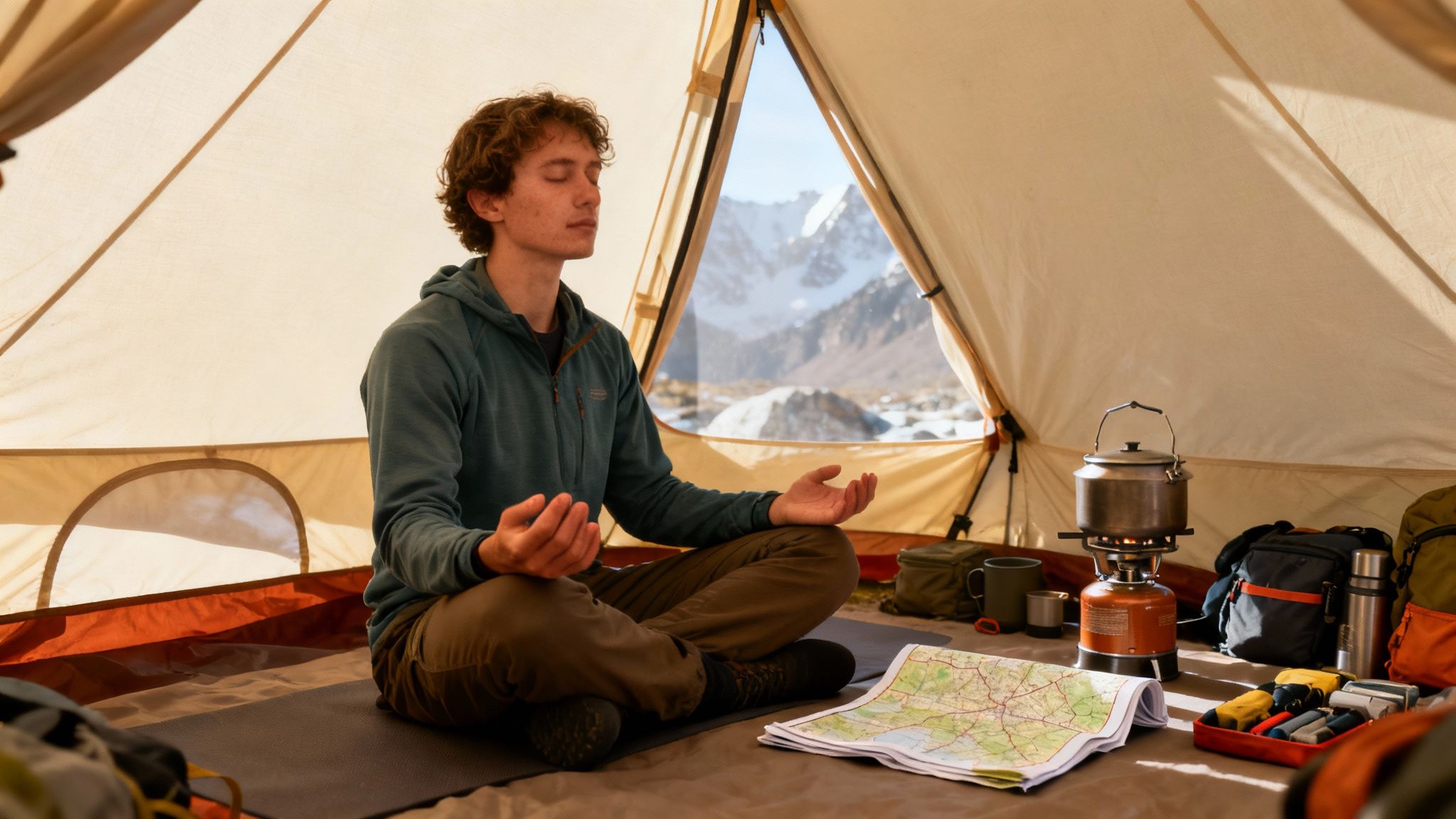
The work starts now. These are not chores; they are drills. Each one is a small, manageable exercise that builds the psychological scaffolding needed to withstand immense pressure later on.
Visualisation: The Power of Mental Rehearsal
One of the most powerful tools in our arsenal is visualisation . This is not just daydreaming about reaching the Pole. It is a detailed, multi-sensory mental rehearsal of specific actions, especially those you will need to perform under duress.
For example, do not just picture yourself at the finish line. Sit quietly for ten minutes and mentally walk through setting up your stove in a blizzard. Feel the bite of the cold on your fingertips. Hear the wind howling against the tent fabric. See the precise sequence of connecting the fuel bottle, priming the stove, and shielding the flame.
Running these mental simulations creates neural pathways that make the real actions feel familiar. When the blizzard actually hits, your brain already has a script to follow, which reduces panic and makes you far more efficient.
Breathwork: Controlling Your Physiology
Your physical state and mental state are welded together. When a sudden stressor hits—a crevasse appearing from nowhere, a teammate showing signs of hypothermia—your nervous system is going to spike. Learning to control your breath is the most direct way to manage that response.
We teach a simple but profoundly effective technique called box breathing .
- Inhale slowly for a count of four.
- Hold your breath for a count of four.
- Exhale slowly for a count of four.
- Hold the exhale for a count of four.
Practise this every day, even when you are calm. Just a few rounds can lower your heart rate and bring clarity back to your thoughts. When you have to make a critical decision, this simple drill gives you the mental space to think rationally instead of just reacting.
The Stoic Practice of Negative Visualisation
Whilst positive visualisation prepares you for action, negative visualisation prepares you for failure. This is an ancient Stoic exercise where you deliberately think through what could go wrong.
Spend time contemplating potential setbacks: a broken ski binding, a contaminated food supply, a lost GPS unit. The idea is not to dwell on disaster but to strip it of its emotional power by figuring out practical solutions ahead of time.
What is my contingency plan if my Gransfors Bruks axe handle splits? What are the immediate steps I take if my primary navigation tool fails? By confronting these possibilities in a controlled setting, you turn a vague fear of the unknown into a set of solvable problems.
This kind of proactive problem-solving builds a robust sense of competence. You start to realise that whilst you cannot control every event, you can always control your response.
The Unseen Power of Micro-Commitments
Big objectives are only ever achieved by executing small tasks with discipline. This is the simple principle behind micro-commitments —small, daily promises you make to yourself and keep without fail.
A few examples:
- Finish every workout: Even when you are tired, complete the final set. You are training the habit of pushing through discomfort.
- Stick to a cold shower routine: Voluntarily exposing yourself to discomfort proves that your mind, not your body's desire for comfort, is in charge.
- Pack your kit the night before: It is a small act of discipline that reinforces organisation and preparedness.
Each completed micro-commitment is a vote for the person you want to become: someone who is disciplined, reliable, and follows through. This foundation of self-trust is non-negotiable on an expedition. When you know you can rely on yourself in the small things, you build the confidence to handle the big ones. Research even shows that mental toughness can account for up to 27% of the variation in performance in high-stakes environments.
Stress-Inoculation Drills
The final stage is to combine these skills in stress-inoculation exercises . This is a core part of our Academy curriculum. At our Sweden training centre ( 64° 25' 24" N ), we create scenarios that replicate the pressures of a real expedition.
A timed navigation challenge in poor visibility is not just a test of map and compass skills. It is an exercise in managing the frustration and anxiety that comes with being disoriented. It forces you to use your breathwork to stay calm, rely on your disciplined processes, and make clear decisions under pressure.
By gradually increasing your exposure to controlled stress, you inoculate yourself against its effects. You learn to perform effectively not in the absence of pressure, but in spite of it. These daily drills and targeted exercises are how you truly prepare for the unknown, ensuring your mind becomes your greatest asset.
Making Sound Decisions Under Pressure
The true measure of your mental toughness is not how you feel when things are going well. It is the quality of your judgement when conditions are at their worst. A polar environment has a way of stripping away everything but the essential. In that raw space, your ability to think clearly under duress becomes the most critical piece of equipment you carry.
History is filled with case studies. Look at Shackleton’s 1,300-kilometre (800-mile) open-boat journey in the James Caird. Every decision—from setting a course to rationing water—was made under unimaginable physical and psychological strain. His success was not luck. It was the product of a mind that could maintain absolute clarity amidst chaos.
A Framework for Clarity: The OODA Loop
When stress spikes, instinct can easily scream louder than reason. To counteract this, military professionals and expedition leaders rely on structured decision-making frameworks. One of the most effective is the OODA Loop , a concept developed by military strategist Colonel John Boyd.
It is a deceptively simple, four-stage cycle that forces methodical thinking when you need it most.
- Observe: Gather raw information from your surroundings. What is the wind doing? What does the sky look like? How is my teammate moving?
- Orient: This is the most crucial step. You analyse the data in the context of your situation. It means recognising your own biases, understanding the bigger picture, and meshing new information with what you already know. That approaching cloud bank is not just a cloud; it is a sign of the potential storm system you read about in the forecast.
- Decide: Based on your orientation, you choose a course of action. We will make camp here and now , whilst we still have good visibility.
- Act: You execute that decision. Start setting up the Hilleberg tent immediately.
This cycle is continuous. The moment you act, you are immediately observing the results of that action, and the loop begins again. It pulls you out of a reactive, panicked state and puts you firmly back in control. For more on this, you can explore how to lead with confidence even when your nervous system says no.
Determination Versus Stubbornness
There is a fine line between determination and stubbornness. A polar environment is an unforgiving place to learn the difference.
Determination is about pushing through extreme discomfort to achieve a rational, calculated objective. Stubbornness is clinging to an original plan when all the evidence screams that it is no longer viable.
Knowing when to turn back is not a sign of weakness; it is a mark of superior judgement. A successful expedition is one you come home from. This is a non-negotiable principle we instil in all our teams.
Making the call to abandon a summit attempt or cut a day’s travel short because of deteriorating conditions is often the hardest decision a leader can make. It requires you to subordinate your ego to an objective risk assessment. It means admitting that the conditions, not your willpower, have the final say.
This is a skill one must practise. It involves constantly asking, "What does the evidence tell me?" rather than "What do I want to be true?" It is a mental discipline that separates seasoned professionals from cautionary tales.
These same principles—risk assessment, clear communication, and decisive action—are the cornerstones of our ‘Offsite On Purpose’ corporate leadership programmes. The context might change from a glacier to a boardroom, but the fundamentals of how to make sound decisions under pressure remain exactly the same. The ability to maintain mental clarity in extreme environments is a transferable skill that defines effective leadership, anywhere.
Forging a Mentally Tough Team
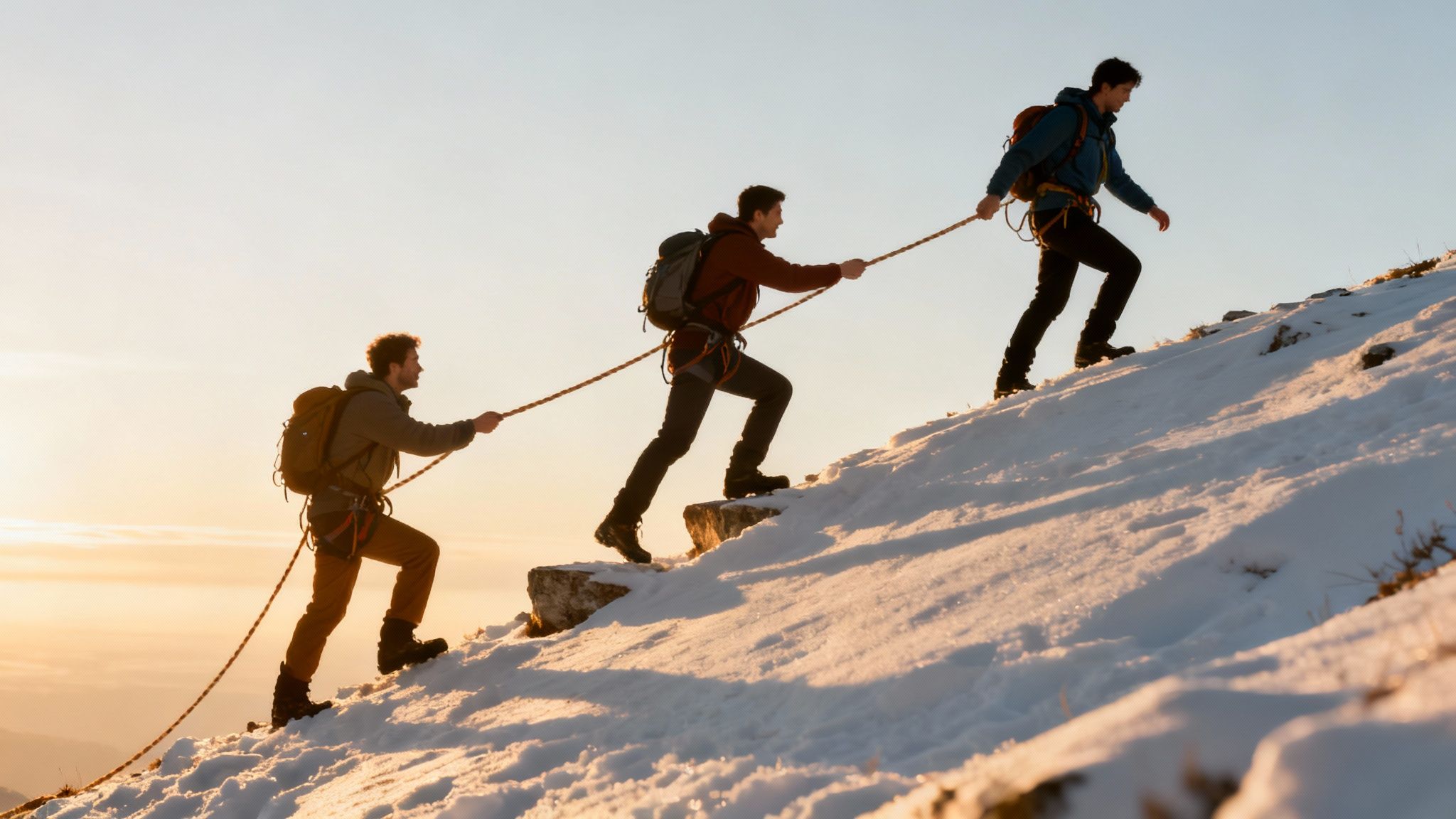
When you are roped up and crossing a crevasse field in Svalbard, individual resilience only gets you so far. The real test is the collective strength of the group.
One person’s poor attitude or a simple communication breakdown can have catastrophic consequences for the whole team. It is the weak link in the chain that always breaks first.
The intense, isolated world of an expedition amplifies every friction. A minor annoyance you would brush off at home can fester into a serious problem out there. That is why we build mentally tough teams , not just tough individuals.
The Power of Proactive Protocols
You cannot just hope for the best when it comes to team dynamics. Hope is not a strategy.
Resilient teams are built on clear, pre-agreed protocols. These are not about restricting freedom; they are about minimising the small frictions that drain energy, so everyone can focus on the bigger goal.
From day one, we establish simple but non-negotiable routines:
- Standardised Tent Routines: We lock in a precise sequence for everything inside the tent. Who melts snow first, how kit is stored, where things live. This eliminates a huge source of daily conflict and makes life more efficient.
- Structured Communication Windows: We set aside specific times for check-ins and debriefs. It ensures everyone is in the loop but also gives people the headspace they need. No one is exhausted from constant, unstructured chatter.
- Conflict Resolution Framework: We agree on a simple way to air grievances directly and respectfully. It is usually about committing to listen without interruption and focusing on the problem, not the person. These things need to be addressed before they escalate.
These structures are the scaffolding that holds a team together when fatigue starts to set in.
Creating a Culture of Open Feedback
On an expedition, silence can be lethal.
A teammate not admitting their foot is getting cold, or a navigator feeling uncertain but remaining quiet—these things put the whole group at risk. A mentally tough team creates a culture where honest feedback is not just accepted; it is expected.
This comes down to trust. It starts with leaders showing vulnerability, admitting their own mistakes, and asking for input. It is reinforced by small things, like thanking someone for pointing out a potential hazard. The goal is to make it safe for anyone to raise a red flag.
An expedition team is a closed loop. The energy and morale of each person directly affects everyone else. Small acts of support—making a hot drink for a teammate, helping with a difficult task without being asked—are not just kind gestures. They are critical investments in the team's collective mental bank account.
Recognising and Managing Mental Fatigue
You must learn to spot the signs of mental fatigue in your teammates, just as you would watch for signs of frostbite. The indicators can be subtle, but they are often the first warning of a deeper issue.
Look for changes in behaviour:
- Someone who is usually chatty becomes withdrawn and quiet.
- Uncharacteristic irritability over minor things.
- A drop in personal admin—fumbling with simple tasks like packing their pulk.
When you see these signs, the response must be supportive, not critical. It is about opening a door. "You seem a bit off today. Is everything alright?" This kind of proactive support can stop a small problem from spiralling.
The psychological strain of expedition life is immense, and building collective resilience is the only real defence. This is not unique to expeditions. A Mental Health Foundation survey found that over four in ten adults in Great Britain have experienced depression. Mentally tough people are better equipped for that adversity, and on a team, that trait must be collective.
This focus on team resilience is a central pillar of the training we provide at The Pole to Pole Academy. We do not just build explorers; we build cohesive, high-performing teams ready for anything.
Questions on Mental Toughness
Theory is one thing; reality on the ice is another. People often have questions when the abstract concept of 'mental toughness' meets the practical demands of a high-stakes environment. These are the operational truths we have learned leading teams in some of the most unforgiving places on Earth.
Can This be Trained?
Absolutely. There is a myth that mental toughness is an innate trait—you are either born with it or you are not. That is wrong.
Think of it like physical strength. It is a skill you develop systematically through consistent training, deliberate practice, and controlled exposure to stress. Our entire philosophy at Pole to Pole is built on this.
We use structured drills and stress-inoculation scenarios—think Svalbard in the depths of winter—to progressively build the '4Cs': Control, Commitment, Challenge, and Confidence. It is strength conditioning for the mind. You start with manageable loads and gradually increase the intensity, forcing your mind to adapt and grow stronger.
How is it Measured?
You do not measure progress by how you feel. You measure it by how you perform when things get tough. It is about observable behaviour, not internal mood.
We look for tangible indicators of improvement:
- Better emotional regulation when a critical piece of gear fails at -25°C.
- Rock-solid consistency in daily routines (tent admin, navigation checks) even when you are exhausted.
- A shift in perspective , where what was once a 'threat' is now just a logistical problem to be solved.
- Sharper decision-making in ambiguous situations, like reading deteriorating weather patterns on the horizon.
On our training expeditions, we give direct, specific feedback on these behaviours. We watch how someone handles a navigation drill in a complete whiteout or how they manage their personal admin after a long day on skis. That observable improvement is the only metric that matters.
What is the Most Important Habit for Resilience?
If I had to boil it down to a single habit, it would be this: embrace voluntary hardship .
It means consistently choosing to do the hard thing in your daily life, especially when you do not have to. Take a cold shower. Do the workout when you have zero motivation. Tackle your most difficult task first thing in the morning.
Every time you deliberately choose discomfort over comfort, you are laying the psychological groundwork for handling the involuntary hardships of an expedition, where comfort is not an option.
This practice recalibrates your baseline for what you consider "hard." It trains your mind to accept and operate within difficult conditions, which is the essence of resilience.
How is Solo Mental Toughness Different from Team Resilience?
They are two different things entirely.
For a solo explorer like Børge Ousland, mental toughness is a deeply internal battle. It is about self-discipline, the dialogue inside your own head, and finding motivation in total isolation. The entire psychological load rests on one person's shoulders.
Team resilience is about managing complex human dynamics under extreme stress. It requires sharp communication, empathy, and the ability to put your ego aside for the good of the group.
Whilst both require the core 4Cs, a solo traveller's sense of 'Control' is purely internal. For a team member, 'Control' also means managing your reactions and impact on others. A strong team can be an incredible source of mutual support—a lifeline the solo explorer does not have. A dysfunctional team can become a source of stress far greater than any blizzard.
At Pole to Pole , we do not just take you on trips; we build the mental and physical competence you need to thrive on them. Whether you are preparing for your first polar journey or leading a corporate team through a challenge, our programmes are designed to forge genuine resilience.
Explore your possible and see our upcoming expeditions at https://www.poletopole.com.