How to Overcome Fear of Failure: An Expedition Leader's Guide
To overcome the fear of failure, you must first stop seeing it as an ending. It is not. It is critical data, gathered on a difficult journey. The process involves looking honestly at your specific triggers, building psychological resilience through deliberate practice, and learning to treat setbacks as navigable terrain, not impassable walls.
The Unseen Crevasse in Modern Ambition
Imagine standing on the edge of a vast crevasse field in Antarctica. The way forward is a lattice of shifting ice and uncertain snow bridges.
That moment—where a single misstep means tangible, immediate failure—mirrors the psychological landscape so many of us navigate in our professional and personal lives. The fear you feel is real, valid, and protective. But it is not a signal to turn back. It is a signal to prepare with greater focus.
This guide is about overcoming the fear of failure by applying the practical, field-tested mindset of a polar explorer. We will move past abstract advice and get into the specific drills and mental routines used to manage risk in the world's harshest environments. The principles needed to cross a glacier are directly applicable to launching a business or leading a team through high-stakes uncertainty.
A National Headwind
This is not just a personal quirk; it is a significant cultural and economic headwind. In the UK, fear of failure has become a primary barrier to innovation.
New research from the think tank Onward reveals that 53 per cent of British workers aged 16-64 now cite this fear as the main reason for not starting a business. That is a sharp increase from 44 per cent in 2019 and just 35 per cent in 2016. It shows a growing aversion to risk that kills potential long before any expedition—or project—even begins.
"We don't fight nature — we live in it." This is a core part of our philosophy at Pole to Pole. The same applies to fear. The goal is not to conquer it, but to understand its mechanics, respect its power, and learn to operate skilfully in its presence.
Navigating the Internal Whiteout
We need to reframe this fear. It is not a weakness, but a natural human response that can be understood, managed, and even channelled.
The internal confusion and paralysis caused by the fear of failure feels much like navigating in a whiteout. Your senses are unreliable, your perception of distance is gone, and every single step feels fraught with peril.
You do not just push blindly on. Instead, you fall back on proven systems and core skills:
- Trusting your instruments: You learn to rely on objective data and established processes, not just how you feel in the moment.
- Shortening your focus: You concentrate on the immediate next step, not the overwhelming distance to the final objective.
- Clear communication: You maintain honest, open dialogue with your team to share the cognitive load.
By applying these expeditionary principles, you can turn a vague, paralysing dread into a set of specific, manageable challenges. This guide will show you how to build the skills to navigate that internal whiteout, one deliberate step at a time. A great place to start is exploring what adventure teaches us about limiting beliefs.
Diagnosing Your Personal Fear Signature
To overcome a fear of failure, you first have to give it a name. An address. Treating it as a single, overwhelming force is like trying to navigate a glacier without a map—you have no specific features to orient yourself against.
Fear is rarely a monolith. It is a collection of highly specific anxieties, and an explorer must first assess the terrain before choosing a route.
Before you can build the right strategy, you have to conduct an honest self-assessment. The goal here is to move past the generic label of “fear of failure” and pinpoint your unique triggers. Is your hesitation rooted in the practical risk of financial loss? The social sting of judgement? Or a deeper sense of personal inadequacy? Only by breaking down a vague emotion into a set of specific, manageable problems can you begin to solve them.
From Vague Fear to Specific Problems
During debriefs on our training courses in Svalbard, we find that what people initially call a fear of failure is often one of several distinct concerns. Pushing past the general term is the first critical step.
Real progress begins when "I'm afraid to fail" becomes "I'm concerned about letting the team down if my navigation is off."
This process requires the same clear-headed honesty you would need when assessing dwindling fuel supplies or changing weather conditions on the ice. It is not an emotional exercise; it is a logistical one. Start by asking yourself: if this venture were to fail, what is the single outcome I dread the most?
This simple decision-making framework channels the expedition mindset when you encounter a challenge that triggers this fear.
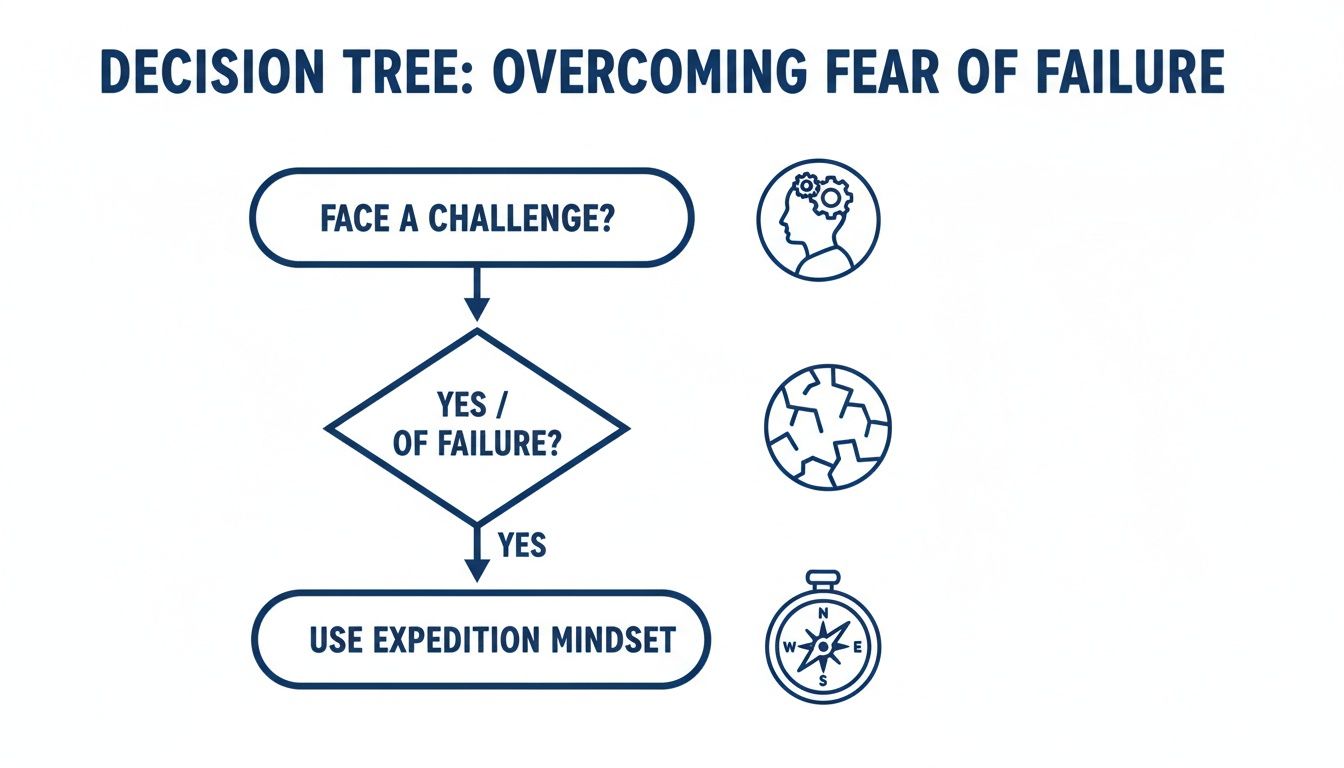
The flowchart visualises the key pivot point: acknowledging the fear and then consciously choosing to apply a structured, expedition-based mindset instead of reacting emotionally.
Mapping Your Fear Triggers
To help you get specific, we have developed a diagnostic tool. Think of it as mapping your personal terrain—identifying the specific hazards that cause you to hesitate. By understanding the landscape of your fear, you can plan a much more effective route forward.
Mapping Your Fear Triggers: An Expeditioner's Diagnostic Tool
| Fear Domain (The Terrain) | Specific Trigger (The Hazard) | Common Internal Monologue (Radio Chatter) | Practical First Step (Route Adjustment) |
|---|---|---|---|
| Reputation & Social Standing | Fear of public judgement or embarrassment from peers and colleagues. | "Everyone will think I'm incompetent if this does not work. I'll lose their respect." | Identify one trusted peer and share your plan and your specific concern with them. |
| Competence & Self-Worth | Fear that failure will confirm a deep-seated belief of personal inadequacy. | "If I cannot do this, it proves I am not good enough. I have been faking it all along." | List three past accomplishments that required you to learn a new, difficult skill. |
| Financial Security | Fear of losing money, investment, or jeopardising your financial stability. | "This is too big a risk. If it fails, I could lose everything I have worked for." | Calculate the smallest possible financial risk you can take to test your idea. |
| Perfectionism | Fear that the outcome will be flawed or fall short of impossibly high standards. | "It is not ready yet. If I cannot execute this perfectly, there is no point in even starting." | Set a non-negotiable deadline to complete just the first 10% of the project. |
Using a tool like this helps you do the essential work of breaking an overwhelming fear into its component parts. Each part has a size, a shape, and a location. And anything that can be mapped can be navigated.
This diagnostic process is not about dwelling on the negative. It is an act of reconnaissance. Acknowledging a crevasse on a map does not make it more dangerous; it makes it manageable. You can now plan to go around it, bridge it, or rope up to cross it safely.
This is the foundation of the expeditionary mindset and the first concrete step towards mastering your fear of failure.
Building Psychological Resilience: The Core Training
Mental preparation is not some abstract concept. It is a series of drills, repeated until they become automatic—just like practising tent routines in high winds or learning to pack a 50kg pulk for the best possible balance. Once you have diagnosed your specific fears, it is time to build the psychological muscle to manage them. This is the core training.
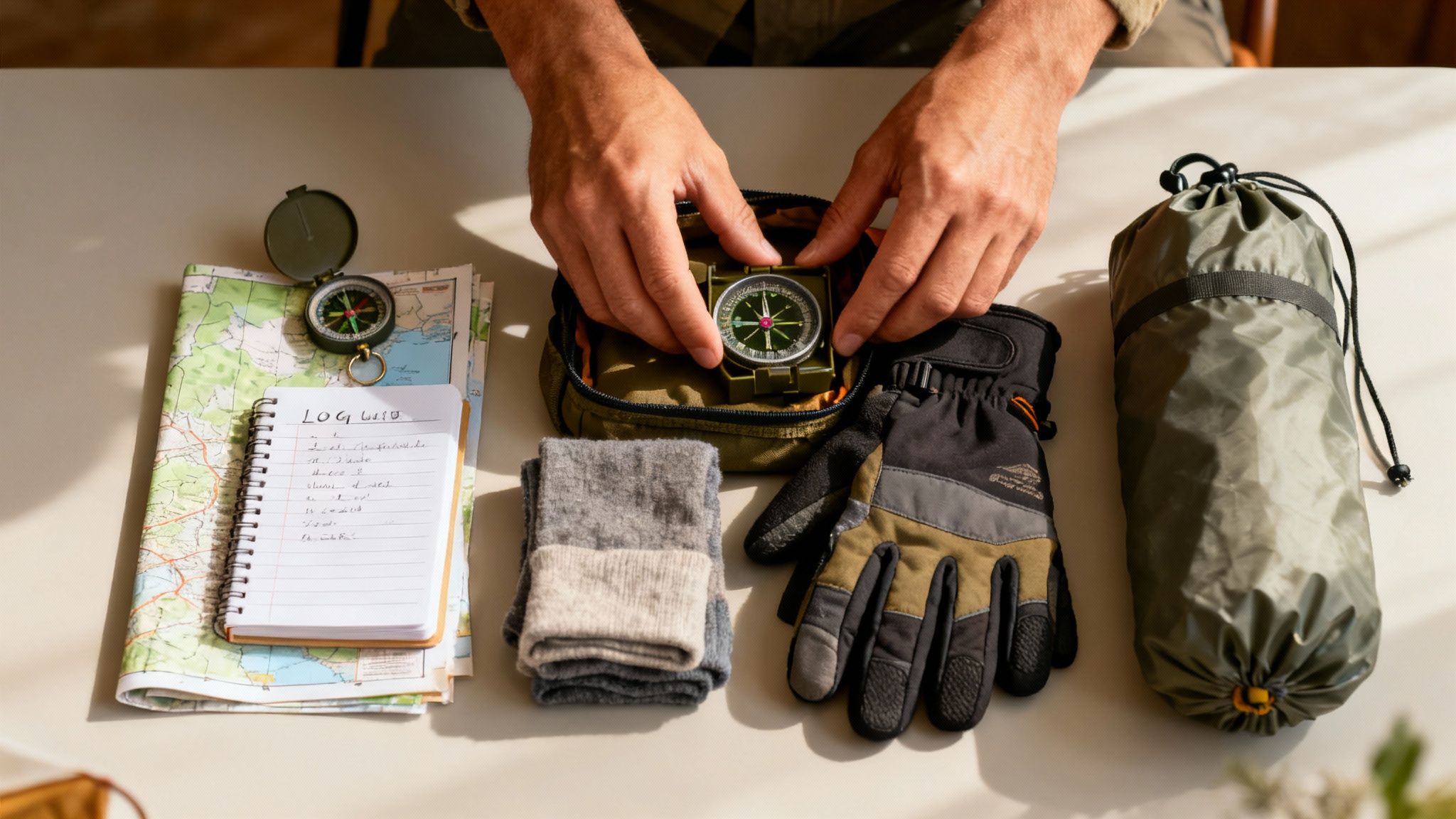
The real work does not start on the ice; it starts inside your own head. We focus on two fundamental expedition skills: cognitive reframing and structured visualisation. Think of these as the tools you use to recalibrate your internal compass.
Cognitive Reframing: Redefining The Data
The single most powerful shift you can make is to stop labelling outcomes as "success" or "failure." An expeditioner does not fail; they gather data. A route that proves impassable provides crucial information for the next attempt. A stove that malfunctions at -25°C teaches a hard lesson about fuel viscosity that prevents a future catastrophe.
This is not just playing with words. It is a fundamental change in how you process experience, moving it from the emotional centre of your brain to the analytical one. Every outcome, expected or not, becomes just another valuable data point.
Start adopting this language, both in your own head and in your team debriefs:
- Instead of, "We failed to reach the waypoint," try, " We gathered data showing this route is inefficient in these conditions. "
- Instead of, "My presentation was a disaster," reframe it as, " The data shows my communication approach was not effective for this audience. "
This methodical approach strips the emotional charge from setbacks. It lets you analyse and adapt without being paralysed by judgement—a critical discipline for anyone serious about overcoming fear. Part of this is learning to rebound effectively, much like how athletes learn to mentally recover after setbacks.
Structured Visualisation: The Amundsen Method
Roald Amundsen’s success in reaching the South Pole was not an accident. He spent countless hours on the Hardangervidda plateau in Norway, meticulously rehearsing the entire expedition in his mind. This was not daydreaming; it was structured, procedural visualisation.
He mentally walked through every single routine: navigating in a whiteout, repairing a broken ski binding with frozen fingers, managing rations down to the last biscuit. By the time he set foot in Antarctica, he had already ‘lived’ the expedition a dozen times over.
To use this method yourself, break your goal into its component parts and visualise the process , not just the prize at the end.
- Identify a critical phase: A tough negotiation, a key technical climb, or a challenging leg of a journey.
- Visualise the routine: Mentally rehearse the specific, sequential actions needed. See yourself calmly setting up your Hilleberg tent as the wind starts to pick up. Feel the motions.
- Introduce problems: Now, visualise something going wrong. A key piece of equipment fails, a team member disagrees with the plan, the weather turns. Mentally work through your response protocol, calmly and methodically.
This practice builds the neural pathways that make your response more automatic under real-world pressure. When the situation finally arises, it feels familiar, not terrifying. You have already solved the problem.
Building Empirical Evidence Against Self-Doubt
Fear loves a vacuum. It thrives on a lack of concrete evidence of our own capability. This is especially relevant when we look at the confidence gap between men and women, which research consistently shows is not linked to actual competence.
For instance, a 2023/24 GEM report highlighted that in the UK, 63 per cent of women would not start a business due to fear of failure, compared to just 44 per cent of men. That disparity exists despite equal ambition and skill.
The most effective way to counter this is to build a personal dossier of empirical evidence. Controlled exposure to challenging environments provides undeniable proof of competence. When you have successfully navigated with just a map and compass or managed a difficult team dynamic, your internal monologue of self-doubt has to contend with hard facts.
This principle is absolutely central to our training philosophy. Each skill mastered, from stove operation to crevasse rescue drills, becomes another piece of evidence. It is a systematic process of replacing fear-based assumptions with competence-based certainty. You can learn more about our approach to harnessing physical and mental challenges to build true resilience.
Graded Exposure and Deliberate Practice
Theory is one thing; putting it under pressure is how you forge a real skill. On an expedition, we do not build competence by reading about arctic conditions. We get out there and methodically expose ourselves to them in a controlled, progressive way. This exact principle is the most powerful tool for dismantling the fear of failure, no matter the context.

This approach is called graded exposure. It is all about breaking down a daunting objective into a series of smaller, more manageable steps, each with a calculated and survivable level of risk. A cornerstone of this practice is exposure therapy, where you gradually and deliberately confront situations that trigger your apprehension.
The goal is not to court disaster. It is to create a feedback loop where small, contained 'failures' produce learning, not catastrophe.
Designing Your Micro-Expeditions
Think of a micro-expedition as a low-stakes mission designed purely to build your tolerance for things not going to plan. It is a chance to test your skills and mindset in an environment where the consequences of an error are minimal. You are not trying to succeed; you are trying to gather data on what you can handle and recalibrate your response to the unexpected.
These are not grand, sweeping gestures. They are small, intentional acts of practice.
- For the aspiring adventurer: Do not plan a multi-day trek straight away. Instead, tackle a short, local trail in poor (but safe) weather. The goal is not to enjoy the walk, but to test your layering system, practise navigation when landmarks are obscured, and manage your own morale when you are feeling uncomfortable.
- For the corporate leader: Delegate a task you would normally control down to the last detail. Give your team member the objective but not the precise method. The 'failure' might simply be that the result looks different from how you would have done it, not that it is wrong. The real learning is in trusting your team and accepting different ways of working.
Competence is the antidote to fear. Each small, successful exposure provides a piece of hard evidence that you can handle more than you believe. This is the core training philosophy at the Pole to Pole Academy, located at 64° 25' 24" N in Swedens interior. We do not begin in a blizzard.
Progressive Skill Building in Practice
Our training programmes are built on this exact principle of progressive loading. We start by teaching trainees how to assemble a Hilleberg tent in calm, daylight conditions. Once that becomes second nature, we add layers of complexity. Do it with heavy gloves on. Now do it at night. Now do it in a simulated blizzard with manufactured urgency.
Each stage introduces a new, potential point of failure. A dropped pole in the snow, a tangled guyline, a flicker of frustration. But because the environment is controlled, every mistake becomes a practical lesson, not a full-blown crisis. This incremental approach builds not just skill, but a deep-seated confidence that is earned through action, not just talked about.
This systematic process is critical. Our guide to training for the unknown details exactly how we apply this philosophy to both physical and mental preparation.
By the time our teams face genuinely high-stakes situations, they have a whole library of successfully managed micro-failures to draw upon. They know they can handle things going wrong because they have done so, repeatedly, in training. This transforms fear from a paralysing unknown into a familiar set of problems for which they have practised the solutions. Your own journey to overcome the fear of failure should be no different from this.
How to Lead a Team When Everything Is on the Line
Whether you are guiding a team across an Antarctic plateau or through a critical corporate project, the psychology is the same. The principles do not change just because the landscape does. A leader’s job is not to prevent every mistake. It is to build a team so competent, so resilient, and so trusting that it can take a hit, learn from it, and get stronger.
Fear of failure is not just a personal feeling; it has a real, measurable economic impact. In the UK alone, fearful leadership styles are estimated to cost £2.2 billion in lost productivity every year. The research is stark: 88 per cent of fearful leaders are constantly worried about being wrong, and nearly half do not trust their own people to handle things without them. This does not drive performance; it creates a culture of paralysis. You can read the full research about fearful leadership styles to get the complete picture.
The antidote? A leader who intentionally builds genuine psychological safety.
Normalise Failure with Brutally Honest Debriefs
The single most powerful tool for forging a resilient team is the after-action review. The debrief. After every significant phase of a project or mission—good or bad—the team needs to dissect what happened, without finger-pointing.
The structure is simple and it never changes:
- What did we set out to do?
- What actually happened?
- Why was there a difference?
- What do we keep doing, and what do we change?
This is not a forum for blame. It is a sterile, data-driven process designed to wring every last drop of learning out of every action. When a leader runs one of these honestly, especially after their own plan went sideways, the message is crystal clear: mistakes are not a sign of incompetence. They are a source of vital intelligence.
Lead from the Front: Vulnerability Forges Trust
Trust is the currency of any high-performing team. In tough environments, it is not built on a leader’s flawless record. It is built on their integrity.
Ambassadors for Pole to Pole, like former special forces operators Jason Fox and Jordan Wylie MBE , talk openly about their failures. They understand that admitting a navigation error or a poor tactical call does not make them look weak.
It does the opposite. It strengthens their authority. It shows the team they are human, that they value truth over ego, and that no one is above the process of getting better. This creates the safety for everyone else to do the same, unlocking a feedback loop that fear would otherwise choke.
A leader's job is not to have all the answers. It is to create an environment where the best answers can surface. That means giving your people real autonomy and trusting them to deliver.
Empower Your Team with Genuine Autonomy
Micromanagement is a flashing red light. It is a symptom of a leader’s own fear of failure, broadcasting a deep-seated lack of trust in their team’s ability.
True empowerment means handing over responsibility and the authority that goes with it.
On an expedition, you trust the navigator to navigate and the medic to handle medical issues. You do not stand over their shoulder second-guessing them. In the office, it means defining the objective and the boundaries, then stepping back and letting the experts you hired figure out the best way to get there.
When people feel trusted and have ownership of their role, their entire focus shifts. They stop worrying about avoiding blame and start concentrating on achieving the mission. They become more engaged, more innovative, and far more resilient when things inevitably go wrong. That is how you build a team that does not just survive uncertainty—it thrives in it.
Answering Your Questions on the Fear of Failure
As you start putting these ideas into practice, some questions are bound to come up. These are the ones we hear most often on our training programmes, and I will answer them with the same directness we use in an expedition briefing.
What Is the Difference Between Healthy Caution and Debilitating Fear?
This is a critical distinction. Healthy caution is your ally; debilitating fear is a saboteur.
Think of it this way: healthy caution is based on an objective assessment of risk, and it pushes you towards better preparation. It is the voice in your head that says, “double-check the coordinates,” or “let us inspect that climbing rope one more time.” It is data-driven, rational, and it genuinely improves your chances of success.
Debilitating fear, on the other hand, is almost always rooted in subjective anxieties. It is about ego, identity, or what other people might think. It does not lead to better prep; it leads to paralysis.
A cautious decision to turn back from a summit is based on hard facts like worsening weather or a tired team member. A fear-based decision is driven by a panicked inner monologue about looking like a failure. One is sound expedition practice, the other is a mindset trap.
What Is the Single Most Effective Daily Practice for Building Resilience?
Keep a 'failure debrief' journal. Simple, powerful, and non-negotiable for building a resilient mindset.
Every evening, just five minutes. Write down one small thing from your day that did not go to plan. It could be a minor navigation mistake on a training hike, a miscommunication with a colleague, or a task you fumbled.
Then, you run a quick after-action review, just as we would in the field:
- The Plan? (e.g., Finish that report by 15:00 .)
- What Happened? (e.g., It was done at 17:00 .)
- The Gap? (e.g., I completely underestimated how long the data collation would take.)
- Next Time? (e.g., Block out an extra hour specifically for the data work.)
This simple, consistent habit is transformative. It reframes small setbacks, turning them from emotional hits into valuable data points you can learn from. It is a core expedition skill that systematically desensitises you to the sting of imperfection.
How Do I Manage Fear of Failure When Working in a Team?
When you are in a team, fear loves ambiguity. The antidote is relentless clarity, especially in two key areas: capabilities and roles.
First, you have to build a culture where it is safe to be honest about skills. Before the expedition or project kicks off, be transparent about individual strengths and—crucially—where people need support. This kills the fear of being 'found out' and allows the team to build a solid plan that accounts for reality, not ego.
Second, make sure every single person's role and responsibilities are crystal clear. Fear thrives in those grey areas where people are not sure what is expected of them or they are worried about stepping on someone else's toes. A well-defined role is a solid platform to operate from with confidence.
An expedition team is not a group of people who never make mistakes. It is a group of specialists who trust each other's expertise and have clear protocols for when things go wrong. Trust and clarity are the antidotes to collective fear.
Is It Possible to Completely Eliminate the Fear of Failure?
No, and you should not want to. The goal is not elimination; it is management. Fear is a vital survival signal, hardwired into our biology over millennia to alert us to genuine risk.
Experienced explorers like Ranulph Fiennes or Børge Ousland do not lack fear. What they have is a highly developed and functional relationship with it. They have spent decades training themselves to separate the signal from the noise.
This entire process of building resilience is about recalibrating your internal compass. You are learning to quieten the irrational, paralysing fears (like social judgement or perfectionism) so you can clearly hear the rational, protective ones (like objective danger or dwindling resources). The fear itself is not the enemy. Your relationship with it is what determines everything.
At Pole to Pole , we believe that developing this relationship with fear is the key to unlocking what is possible. Our expeditions and training programmes are designed to give you the tools and the direct experience needed to turn apprehension into action. Explore our signature challenges and start your journey today.