How to Travel to Antarctica: An Expedition Leader's Guide
Thinking about a trip to Antarctica is not like booking a two week holiday in the sun. It is about preparing for an expedition.
For almost every journey to the continent, you will either leave by expedition ship from Ushuaia, Argentina , or fly to an interior base camp from Punta Arenas, Chile , for a land based expedition. These two gateways are the starting line for nearly all Antarctic travel.
Your First Step Towards The Ice
This guide cuts through the marketing fluff to give you a realistic, practical look at what it takes to get to the world's last great wilderness. It is based on decades of polar experience, giving you the kind of straightforward advice you would expect from an expedition leader briefing their team.
We will break down how you actually get to Antarctica, from ship based voyages to deep field ski expeditions. It is all about understanding what each option demands, physically, mentally, and financially so you can choose the right path.
An Antarctic journey is a serious undertaking. Success is not about grand gestures; it is about quiet competence and diligent planning long before you ever see the ice.
Setting Realistic Expectations
An expedition to the continent is a major commitment of time, training, and money. It is a world away from a typical holiday.
- Financial Commitment: Costs can start at around £8,000 for a basic peninsula cruise and climb to over £50,000 for something like a guided Last Degree ski expedition.
- Time Investment: The planning process alone can take one to two years. This involves physical training, sorting out logistics, and getting a spot on a reputable programme.
- Physical Preparation: Even on a ship, you need a good level of fitness to get the most out of it. For any overland travel, a dedicated and specific training regime is completely non-negotiable.
Antarctica demands respect. It is not a destination to be conquered, but an environment to be understood and lived within. Your preparation reflects this understanding and is the true first step of your expedition.
The journey does not start at the port. It begins in the months, sometimes years, of planning that come before. If you are leaning towards a land based route, it is vital to understand the role of your departure point. We have put together a dedicated article on Punta Arenas, the gateway for many deep field expeditions, to give you the full picture.
Choosing Your Method of Antarctic Travel
The phrase ‘travel to Antarctica’ can mean a thousand different things. Before you go any further, the first and most critical decision is defining what visiting the white continent actually means to you.
Is it watching whales breach from the deck of a ship on the Peninsula? Or is it the deep, quiet commitment of a human-powered crossing? This is not about picking a holiday package; it is about aligning your personal ambition with the stark realities on the ice. The decision you make here will shape everything that follows.
The path you take is fundamentally tied to your appetite for physical challenge and logistical commitment. These factors, in turn, dictate the cost and duration of your journey.
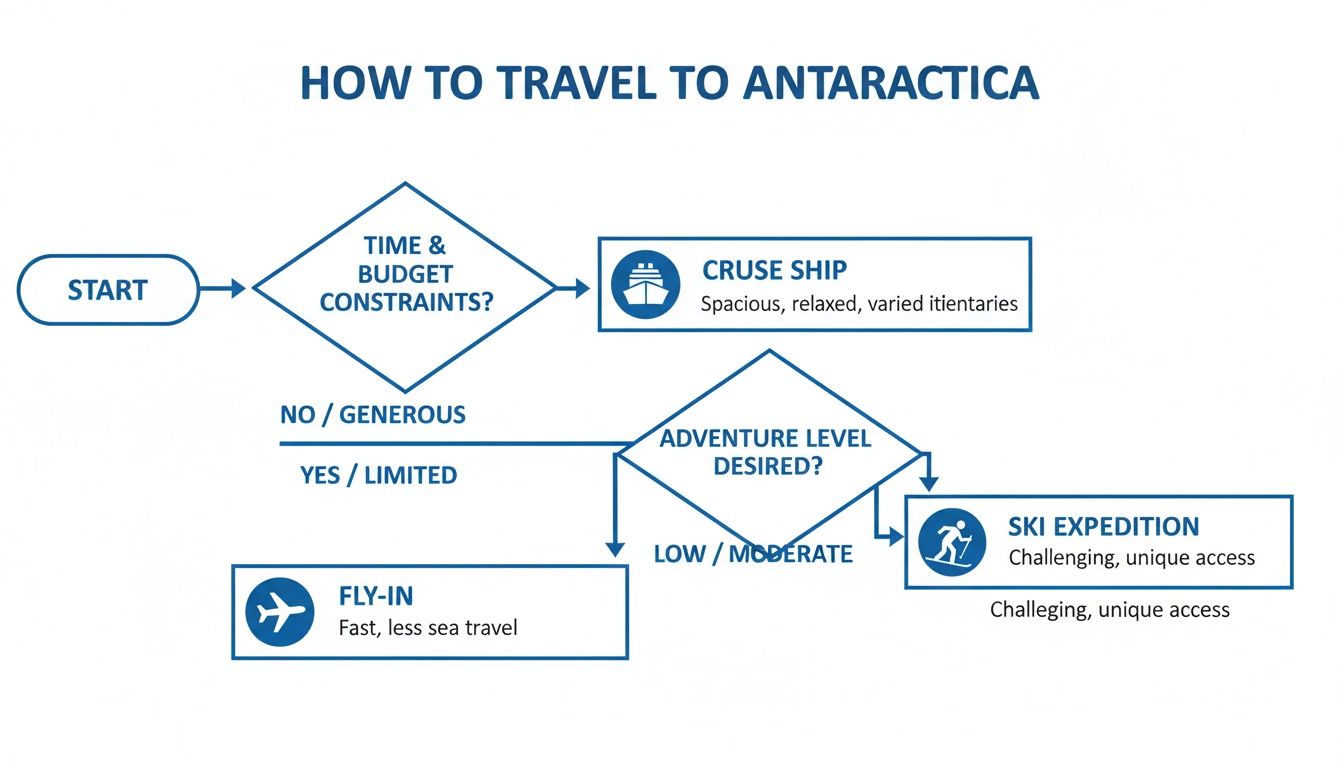
To simplify things, here is a look at how the main travel methods stack up against each other.
Comparison of Antarctic Travel Methods
| Travel Method | Typical Duration | Estimated Cost (GBP) | Physical Demand | Primary Focus |
|---|---|---|---|---|
| Expedition Cruise | 10-21 Days | £8,000 - £25,000+ | Low | Coastal wildlife, scenery, historical sites |
| Fly In Interior | 5-14 Days | £25,000 - £80,000+ | Low to High | Deep field access, South Pole, specific peaks |
| Ski Expedition | 7-60+ Days | £45,000 - £100,000+ | Very High | Human powered journey, self sufficiency, endurance |
Each option offers a completely different lens through which to experience Antarctica. Let us break them down.
The Expedition Cruise: A Popular Gateway
By far the most common way people see Antarctica is via an expedition cruise. Most of these voyages set off from Ushuaia, Argentina, before tackling the infamous Drake Passage, a two to three day crossing that gets you to the Antarctic Peninsula.
Life aboard these ice strengthened vessels is comfortable. The entire experience is geared towards Zodiac landings at designated coastal sites, giving you incredible access to sprawling penguin colonies, seal haul outs, and historic explorers’ huts. It is a phenomenal way to see the continent's periphery and its abundant wildlife, all without needing any specialised polar skills.
Make no mistake, though: this is a fundamentally different experience from an overland expedition. You are a visitor observing the environment from a secure, catered base. For many, that is exactly the rewarding and awe inspiring experience they are looking for.
The Fly In Interior Experience
If you are short on time or have a deep aversion to the idea of the Drake Passage, fly in logistics offer a direct shortcut to the continent's interior. A specialised aircraft flies from Punta Arenas, Chile, landing just a few hours later on a blue ice runway at a base like Union Glacier Camp, located at roughly 80°S .
This approach bypasses the sea voyage completely, placing you deep inside Antarctica almost instantly. From these remarkably well established camps, you can launch into other adventures: a flight to the South Pole, an attempt on Mount Vinson, or a visit to an Emperor penguin colony.
This option gives you a real taste of the deep field the vast, empty, silent landscapes of the polar plateau that ship based tourists will never see. It is a bridge between coastal tourism and a full scale expedition, offering a much more profound sense of the continent's sheer scale.
The numbers really highlight the difference. In the 2015-16 season, for example, 38,478 tourists visited Antarctica, with over 75% arriving by ship. The British Antarctic Survey notes that only about 1% of visitors fly directly to the interior, making these deep field experiences truly unique. You can dig into the latest Antarctic visitor statistics via the IAATO.
The Human Powered Ski Expedition
This final route is the most demanding and, for a certain type of person, the most rewarding. This is the overland ski expedition, a full on commitment to crossing the ice under your own power, pulling a pulk with every last thing you need to survive.
These journeys vary hugely in scale and duration:
- The Last Degree: Skiing the final degree of latitude (approximately 111 kilometres or 69 miles ) to the Geographic South Pole. This usually takes around 7-10 days, covering 15-20km per day.
- Coast to Pole: A full, unassisted journey from a coastal starting point like the Hercules Inlet all the way to the Pole. This covers over 1,130 kilometres (700 miles) and takes roughly 45-60 days. It is a massive undertaking, following in the ski tracks of explorers like Amundsen and Scott.
- Other Crossings: A whole host of other routes exist, each presenting its own unique challenges of distance, terrain, and brutal weather, from expeditions led by Børge Ousland to those of Felicity Aston.
This is polar travel in its purest form. It demands an incredibly high level of physical fitness, unshakeable mental resilience, and technical skill built through months, or even years, of dedicated training. There is no warm ship to return to at night; your tent is your only refuge. Success is measured one painstaking kilometre at a time, earned through sheer effort and sound decision-making when you are cold, tired, and utterly exposed.
Navigating The Logistics Of Your Expedition
Once you have settled on how you are getting to Antarctica, the real work begins. The logistical phase for any serious expedition is a multi year chess game that demands an almost obsessive attention to detail. A single oversight in permits, insurance, or medicals can completely unravel the entire undertaking before you have even packed your kit bag.
This is not a process to be rushed. Committing to a ski expedition, for instance, means locking in your place with an operator like Pole to Pole up to 24 months in advance . That timeline is not arbitrary; it allows for staggered payments, serious training, and methodically working through the mountain of paperwork required.
Your Expedition Planning Timeline
A realistic schedule is your most important tool. For a major overland journey, this timeline is not a suggestion, it is the critical path that guarantees every piece of the puzzle is in place exactly when it needs to be.
- 24 Months Out: This is when you research and choose your expedition operator. You will place your deposit to secure a spot, as team sizes are always kept small and fill up fast.
- 18 Months Out: Time to kick off your formal physical training programme. It is also smart to get initial medical checks done now to flag any underlying issues that need sorting.
- 12 Months Out: Book your polar training course. This is non negotiable. It is where you build essential skills and test your entire system in a tough but more forgiving environment like Iceland or Svalbard.
- 9 Months Out: Begin buying your specialised personal kit. The next major payment instalment for your expedition is also typically due around this time.
- 6 Months Out: Lock in your expedition insurance and book international flights to your gateway city, either Ushuaia, Argentina (around 34°W ), or Punta Arenas, Chile ( 70°W ).
- 3 Months Out: Complete your final, thorough medical and dental examinations. All required documents, including medical forms and insurance certificates, must be submitted to your operator.
Following a structured approach like this prevents the last-minute panic that can derail a trip and helps you build a solid foundation for the journey ahead. As you work through these complex logistics, it is vital to understand how to choose the right travel insurance that covers all the unique risks involved.
Permits, Insurance, and Medicals
These three pillars are the administrative heart of your expedition. Standard, off the shelf solutions simply will not work here; everything has to be tailored to the extreme demands of Antarctica.
All human activity on the continent is governed by the Antarctic Treaty System . A reputable operator handles the labyrinthine permitting process on your behalf, which is a huge part of what you are paying for. This ensures your expedition is fully compliant with international law and the world's most stringent environmental protocols.
Expedition insurance is a different beast entirely from standard travel insurance. Your policy must explicitly cover medical evacuation from remote polar regions a service that can easily cost over £100,000 . If you do not have adequate cover, you will be denied travel. It is as simple as that.
Finally, the medical clearance is rigorous for a reason. You will need a comprehensive examination and a direct sign off from your doctor, confirming you are fit to handle the immense physical and psychological stress of the environment. A sudden dental emergency on the polar plateau is a nightmare scenario, which is why a thorough check up is absolutely mandatory.
Gateway Travel Arrangements
Your final logistical hurdle is simply getting yourself to the end of the world. Most deep field ski expeditions depart from Punta Arenas, Chile, whilst the vast majority of expedition cruises set sail from Ushuaia, Argentina.
Check visa requirements for these gateway countries well in advance. For UK citizens, entry is usually straightforward for tourism, but regulations can always change. Your operator will give you specific arrival dates, which almost always include several buffer days to account for inevitable travel hitches or baggage delays.
Remember, the austral summer offers a very narrow window for these journeys. If you want to dive deeper into how timing can shape your entire experience, check out our guide on the best time to visit Antarctica for your expedition. Proper logistical management is what ensures you arrive at the start line prepared, equipped, and ready for the ice.
Physical And Mental Preparation For The Ice
Antarctica does not forgive a lack of preparation. The most important piece of your expedition is not your kit, your route, or your logistics, it is you.
Out on the ice, there are no shortcuts. Your body is the engine, and your mind is the navigation system. Both have to be conditioned for the brutal realities of the polar plateau.
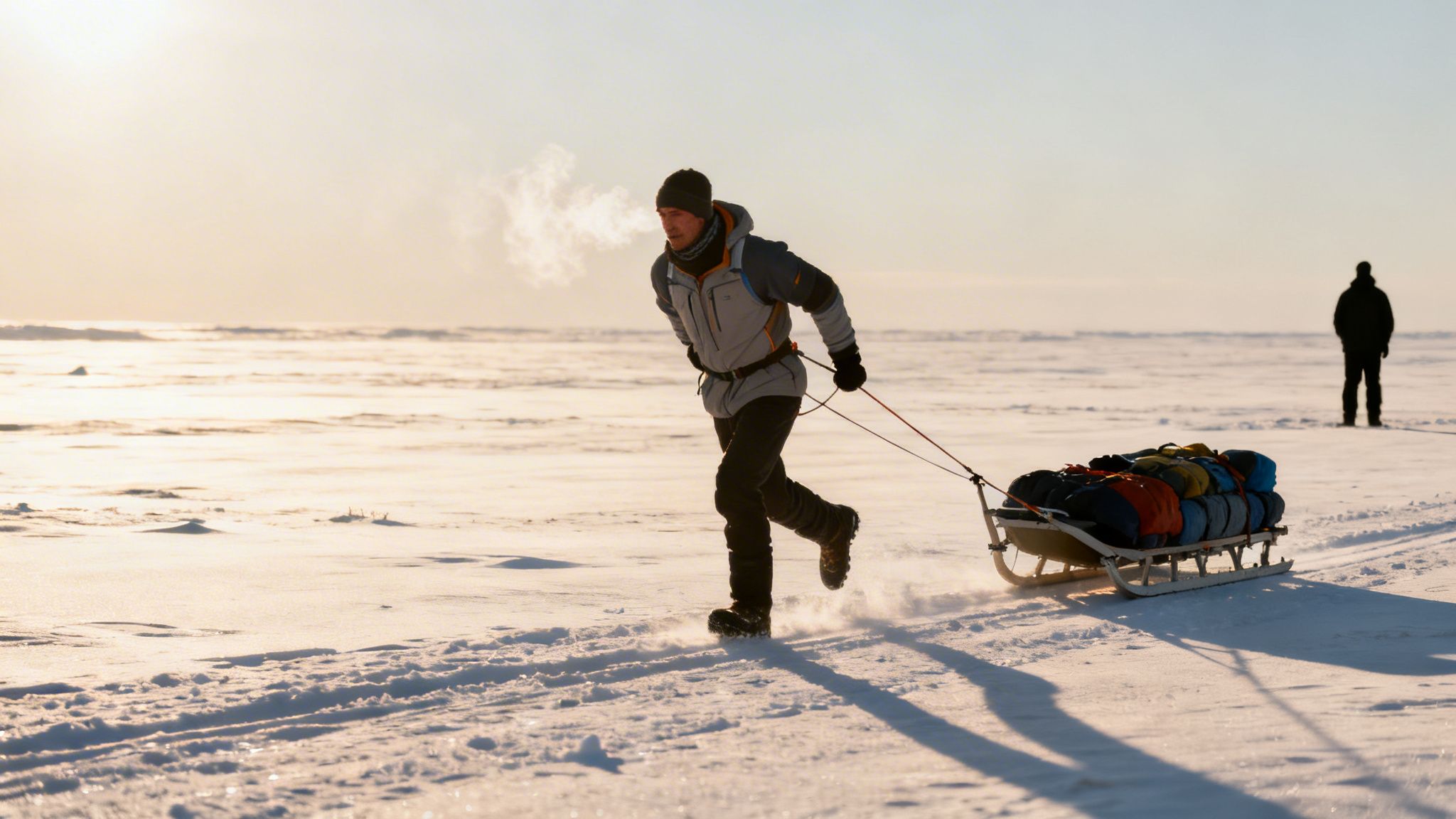
For a serious ski expedition, this means getting far beyond generic gym fitness. The goal is incredibly specific: to build the endurance to haul a 45-50kg pulk for 8-10 hours a day, every day, in temperatures that can easily drop below -30°C . This is not about explosive power; it is about relentless, steady state output.
Building The Physical Engine
Your training programme has to replicate the demands of the journey. The single most effective way to simulate pulk hauling is tyre pulling. It is unglamorous, repetitive, and profoundly effective at building the exact muscle groups and cardiovascular base you will need.
A typical training progression looks something like this:
- Building a base: Months of long duration, low intensity cardio, think long hikes, runs, or cycling.
- Introducing resistance: Start adding tyre pulling sessions. Begin with one or two tyres and gradually increase the duration and weight.
- Getting specific: Progress to long, multi hour treks pulling tyres over varied terrain, ideally wearing the boots and some of the clothing you will use on the ice.
- Strength work: Focus on your core, back, and legs to provide a stable chassis for that endurance engine.
Remember, staying strong throughout your journey to the ice is crucial. For convenient and effective workouts, things like resistance bands for travel offer a compact way to maintain your strength on the go.
Forging Mental Resilience
The physical challenge, whilst immense, is often secondary to the mental one. The Antarctic interior is a high-stress environment defined by isolation, monotony, and constant risk. Here, psychological resilience is not an abstract concept; it is a critical survival tool.
At the Pole to Pole Academy, we operate on a simple philosophy: competence before confidence. True confidence is not bravado. It is the quiet assurance that comes from repeatedly and successfully applying your skills under pressure. This is what you must build.
The growth in Antarctic tourism has been managed carefully for decades, creating a structured environment where visitors must operate within strict protocols. With landings on the Antarctic Peninsula growing at 6% annually for two decades, this framework just underscores the need for every expedition member to be fully prepared and self-sufficient.
The Psychology Of The Small Team
You will be operating within a very small team where every action has a direct impact on the group. Managing these dynamics is just as important as navigating a crevasse field.
Key areas for mental preparation include:
- Decision making under fatigue: You need to practise making clear, logical choices when you are cold, tired, and hungry. This is a skill you can hone.
- Emotional regulation: This is the ability to manage your own frustrations and keep a level head, especially when things are going wrong.
- Conflict resolution: Understand that minor irritations can escalate quickly in isolation. Open, honest, and respectful communication is not just nice to have, it is non-negotiable.
This is exactly why progressive training in environments like Iceland or Svalbard is so vital. It is not just about testing your kit. It is about testing yourself and the team in a controlled but genuinely challenging setting. It is where you learn the crucial difference between determination, which pushes you forward, and stubbornness, which can be catastrophically dangerous.
The goal is not to fight nature but to live within it, competently and respectfully. Your preparation, both physical and mental, is the foundation of that competence. It must be deliberate, consistent, and honest.
Your Essential Polar Expedition Kit List
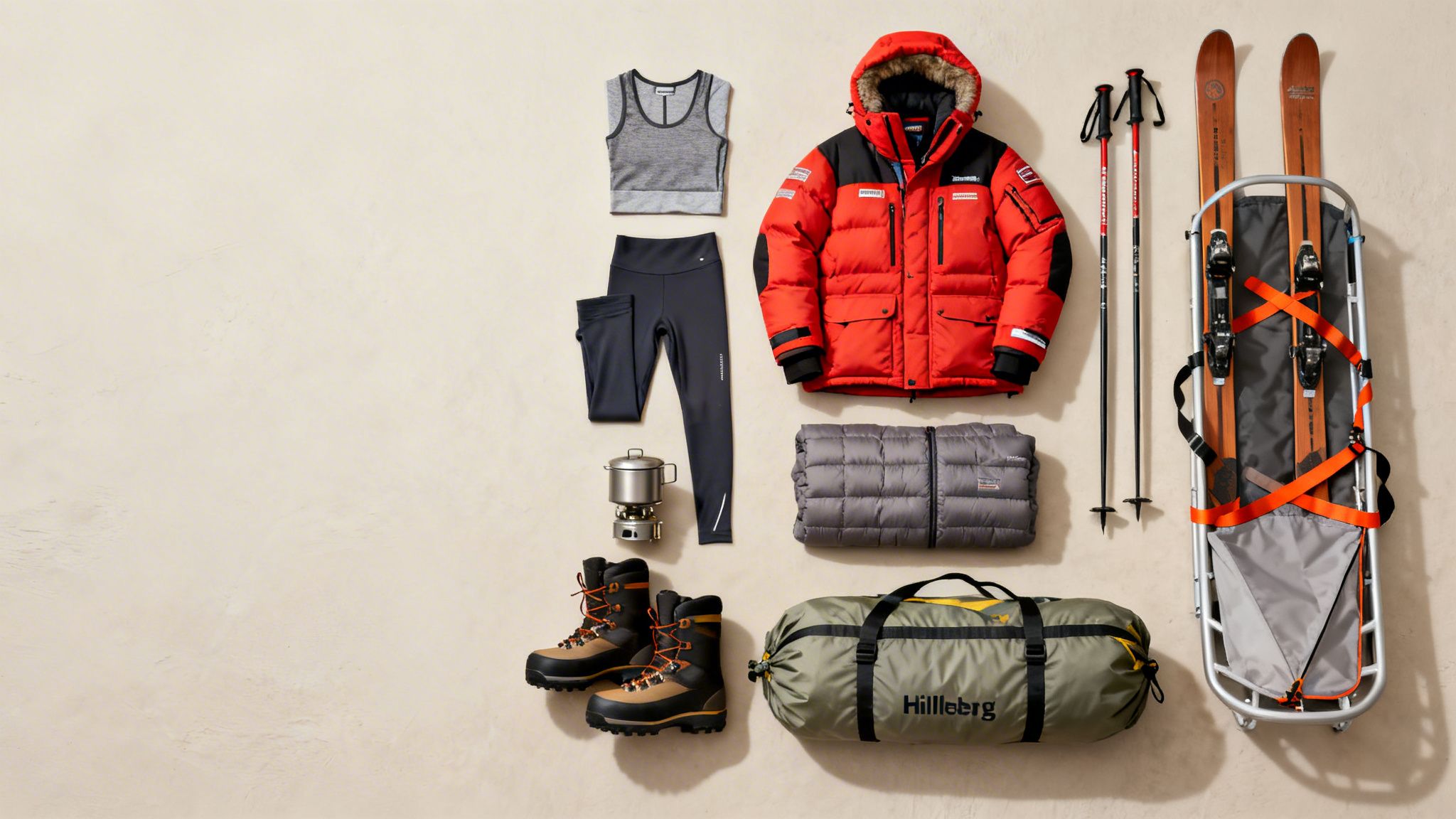
Out on the ice, your gear is not just a collection of items. It is a life support system. Every single piece has to work in perfect harmony with the rest. A single failure, a zip that breaks, a glove that tears, a stove that sputters out can trigger a cascade of serious problems. This is not a list of nice to haves. It is the proven system you need to function when the temperature plummets towards -30°C .
Your entire approach to clothing needs to be built around layering. The real goal is not just staying warm; it is about actively managing every drop of moisture. Sweat is the enemy out here. If it freezes inside your insulation, the gear loses its thermal properties, and the risk of hypothermia shoots up.
The Foundation: Base and Mid Layers
It all starts right next to your skin. Your base layers are there for one primary job: to wick sweat away from your body and keep you dry.
- Material: High quality merino wool is the undisputed champion. Brands like Fjällräven or Aclima produce exceptional wool base layers that hold their warmth even when damp and are naturally odour resistant, a huge bonus on a long trip.
- System: You will need two sets. A lighter one for high output skiing, and a heavier, expedition weight set for colder days and for living in the tent.
On top of that come your mid-layers, which provide the bulk of your insulation. Fleece is a reliable old friend, but modern synthetic insulated jackets (think Primaloft) offer incredible warmth for their weight. Adaptability is the name of the game. You must be able to add or shed these layers effortlessly as your effort level and the weather dictate.
Your Shell Against the Elements
Your outer layers are your shield against the wind. In the dry, biting cold of the Antarctic interior, a fully waterproof membrane like Gore Tex is often overkill and can actually trap moisture. What is non negotiable is a garment that is 100% windproof and built to last.
Look for a shell jacket and salopettes (bib trousers) made from seriously robust fabrics. These should be uninsulated, acting purely as a barrier over your insulating layers. Features like oversized zips you can grab with mitts on, a large and well designed hood, and reinforced fabric on high wear areas are not luxuries; they are critical design elements.
Your clothing is your personal thermostat. Learning to regulate it stripping a layer before you overheat, adding one before you feel the chill is one of the most fundamental skills of polar travel. It is a constant, conscious process.
Critical Expedition Hardware
Moving beyond clothing, this is the hardware that lets you live and travel on the ice. There is absolutely no room for compromise here.
- Boots: Expedition grade polar boots are a must. They are a two part system: a rigid outer shell and a thick, removable insulated liner. This design is crucial because it allows you to bring the liners into your sleeping bag at night to dry out and stop them from freezing solid.
- Skis and Bindings: We use cross country skis, but these are wider and tougher than anything you would see on a groomed track. They are paired with simple, durable bindings that can handle your bulky boots, a setup designed for utter reliability and field repairs.
- Pulk: This is your sledge, your lifeline. It holds all your food, fuel, and equipment. For a Last Degree expedition, your pulk will weigh between 45-50kg at the start. Learning to pack it for perfect balance is a skill in itself, making sure it pulls smoothly and does not flip on uneven ground.
The Mobile Base Camp: Tent and Stove
After an 8 to 10 hour day on skis, your tent and stove become the centre of your universe. They have to be completely dependable.
- Tent: Expedition tunnel tents, like the Hilleberg Keron 4 GT, are the gold standard for a reason. Their aerodynamic shape handles the ferocious katabatic winds of the polar plateau, and their construction is bombproof.
- Stove: You need a multi fuel stove that runs on white gas (Coleman fuel), as it is the only thing that performs reliably in the extreme cold. Your stove is not just for cooking; it is your only way to melt snow for drinking water, a task that eats up a surprising amount of time and fuel every single day.
Pulling together a full kit is a massive undertaking. For a much deeper dive, you can read more about the kit required to face the coldest place on Earth and see exactly why every single item counts. This entire system, from your socks to your tent pegs, is what makes it possible to not just survive, but thrive in the most demanding environment on our planet.
Your Antarctic Questions, Answered
Planning a trip to the bottom of the world naturally brings up a lot of questions. It is a remote, demanding environment, and preparation is everything. Here are some of the most common queries we get, with direct, experience-based answers to give you some clarity.
How Much Does an Antarctic Trip Really Cost?
Antarctic travel costs vary massively, and it is critical to understand what you are paying for. A cheap trip is rarely a good one, and the price tag for a major expedition reflects an immense logistical and safety framework that you simply cannot do without.
An 11 day expedition cruise to the Antarctic Peninsula will typically set you back somewhere between £8,000 and £15,000 per person. This usually gets you your cabin, meals, and all the Zodiac boat excursions.
On the other end of the scale, a full blown, guided Last Degree ski expedition to the South Pole is a completely different beast. For that kind of undertaking, costs start upwards of £50,000 .
Always scrutinise what is included. International flights to your starting point, specialised expedition insurance, your personal kit, and any required training courses are almost always extra. The higher price for a ski expedition covers incredibly complex logistics, specialised flights into the continent's interior, elite guides, robust safety systems, and all the food and fuel needed to survive on the polar plateau.
When Is the Best Time of Year to Go?
The window for Antarctic travel is tight, running only through the southern summer from November to March. Outside of these months, the sea ice and extreme cold make travel impossible for tourists or private expeditions. But even within that short season, things change a lot.
- November: Early season. The continent is pristine, blanketed in fresh snow. It is a good time for wildlife, as penguins are courting and building their nests.
- December and January: This is peak season. You get the warmest temperatures, often hovering around 0°C on the Peninsula and the most daylight, with up to 24 hours of sun in some places. These months offer the stable conditions needed for ski expeditions.
- February and March: As the season winds down, this becomes the best time for whale watching. But temperatures start to drop, nights get longer, and the sea ice begins to creep back, which can sometimes block access to certain areas.
Do I Need Specialised Training for an Antarctic Cruise?
This is a really important question because it gets to the heart of the difference between an Antarctic trip and an Antarctic expedition. The prep for a cruise is fundamentally different from an expedition.
For a standard expedition cruise, no, you do not need specialised polar training. A decent level of general fitness is all you need to handle walking on uneven ground during shore landings and climbing in and out of the Zodiacs. The ship’s crew and guides manage all the safety and logistics.
For any deep-field travel like a ski expedition with Pole to Pole intensive, specialised training is absolutely non negotiable. It is the bedrock of your safety and success.
This means attending a dedicated polar skills course. You will learn critical skills like navigating in whiteouts, crevasse rescue, managing a tent in extreme cold, and handling stoves safely. This goes hand in hand with a serious physical conditioning programme, often lasting over a year, to build the specific endurance you will need on the ice.
What Are the Rules for Visiting Antarctica?
Antarctica is a continent governed by the Antarctic Treaty System , dedicated to peace and science. All human activity is controlled by its strict environmental rules. The International Association of Antarctica Tour Operators (IAATO) sets out specific guidelines to make sure all travel is done responsibly.
The core rule is simple: ‘Leave No Trace’. And that is not a suggestion, it is mandatory.
A few key rules you must follow:
- Wildlife Distances: Keep your distance. You must stay at least 5 metres (16 feet) away from penguins and seals, and even further from nesting birds.
- Biosecurity: You cannot introduce non native species. All your outer gear must be inspected and cleaned before you step ashore.
- No Souvenirs: You cannot take anything, natural or man made. That means no rocks, no bones, no feathers, not even artefacts from old huts.
Every single visitor has a legal and moral duty to protect this place. Any good operator will make sure these rules are crystal clear and strictly enforced.
The journey to Antarctica begins long before you touch the ice. It starts with meticulous preparation and a deep respect for the environment you are about to enter. Building the right skills and mindset is the first, most critical step. At Pole to Pole , our Academy courses and guided expeditions are designed to provide that foundation, turning ambition into competence. Explore your possible with us.