Wilderness First Aid Training: Essential Skills for Remote Expeditions
Wilderness first aid is not just another certificate for your wallet. It is the medical standard for any environment where you cannot simply dial 999 and expect an ambulance in ten minutes. It represents a complete shift in thinking, moving away from the "keep them stable until the professionals arrive" mindset of urban first aid towards prolonged field care . You learn how to manage a casualty for hours, or even days. It is less about a qualification and more about a fundamental change in how you approach a crisis.
Why Standard First Aid Fails in the Wild
Picture this: you are on a glacier traverse in Svalbard. A simple misstep, an awkward fall, and you hear that sharp, unmistakable crack of a bone breaking. Help is not minutes away; it might be days. In that moment, a standard first aid certificate, designed for the rapid response times of a city, becomes dangerously inadequate. The principles that work in an office or on a high street simply do not apply when you are facing the raw realities of a remote expedition.
The crucial difference boils down to two things: time and resources. An urban first aider is a single, temporary link in a long chain of survival. Their job is to preserve life until paramedics arrive. In the wilderness, you are the entire chain.
The Critical Shift in Mindset and Method
Standard first aid assumes a controlled environment and a swift, organised evacuation. Wilderness medicine throws all those assumptions out of the window.
- Prolonged Patient Care: You are not just managing someone for ten minutes. You might be responsible for them for 48 hours or more. That means monitoring vital signs, managing pain, and stopping their condition from deteriorating over a long, grueling period.
- Environmental Dangers: A simple fracture is one thing. That same fracture at -20°C is a life threatening event. Hypothermia is not just a possibility; it is an active, relentless threat to both your casualty and the rest of the team.
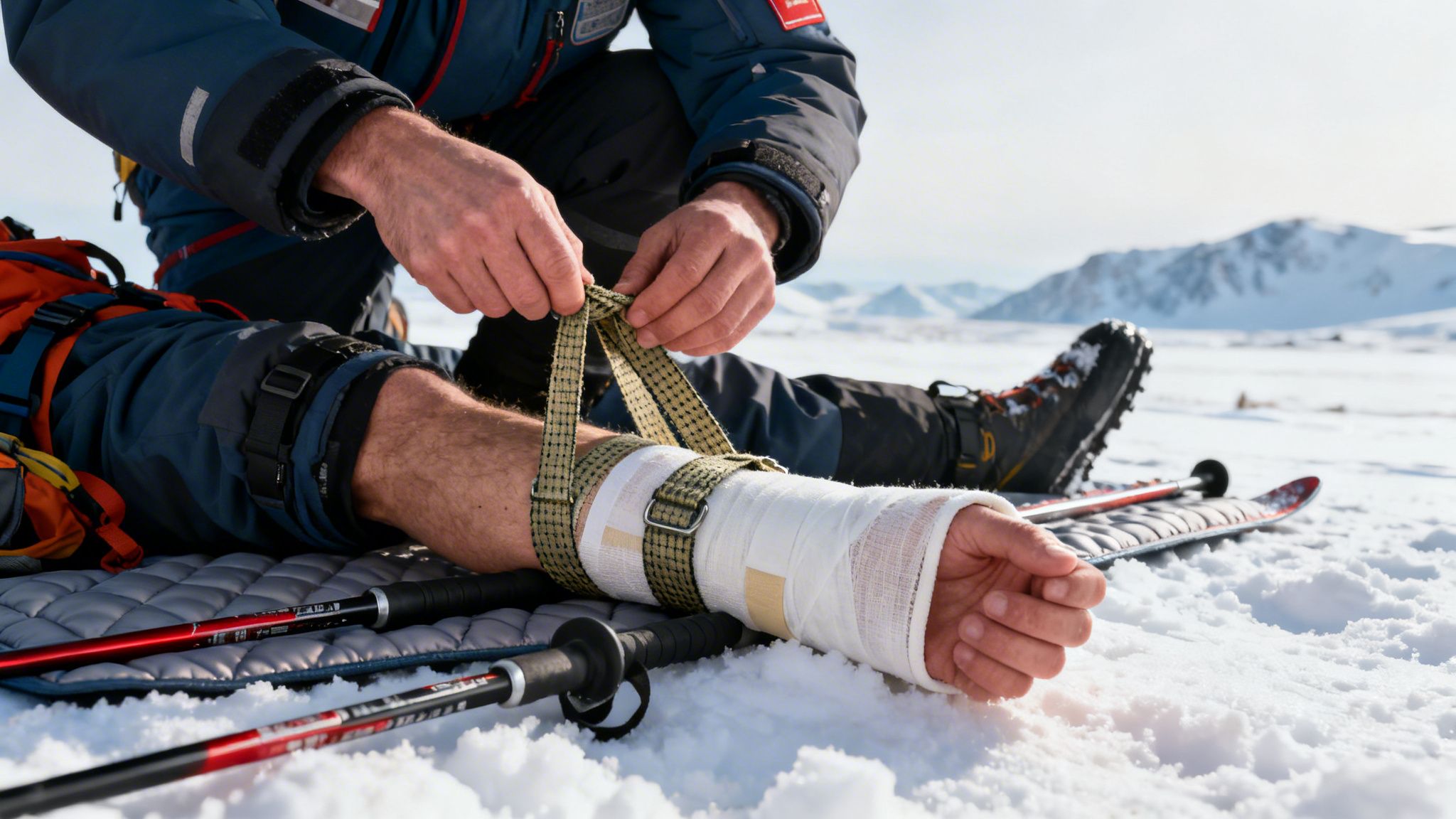
- Improvised Solutions: Forget a fully stocked ambulance. Your world class toolkit might be a pair of ski poles and some climbing tape for a splint, or a shelter you have had to rig from a pulk and a survival tarp.
This is the heart of it all: the shift from temporary stabilisation to long term management. It is about deeply understanding that the decisions you make in those first few hours will directly determine the outcome when real medical care is a full day's ski away.
The Evolution of Remote Care Standards
This specialised way of thinking is not new. Here in the UK, dedicated wilderness first aid training really began to take shape in the late 1990s. Pioneering organisations like Rescue Emergency Care saw the gap, they realised standard first aid just was not cutting it for guides and mountaineers. Their REC Level 2 course, a solid 16 hour programme, quickly became the benchmark for countless outdoor qualifications. You can dig deeper into the history of UK wilderness medical training and see how it grew from these early, essential courses.
This whole evolution is built on one stark truth. When you are out there, whether it is the Cairngorms in a winter storm or the vast Antarctic plateau your most important piece of kit is not your ice axe or your GPS. It is your ability to make calm, sound medical decisions under immense pressure, with whatever you have in your pack and no one to call for immediate backup.
Choosing Your Level of Wilderness Medical Training
Deciding on the right level of wilderness first aid training is one of the most critical steps in planning any expedition. It is easy to get lost in a sea of acronyms and course titles, but the choice really boils down to one simple question: what are the realistic demands of your environment?
Your qualification has to match the mission.
There is no single “best” course, only the most appropriate one for your specific journey. A guided summer trek in the Icelandic highlands is a world away from a self-sufficient, month long ski traverse of the Greenland ice cap. Understanding the different tiers of training ensures you are prepared with the right skills, not just a certificate.
The image below shows the fundamental split between standard first aid, remote care, and true wilderness medicine.
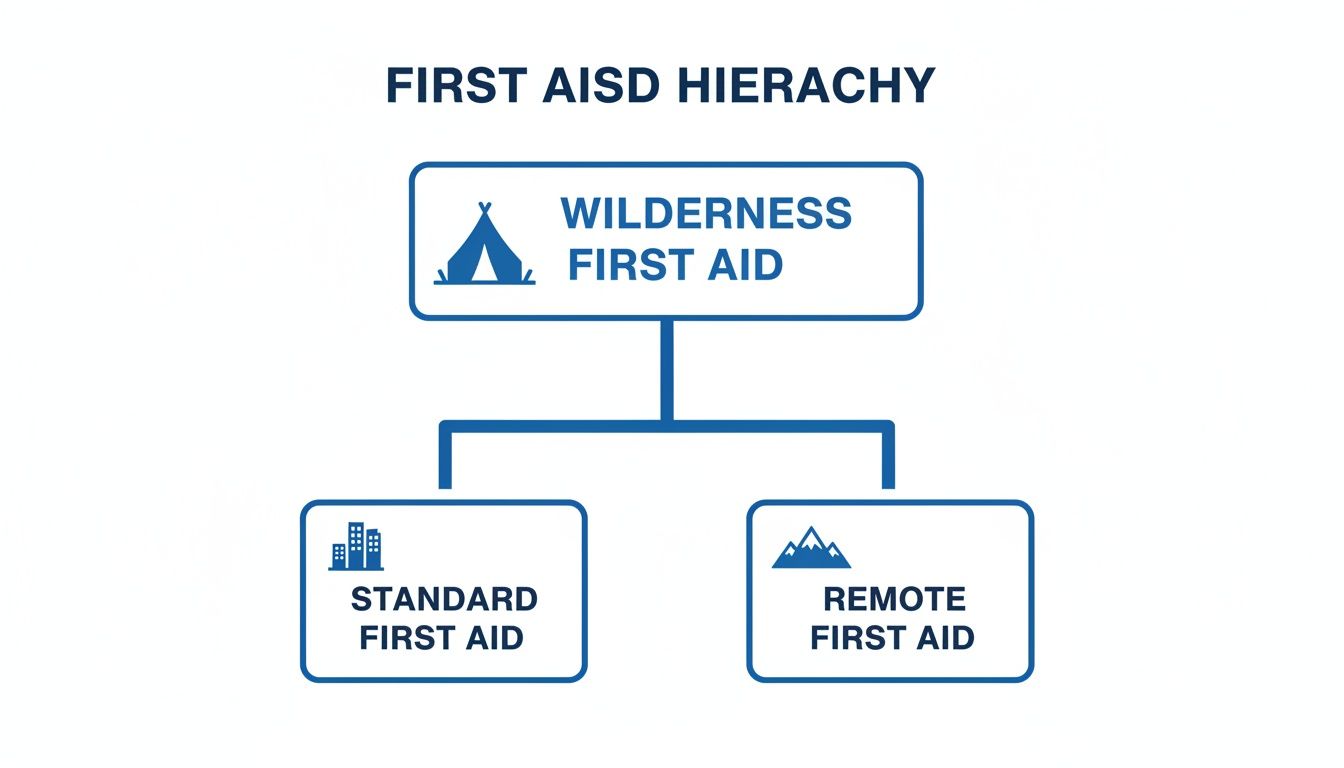
This hierarchy makes it clear: wilderness care is its own discipline, built for environments where self sufficiency is the only option you have.
A Quick Comparison of UK Courses
To help you navigate the main options available in the UK, we have broken down the three core levels of certification. Each builds on the last, designed for progressively more demanding and isolated environments.
UK Wilderness First Aid Course Comparison
| Certification Level | Typical Duration | Core Skills Covered | Ideal For |
|---|---|---|---|
| Wilderness First Aid (WFA) | 16 hours (2 days) | Basic life support, managing common injuries (fractures, sprains), environmental issues (hypothermia), patient monitoring. | Weekend hillwalkers, participants on guided UK treks, outdoor enthusiasts where help is hours away. |
| Wilderness First Responder (WFR) | 80 hours (8-10 days) | Advanced patient assessment, long term wound care, complex fracture management, medical emergencies (allergies, asthma), evacuation decisions. | Expedition leaders, professional guides, independent adventurers on multi day remote trips (e.g., polar, high altitude). |
| Wilderness Emergency Medical Technician (WEMT) | 160+ hours (3-4 weeks) | All WFR skills plus advanced medical interventions, use of specific medications, and a deeper understanding of anatomy and physiology. | Remote medical professionals, expedition medics, individuals leading long duration, high risk unsupported journeys. |
This table is a starting point. The real value comes from understanding what each level truly empowers you to do when things go wrong far from help.
Foundational Training: Wilderness First Aid (WFA)
For most people, the Wilderness First Aid (WFA) course is the perfect entry point. It typically runs for 16 hours over a weekend and is the minimum standard for anyone who spends time in remote areas where help might be a few hours away.
This is where you move beyond a standard workplace first aid course. You will be introduced to concepts like environmental medicine (dealing with heat and cold) and prolonged patient care.
A WFA is well suited for:
- Participants on professionally guided treks.
- Weekend climbers and hillwalkers in places like the Peak District or Snowdonia.
- Anyone on a shorter trip where evacuation, though delayed, is a reliable option.
Think of it as the essential toolkit for managing an incident and preventing it from getting worse until a mountain rescue team arrives.
Advanced Training: Wilderness First Responder (WFR)
The Wilderness First Responder (WFR) is the undisputed gold standard for expedition leaders, guides, and serious independent adventurers. This is a big step up, an intensive programme usually spanning 80 hours over a week or more.
It is designed for people who are responsible for a group’s safety for days or even weeks away from any professional medical help.
A WFR qualification moves beyond just managing an incident. It gives you the assessment skills and medical knowledge to make critical decisions about long-term care, improvisation, and complex evacuations in the most isolated places on Earth.
This is the benchmark qualification for anyone leading significant expeditions. It is what is expected of a Last Degree South Pole guide or a team leader on a Svalbard crossing. The syllabus is deep, covering everything from detailed patient assessment systems to managing complex fractures and medical emergencies when you are the final word on care.
Verifying Your Qualification
When you are choosing a provider, credibility is everything. In the UK, you should always look for courses that are regulated by Ofqual (The Office of Qualifications and Examinations Regulation). This is your guarantee that the training meets a national standard and has been externally verified.
An Ofqual-regulated certificate gives you confidence that your training is robust, recognised by national governing bodies, and will stand up to scrutiny. Without it, a certificate is just a piece of paper. It is your responsibility to check a provider’s accreditation before you book. That diligence is the first real step in responsible expedition planning.
The Reality of Remote Medical Incidents
The media loves a dramatic expedition emergency. Avalanches, helicopter rescues, major trauma, it makes for a great story. But that is not the reality of wilderness medicine.
The first thing you learn is to forget the Hollywood narrative. Day to day, the things that go wrong are far more mundane, yet no less serious. The most common problems are rarely spectacular.
Think about a simple slip on a wet rock whilst crossing a river, or an awkward fall skiing with a heavy pulk. That is how sprains and fractures happen. These are the bread and butter of wilderness first aid, not dramatic tumbles from a cliff face. Now, take that simple broken ankle and put it in Svalbard in winter, where temperatures can hit -30°C . Suddenly, it is a life-threatening crisis demanding expert management of hypothermia and shock.
The Data Behind Backcountry Injuries
The statistics back this up. The most frequent issues on expeditions are not headline grabbers. They are a predictable mix of physical strain and environmental pressure.
- Musculoskeletal Injuries: Slips and falls causing sprains, strains, and fractures are the number one reason for evacuations.
- Environmental Factors: In polar and high altitude environments, hypothermia, frostbite, and non freezing cold injury are constant threats.
- Soft Tissue Injuries: Blisters, cuts, and scrapes might seem minor, but if they are not managed well, they can lead to serious infections that will end a trip.
You can see this pattern closer to home, too. Data from incidents in the UK wilderness show that things like sprains, fractures, and cold related problems are far more common than major bleeding. The challenges of a multi day trek in the Scottish Highlands, slips on uneven ground, battling the cold are directly relevant to what we face on a Svalbard winter trip or an Antarctic crossing.
From Minor Issue to Major Incident
This data driven reality is at the heart of our training philosophy. A small problem, handled badly, can spiral into a catastrophe. A simple blister gets infected and leads to sepsis. A team member who is not layering their clothes properly slips into the early stages of hypothermia, which clouds their judgement and coordination, making a fall much more likely.
The core of effective wilderness first aid training is not about preparing for a single, dramatic moment. It is about mastering the fundamentals to stop the chain reaction where a small, manageable issue becomes a trip-ending crisis.
Out there, your first goal is always to stabilise the patient. But you also have to understand what comes next. Knowing what is medical evacuation is critical when proper medical help is hours, or even days, away. Good bystander care and prolonged field management make a huge difference to the outcome. It is a world away from an urban emergency like a cardiac arrest, where survival depends on a professional response that simply does not exist on a polar plateau.
This is exactly why solid expedition planning and logistics and medical preparedness are two sides of the same coin.
Core Skills for Expedition Environments
A wilderness first aid course is not about memorising a checklist. It is about understanding the core principles so deeply that you can adapt them to any situation, using whatever you have to hand.
In a warm, sterile classroom, applying a splint is straightforward. On a glacier at -20°C , with a casualty losing heat by the second and only a pair of ski poles and some tape for equipment, it becomes a complex problem. You are suddenly managing medical care, environmental threats, and your own resourcefulness all at once.
That is what real expedition focused training teaches you: how to think , not just what to do. The skills are practical, proven, and built for the unforgiving reality of a remote environment where you are the highest level of care.
Patient Assessment in Extreme Cold
The first ten minutes of any incident are critical. In the extreme cold, your approach has to be radically different from standard urban first aid.
A casualty lying on the snow can become dangerously hypothermic in minutes. The standard 'DRSABC' (Danger, Response, Send for help, Airway, Breathing, Circulation) is still your foundation, but it is adapted. Your immediate priority is insulation. Before you have even finished assessing their injuries, you must get them off the snow and into a survival shelter or onto a mat. Every second counts.
Managing Cold Weather Injuries
On any polar expedition, from a Last Degree ski to a Svalbard crossing, the cold is a constant threat. Your ability to recognise and manage cold related injuries is non negotiable. This goes far beyond simply telling someone to put on another layer.
Key skills you will master include:
- Severe Hypothermia Protocol: You learn to handle a casualty with extreme care to avoid triggering a cardiac event. You master how to package them in a hypothermia wrap using tarps and sleeping bags, and understand why passive rewarming is often the only safe option in the field.
- Frostbite Management: This involves knowing the critical moment when you should not rewarm a frozen extremity. Thawing a foot only for it to refreeze causes catastrophic tissue damage. You will learn how to make that difficult but vital call.
- Non Freezing Cold Injury (NFCI): Often seen in damp, cold conditions just above freezing, NFCI can end a trip. We teach early recognition of the signs, numbness and discoloration and aggressive management through immediate drying and warming.
The core principle of expedition medicine is this: the environment is often a greater threat than the initial injury. Your training must teach you to manage both simultaneously.
Improvisation and Resourcefulness
When your entire medical kit fits into a pulk you are dragging yourself, every piece of equipment has to serve multiple purposes. Resourcefulness is not a bonus skill; it is a fundamental part of wilderness first aid training .
You learn to see your entire expedition kit through a medical lens. A ski pole and a SAM splint become a rigid leg splint. Climbing tape and a cut up sleeping mat can immobilise a suspected spinal injury. A Hilleberg tent pole can be used to fashion an improvised traction splint.
Think about this real world scenario: a teammate dislocates their shoulder three days into a ten-day ski traverse. You are 50 kilometres (about 30 miles) from the nearest help. A competent first responder not only knows the techniques to safely attempt a reduction but also knows how to improvise a sling from a spare Fjällräven base layer and ski straps to secure the arm for the long ski out.
This is the true test of your training. It is the ability to look at a chaotic scene, assess your patient, survey your limited gear, and build a calm, effective plan. That confidence does not come from a textbook; it is forged through repeated, realistic scenarios in the kind of tough conditions you will actually face.
How to Select the Right Training Provider
Not all wilderness first aid training is created equal. A certificate is one thing; genuine competence when a situation is falling apart around you is another entirely.
Choosing the right provider is not about finding the cheapest or closest course. It is an investment in a philosophy that prepares you for the unforgiving reality of a remote environment. Your choice will directly shape your ability to make clear decisions under the kind of pressure most people will never experience.
A generic course in a comfortable classroom might teach you the theory. But it will never forge the resilience needed when you are cold, exhausted, and facing a real medical problem kilometres from any help. The training environment and the instructors’ experience are not minor details, they are the heart of effective preparation.
Instructor Experience and Credibility
The single most important factor is the calibre of your instructors. A good provider is led by people who have more than a teaching certificate; they have hard-won, practical experience from genuine expeditions. They do not just teach the syllabus. They have lived it.
When you are vetting an organisation, ask pointed questions about the instructors' backgrounds. Have they operated in polar environments? Have they managed real medical incidents far from help? Someone who has treated frostbite in Svalbard or managed a casualty during a whiteout on the Hardangervidda, as men like Roald Amundsen and Ranulph Fiennes did, brings a level of insight that cannot be replicated.
This is the difference between learning theory and absorbing wisdom.
The Importance of a Relevant Training Environment
Context is everything. Learning to manage hypothermia in a heated hall is an academic exercise. Learning to manage it during a simulated night-time scenario in the Cairngorms in winter, with the wind driving snow against your shelter, is where real skill is forged.
The environment itself must be part of the training. It teaches you how cold affects your fine motor skills, how difficult communication becomes in high winds, and how quickly a minor issue can escalate when you are exposed to the elements.
A provider’s choice of location tells you everything about their philosophy. Specialised centres, like our own Pole to Pole Academy in Iceland's interior ( 64° 25' 24" N ), are deliberately positioned in challenging environments. This ensures every practical session is grounded in the reality you will face on an expedition.
A sterile classroom simply cannot prepare you for the physical and mental stress of performing under pressure in the cold. You can discover more about how we build these skills on our expedition training course.
Syllabus and Training Philosophy
Finally, look closely at the course content and the provider’s underlying philosophy. Does the syllabus prioritise realistic, prolonged care scenarios over simple box ticking exercises? A quality course will force you to manage casualties for hours, not minutes, making difficult evacuation decisions and improvising solutions with the kit you would actually carry.
Look for a focus on decision making, not just technique. The best wilderness first aid training teaches you how to think, not just what to do. It builds the judgement to know when to act, when to wait, and how to lead a team through a crisis with a calm, methodical approach.
This focus on building competence before confidence is the hallmark of a provider that truly understands what is at stake.
Keeping Your Skills Expedition Ready
Getting your wilderness first aid certificate is a huge milestone, but the paper itself is just the starting line. Like any other critical expedition skill, whether it is navigating a whiteout or fixing a stove at -30°C – medical skills are perishable. They fade if you do not use them. The real work starts after the course, folding these life saving techniques into your regular routine until they are pure instinct.
This commitment to constant practice is at the very heart of an expedition mindset. It is a quiet promise you make to yourself and your team. Real competence is not about passing a test; it is about being able to act calmly and correctly when you are cold, exhausted, and a real incident is unfolding right in front of you. The principles are the same whether you are leading a team across the Greenland ice cap or making a critical call in the boardroom.
From Theory to Muscle Memory
The gap between knowing something in a classroom and being able to do it in the field is closed by one thing: consistent, hands on practice. Hoping you will remember what to do when an emergency finally happens is not a strategy. You have to be proactive, keeping the knowledge fresh and your hands familiar with the work.
It is about getting the theory out of your head and into your hands, building that crucial muscle memory.
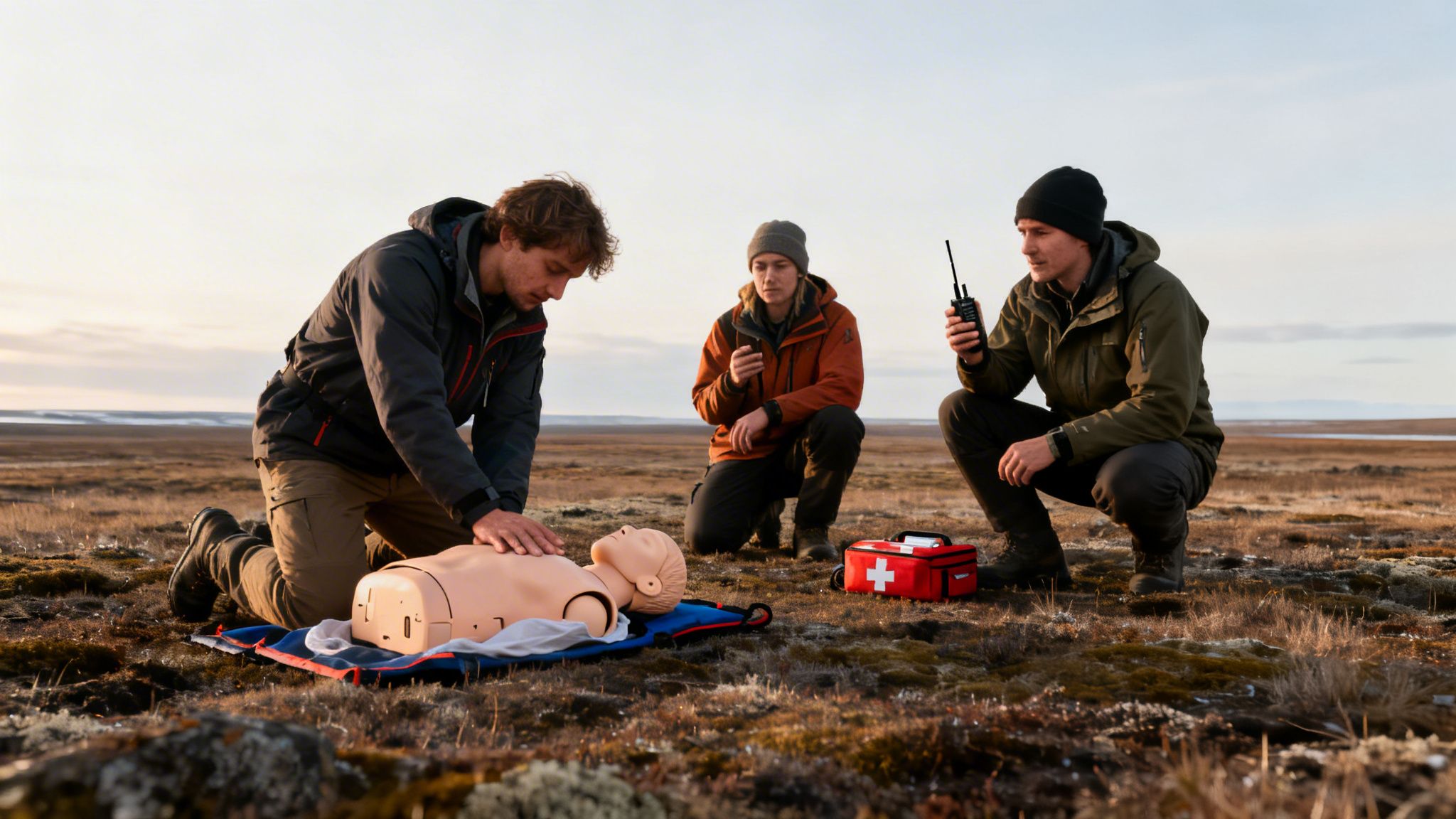
- Practise with Your Own Kit: A real incident is the worst time to find out your med kit is a mess. Get into the habit of unpacking it, handling the contents, and running drills with the actual gear you carry. You need to be able to find a SAM splint or a trauma dressing by feel, even in the dark.
- Run Regular Scenarios: On training weekends or even just a day out in the hills, set aside an hour for a simulation. Have a teammate act out a specific injury, a suspected fracture, the first signs of hypothermia and work through the entire response, from assessment to packaging them for a potential evacuation.
- Review and Rehearse Protocols: Talk through the tricky scenarios as a team. What is our plan for a dislocated shoulder? How do we manage a severe allergic reaction? Discussing these things in a calm setting builds a shared language and understanding that becomes invaluable under pressure.
The most effective teams treat medical skills as a living discipline, not a one time qualification. They know proficiency is maintained through consistent, deliberate practice, long before they ever step onto the ice.
This constant rehearsal is what turns a panicked, hesitant reaction into a methodical and automatic response. It is about making sure your ability to act is just as reliable as every other piece of your gear. To see how this same principle applies to your kit, you can explore our guide on essential equipment that supports resilience.
This philosophy of preparation, resilience, and clear headed decision making is what defines a truly competent explorer. It is also the very foundation of effective leadership, a principle we put directly into practice in our corporate programmes for teams looking to build these exact same capabilities.
A Few Common Questions
If you are starting to look into wilderness first aid, you probably have a few questions. Here are the answers to some of the most common ones we hear.
How Is Wilderness First Aid Different From a Standard First Aid Course?
Think of it like this: a standard first aid course teaches you how to keep someone stable until an ambulance arrives, which is usually a matter of minutes. Its whole focus is on that short, critical window.
Wilderness first aid starts from a completely different place. It assumes help is not coming for hours, or even days. That changes everything. You are not just stabilising; you are managing a patient for the long haul. The training shifts to prolonged field care, dealing with environmental threats like hypothermia, improvising splints from your own kit, and making tough calls about whether to evacuate or stay put. It is a move from temporary help to long term management in the middle of nowhere.
Do I Need Prior Medical Experience for a Wilderness First Responder Course?
Absolutely not. Good training providers build their courses, even the intensive Wilderness First Responder (WFR) from the ground up.
Whilst the courses are definitely demanding, they do not expect you to walk in with any previous first aid knowledge. What is far more important is a real desire to learn and a willingness to get stuck into the practical, hands-on scenarios. For those who already have advanced medical training, some places offer shorter 'bridge' courses. For most people, though, the full course is the best way to build real, lasting competence.
How Long Is a Wilderness First Aid Certification Valid For?
Most wilderness first aid qualifications in the UK are valid for three years , which lines up with the Health and Safety Executive (HSE) guidelines.
But here is the crucial part: these are complex skills, and they fade if you do not use them. That is why most professional expedition bodies strongly recommend an annual refresher to keep everything sharp. Recertification is usually a shorter course that gets you up to speed on any new protocols and runs you through practical reassessments. At the end of the day, it is your responsibility to keep your ticket in date, especially if you plan on leading or joining a serious trip.
Your ability to act decisively in a medical emergency is the bedrock of safe exploration. At Pole to Pole , we integrate this philosophy into every aspect of our training, ensuring you are prepared not just with skills, but with the mindset to lead when it matters most. Explore what is possible with our expedition training courses.