Huayhuash Trekking Peru: An Expeditioner's Guide to the Alpine Circuit
Let's be clear: the Huayhuash circuit in Peru is not a casual walk. This is a serious, high-altitude expedition. Think of it as a full-blown alpine journey, typically taking 10-12 days and repeatedly crossing passes well over 4,500 metres (14,760 feet) . It’s considered one of the most magnificent mountain traverses on the planet for good reason.
An Unfiltered Expedition Briefing
To step into the Cordillera Huayhuash is to enter a world of raw, uncompromising beauty. This is the landscape that forged one of modern mountaineering's most harrowing survival stories.
In 1985, British climbers Joe Simpson and Simon Yates made their attempt on Siula Grande ( 6,344m ). Their story of survival against impossible odds, immortalised in Simpson’s book Touching the Void , seared this remote Peruvian range into the minds of serious adventurers. Following the book's publication, UK mountaineering organisations were flooded with enquiries about the region.
This trek is a physical and mental undertaking. In spirit, it is closer to a polar expedition than a typical mountain hike. Success is not about conquering nature; it’s about moving through it with respect, efficiency, and a solid mindset. The circuit demands relentless effort, pushing you over high passes day after day, whilst enduring nights where temperatures can plummet below -10°C (14°F) .
The Nature of the Challenge
The entire circuit is a sustained test of endurance and the body's ability to acclimatise. Different from treks that build to a single high point, the Huayhuash is a relentless series of significant ascents and descents, with most of the route sitting above 4,000 metres .
Here is what that means on the ground:
- Sustained Altitude: You do not just visit altitude for a day. You live there. This places continuous stress on the body.
- Multiple High Passes: You will ascend giants like Cacananpunta ( 4,700m ), Punta Cuyoc ( 5,000m ), and Siula Pass ( 4,830m ), each a major physical effort.
- A Remote Environment: You are a long way from immediate support. Self-sufficiency, good judgement, and equipment you can trust are not just beneficial—they are essential.
The objective is not just to cover the distance. It is to operate effectively the entire time. That means managing your energy, staying healthy at altitude, and making sound decisions, especially when fatigued. This is a true expedition, and it demands that level of preparation.
Whilst the Huayhuash is a major highlight, Peru offers much more. You might also look into other unforgettable things to do in Peru. This guide will provide the unfiltered briefing you need to decide if you’re ready for this world-class alpine challenge.
Route Options and The Reality on the Ground
Any successful expedition is built on a brutally honest understanding of what lies ahead. The Huayhuash circuit is no exception. Forget the dramatic photographs for a moment; success here comes down to a tactical appreciation for the daily grind—the distance, the relentless altitude, and the fatigue that slowly chips away at you. This is about the ground truth.
The trek was thrust into the global spotlight after Joe Simpson’s survival story on Siula Grande, an epic that captured the imagination of mountaineers everywhere. The timeline below shows how a single, harrowing event put this remote range firmly on the map for serious adventurers.

This journey from a real-life survival epic to a bestselling book cemented the region’s reputation as a true proving ground. It draws those who are not just looking for scenic views, but for a genuine challenge.
Understanding The Classic Circuit
The standard route, the one that delivers the full huayhuash trekking peru experience, is the classic circuit. This is typically a 10 to 12-day commitment.
This is a sustained high-altitude traverse. You will cover roughly 115 kilometres and cross at least eight major mountain passes. The defining feature? You spend almost the entire time above 4,300 metres (14,100 feet) .
There are shorter options. Some people cut out the northern or southern loops, bringing the trek down to 7 or 8 days . Whilst these are practical for those with limited time, they bypass some of the circuit's most spectacular and demanding terrain. To truly understand the Huayhuash, one must complete the full loop.
The Daily Rhythm: A Sample Itinerary
To grasp what you are committing to, you need to look at the trek day by day. Each morning, you face a significant climb over a high pass, followed by a long descent to the next campsite. The physical output is immense, and the mental discipline to get up and do it again is what separates those who finish from those who do not.
Here’s a look at a classic 10-day circuit. Note the consistent altitude and daily effort. There are no "easy days" on the Huayhuash; it is a continuous physical and physiological test.
Classic Huayhuash Trek Itinerary At A Glance
| Day | Route Stage | Approx. Distance (km) | Highest Altitude (m) | Estimated Trek Time (hours) |
|---|---|---|---|---|
| 1 | Quartelhuain – Mitucocha | 9 | Cacananpunta Pass (4,700) | 5-6 |
| 2 | Mitucocha – Carhuacocha | 9 | Carhuac Pass (4,650) | 6-7 |
| 3 | Carhuacocha – Huayhuash | 15 | Siula Pass (4,830) | 6-7 |
| 4 | Huayhuash – Viconga | 12 | Portachuelo Pass (4,750) | 4-5 |
| 5 | Viconga – Huanacpatay | 12 | Cuyoc Pass (5,000) | 5-6 |
| 6 | Huanacpatay - Cutatambo | 10 | Santa Rosa Pass (5,060) | 6-7 |
| 7 | Cutatambo – Huayllapa | 13 | Descent to village | 4-5 |
| 8 | Huayllapa – Cashpapampa | 11 | Tapush Pass (4,800) | 6-7 |
| 9 | Cashpapampa – Jahuacocha | 10 | Yaucha Pass (4,850) | 6-7 |
| 10 | Jahuacocha – Llamac | 14 | Pampa Llamac Pass (4,300) | 5-6 |
This rhythm of ascent, exposure, and descent is the core reality of the trek. Every pass is a major objective for the day. Take Cuyoc Pass on Day 5—it pushes you to 5,000 metres , an altitude where every step feels like a monumental effort.
Success is not about one big day; it's about managing energy, day after day, for the entire expedition. Internalising this daily grind is the first, most crucial step in preparation. It dictates how you train, what you pack, and the mindset you bring. You are not here to fight the mountains; you are here to develop the strength and competence to move through them safely.
Executing Your Expedition Logistics
An expedition is won or lost long before your boots hit the trail. In a place like the Cordillera Huayhuash, where you’re truly out there, logistics are not just about comfort—they are the bedrock of safety and success. The principles are the same whether you’re heading for the poles or tackling a high-altitude circuit.
The first major decision is how you will operate: guided or completely independent. Whilst you can technically go it alone, we believe a professionally guided trek is the only responsible choice here. The sheer burden of carrying 10+ days of food and equipment at this altitude is immense. It adds a layer of risk that is not just significant, but unnecessary.
A supported team allows you to focus energy where it matters: on the immense physical and mental demands of the environment, not the complexities of resupply and navigation.
Sourcing a Reputable Operator
Huaraz is the undisputed hub for any Huayhuash trek in Peru . This is where you will find your team. Any professional, reputable organisation should provide a standard package that includes:
- A Certified Guide: Your guide is your lifeline. Their local knowledge, expertise in reading the weather, and emergency training are non-negotiable.
- Arrieros and Mules: These mule drivers are the engine room of the expedition, hauling the heavy equipment, food, and camping gear from one site to the next.
- A Cook and Food: A dedicated cook manages all meals, ensuring you get the high-calorie fuel your body requires at altitude.
- Essential Equipment: This covers the basics like a mess tent for meals, all cooking gear, and usually client tents and sleeping mats.
When selecting an operator, look for clear communication, transparent costs, and a solid track record. Do not hesitate to ask pointed questions about their safety protocols and guide certifications.
Understanding the Permit and Fee System
In 2002, control of this land was returned to the local Quechua communities. Since then, they have implemented a fee system that has significantly improved the region’s safety and infrastructure. As you trek, you will be required to pay a fee to each community whose land you cross.
As of 2024, the total for these community fees is around 280 Soles (about £60). You will receive a ticket from each community as proof of payment. This is not just a toll; the money directly funds local patrols and campsite upkeep, making the circuit safer for everyone.
This expedition is a magnet for UK explorers, with endurance demands that rival some continental cycle tours. The trek covers 115 kilometres over 12 days , crossing 11 passes above 4,300 metres and demanding the kind of operational precision we drill at the Pole to Pole Academy.
The core of any expedition, from Antarctica to the Andes, lies in its logistical integrity. A solid plan does not eliminate challenges, but it provides the structure and resources needed to manage them effectively.
Beyond just getting the equipment, you need to master how to pack a backpack for any adventure so that weight is distributed efficiently for comfort and stability.
Finally, getting to the trailhead (usually Quartelhuain) is a critical step. Arranging a private vehicle from Huaraz in advance removes a major potential issue. This is the kind of detail that separates a tough trip from a successful expedition. We dive deeper into these principles in our guide on the logistics behind planning an expedition.
Building Your High Altitude Equipment System
In the high Andes, your kit is not just about comfort; it's a life-support system. A simple checklist is insufficient. This is about understanding why you are carrying each piece, knowing that every item serves a critical purpose. It's the same philosophy we apply to polar journeys, where the right equipment is the absolute foundation of safety and success.
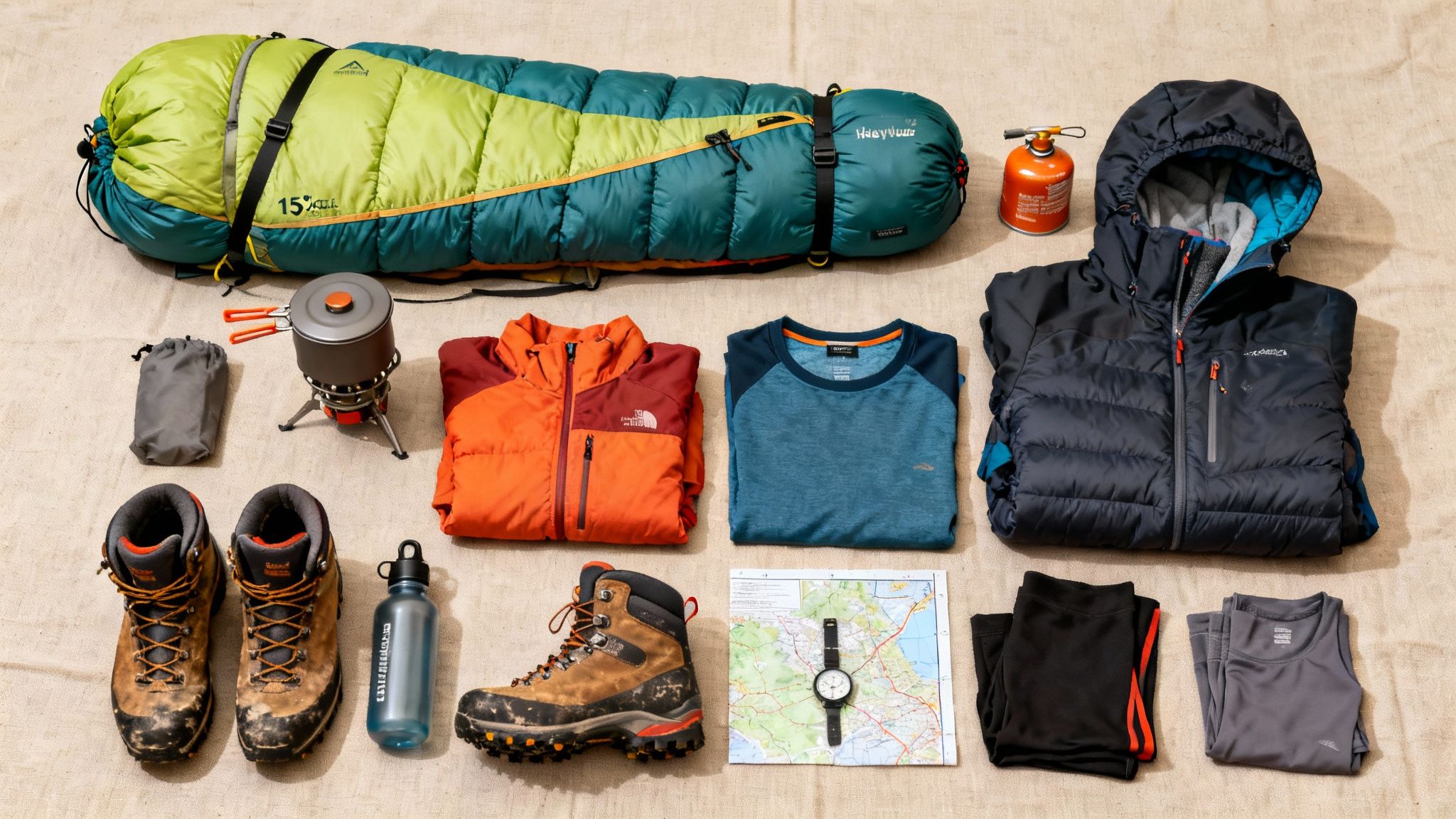
The biggest environmental battle you will fight on the Huayhuash circuit is the extreme temperature swing. Intense sun at altitude can make midday feel surprisingly warm, but the nights consistently plummet below -10°C (14°F) . Your ability to manage body temperature directly fuels your energy and performance. A solid layering system is not just a good idea—it is non-negotiable.
The Layering System Explained
Forget thinking about "outfits." Your clothing needs to work as an integrated, adaptable system. The goal is simple: manage moisture and trap heat. You will be adding and shedding layers all day as you move and as the weather shifts.
-
Base Layer: This is your second skin, designed to pull sweat away from your body. Merino wool, such as that from Fjällräven, is the gold standard; it insulates even when damp and resists odour after days of use. Avoid cotton. It soaks up moisture and will make you dangerously cold the second you stop moving.
-
Mid Layer(s): This is your engine room for insulation. A combination of a good fleece and a lightweight synthetic insulated jacket offers incredible versatility. The fleece breathes well when you're working hard, and the insulated jacket provides a massive warmth boost for its weight during rest stops or evenings at camp.
-
Outer Layer (Shell): Your defence against wind and rain. You need a waterproof, breathable hardshell jacket made from a tough fabric. The mountain environment is abrasive, and this layer must withstand it.
Mission-Critical Shelter and Sleep Systems
When you stop trekking, your tent and sleeping bag take over as your primary defence against the elements. Attempting to save money here is a mistake that can have serious consequences. The exhaustion from shivering all night will destroy your performance the next day.
Your shelter is more than a place to sleep; it's a recovery chamber. A cold, sleepless night at 4,500 metres will significantly degrade your physical and cognitive function. Investing in a robust system is an investment in your own resilience.
Your sleep system must be rated for the conditions you will face. A high-quality down or synthetic sleeping bag with a comfort rating of at least -15°C (5°F) is the minimum. This must be paired with an insulated sleeping mat with a high R-value—this prevents the frozen ground from drawing heat from your body.
For a tent, a four-season model, such as those from Hilleberg, is the correct tool for the job. These are engineered to handle high winds and potential snow. A proven design provides the structural integrity you need for peace of mind when the weather turns.
To help you get organised, here is a breakdown of the equipment that truly matters. This is not just a list; it is a system designed to keep you safe and performing at your best when you are thousands of metres above sea level.
Essential Huayhuash Equipment System
| Category | Essential Item | Recommended Specification | Justification |
|---|---|---|---|
| Layering System | Merino Wool Base Layer | 150-200g weight, long-sleeve top & bottoms | Wicks moisture, regulates temperature, resists odour over multiple days. Critical for avoiding chills. |
| Fleece Mid Layer | Polartec 200 or equivalent | Breathable insulation for active trekking. Can be worn alone or under a shell. | |
| Insulated Mid Layer | Synthetic fill (e.g., PrimaLoft) | Provides high warmth-to-weight ratio even if damp. Essential for static warmth at camp and during breaks. | |
| Hardshell Jacket & Trousers | 3-layer Gore-Tex Pro or equivalent, helmet-compatible hood | Your absolute defence against wind, rain, and snow. Durability is key. | |
| Sleep System | 4-Season Sleeping Bag | -15°C (5°F) comfort rating (down or synthetic) | Ensures restorative sleep in sub-zero conditions, which is vital for daily recovery at altitude. |
| Insulated Sleeping Mat | R-Value of 5.0 or higher | Prevents conductive heat loss to the frozen ground. As important as the sleeping bag itself. | |
| Shelter | 4-Season Tent | Geodesic or tunnel design, proven brand | Provides structural integrity against high winds and potential snow loads common in the Andes. |
| Footwear | Sturdy Hiking Boots | Waterproof, ankle support, well broken-in | Your single most important piece of equipment. Protects against injury and blisters on rugged terrain. |
| Hydration | Water Filter/Purifier | Sawyer Squeeze, SteriPEN, or similar | Prevents waterborne illnesses like Giardia, which can end a trek instantly. |
This is not about ticking boxes. It is about building trust in your kit so you can focus on the journey. When you know your equipment has your back, you are free to perform.
Footwear and Water Purification
Your boots are arguably the most important single piece of kit you will have. They need to be tough, waterproof, and—above all—completely broken in before you consider getting on the plane to Peru. You need boots with stiff, supportive soles to protect your ankles on that rough, uneven ground. Blisters can be a trip-ending disaster, so put the miles in at home first.
Finally, a reliable method of water purification is non-negotiable. Giardia is a serious issue. A simple filter like the Sawyer Squeeze or a UV steriliser like a SteriPEN will allow you to safely drink from the streams and lakes along the route, keeping you hydrated and healthy. The principles of packing resilience with essential equipment apply just as much here in the Andes as they do at the poles—your equipment is your partner.
Mastering Acclimatisation And Preparation
Altitude is the invisible force that defines the Huayhuash. It is the one thing that does not care how fit you are at sea level. Your body's ability to adapt to the thin air above 4,000 metres (13,123 feet) is the absolute foundation of a successful trek. Underestimate it, and this trek will expose you.
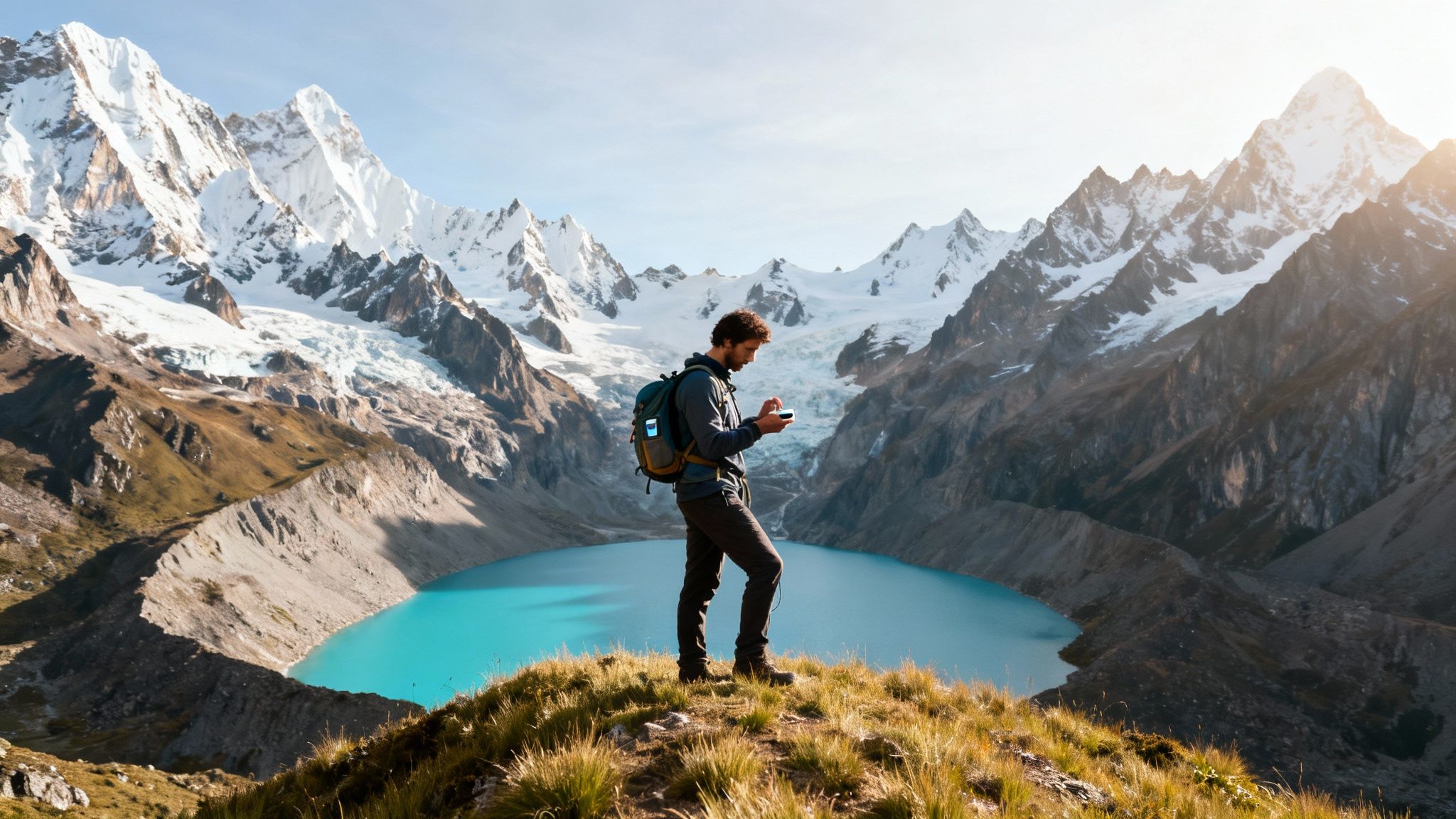
Fitness alone is no defence against Acute Mountain Sickness (AMS). A marathon runner is just as vulnerable as anyone else if they ascend too quickly. Preparation, then, is a two-front effort: physical conditioning at home and meticulous, patient acclimatisation once you are on the ground in Peru.
Progressive Acclimatisation: The Only Method
The only method that works for high altitude is gradual exposure. You cannot rush this physiological process. Flying into Huaraz at 3,052 metres (10,013 feet) is already a massive jump for most people.
We consider a minimum of two to three full days in Huaraz mandatory before you contemplate the trailhead. This is not downtime; it is active acclimatisation.
- Day 1: Arrive in Huaraz. Hydrate relentlessly. Take a gentle walk around town. Avoid alcohol and anything strenuous.
- Day 2: It’s time for a day hike to a higher altitude. Laguna Wilcacocha ( 3,725m ) is a sound option. The goal is to return to Huaraz to sleep. This "climb high, sleep low" principle is critical.
- Day 3: Push higher on a more demanding day hike. The trek to Laguna 69 ( 4,600m ) is the perfect final test before you commit to the main circuit. It provides a real taste of the altitudes at which you will be living.
This progressive schedule gives your body the signal to start producing more red blood cells—the key adaptation for carrying oxygen in thin air. It is not optional. It is a prerequisite for a safe and successful trek.
Physical and Mental Conditioning
Whilst acclimatisation is everything, you still need a solid physical base. The daily reality on the Huayhuash involves long, sustained ascents with a pack. Your training needs to mirror that reality.
Focus on building your engine with cardiovascular endurance—running, cycling, or, even better, hiking with a weighted pack. You will also need to build strength in your legs and core to handle the steep terrain and remain stable under load.
The physical challenge is only half the story. The mental game—the ability to remain calm, make good decisions when tired, and manage discomfort day after day—is what truly defines a successful trekker. This is not about recklessly pushing through pain; it is about building the resilience to operate effectively under sustained pressure.
Mental preparation is its own discipline. It’s about visualising the challenges ahead, accepting that discomfort is part of the process, and training yourself to stay present and focused. For a deeper dive into this vital area, our guide on how to prepare your mind and body for the unknown provides a solid framework. A prepared mind is the most important piece of equipment you can carry.
Staying Safe & Leaving No Trace
Out here, competence is not just about physical fitness. It is about understanding that your safety and your impact on the environment are two sides of the same coin. Moving through the Cordillera Huayhuash responsibly means moving safely, and leaving the mountains as you found them.
A Note on Local Security
Let's address a common question. The region’s past, particularly the presence of the Sendero Luminoso in the 1980s, still casts a long shadow in some minds. The reality on the ground today could not be more different. The Huayhuash is now a remarkably safe place to trek.
This did not happen by accident. In 2002, the government designated the area a 'reserved zone', handing management back to the local communities. This created a community-run fee system that has transformed security.
For a total of about 205 Soles (roughly £45), your contribution directly funds the patrols and upkeep that keep the circuit safe. The results speak for themselves: by 2015, this system had led to a reported 97% drop in incidents, encouraging more trekkers to experience this place. You can read more about the Cordillera Huayhuash's history on Wikipedia.
The Real Risks: Weather and Rockfall
The main dangers in the Huayhuash are not man-made; they come from the mountains themselves. The weather is unpredictable and can turn from brilliant sunshine to a blizzard in minutes. Rockfall is another constant threat, especially on steep ground and the scree slopes below high passes.
Staying safe boils down to good mountain sense and sound decision-making.
- Watch the Sky: Always keep an eye on the clouds and feel for changes in the wind. If the weather turns, be ready to change plans or turn back.
- Keep Moving: On exposed sections like scree fields or under cliffs, do not linger. Move through them efficiently. A helmet is a sensible piece of equipment for the riskier parts of the circuit.
- Start Early: There is a reason high-altitude mountaineers are up before dawn. An early start usually gets you over the high passes before the afternoon weather builds up. It’s a simple rule that saves lives.
The Leave No Trace Ethos
Our philosophy is simple: we do not fight nature; we live within it. This is the heart of responsible trekking. The Huayhuash is a fragile alpine world, and it is on all of us to protect it.
Operating ethically is as fundamental as tying your boots correctly. It means packing out every piece of your rubbish, washing yourself and your dishes well away from rivers and lakes, and sticking to the trail to prevent erosion. It’s about leaving the mountains exactly as you found them for the next person.
This respect extends to the local people whose land you have the privilege of walking through. Treat your guides, arrieros, and any villagers you meet with courtesy. A quiet, humble presence goes a long way.
When you make these practices second nature, you stop being a tourist and start becoming a responsible expeditioner.
Your Huayhuash Questions Answered
Here are the direct, practical answers to the most common questions about trekking the Huayhuash. No fluff, just the essential information needed to finalise your planning.
What Is The Best Time Of Year For Huayhuash Trekking Peru?
The optimal window for trekking the Cordillera Huayhuash is the Andean dry season, which runs from May to September . This period offers the best probability of stable weather, clear skies, and minimal precipitation.
'Stable' should not be mistaken for ‘warm’. You must be prepared for cold nights. At high-altitude camps, temperatures will drop well below freezing, often to -10°C (14°F) . The shoulder months of April and October can be viable, but carry a much higher risk of poor weather and zero visibility.
How Physically Demanding Is The Trek?
The Huayhuash circuit is a demanding expedition. This is not just about being 'fit'; it is about being resilient.
You are looking at consecutive days of hard, physical work, walking for 6-8 hours daily, all at a sustained high altitude. You will cross multiple mountain passes over 4,500 metres (14,760 feet) , with a few that push towards 5,000 metres (16,400 feet) . Rock-solid cardio, strong legs, and previous multi-day trekking experience are essential.
Do I Need A Guide For The Huayhuash Circuit?
Whilst you can technically go it alone, hiring a local, certified guide and a support team of arrieros with mules is the only responsible choice. In a remote environment where self-rescue is not a realistic option, a guide's expertise in navigation, safety, and emergency response is invaluable.
From a practical standpoint, carrying 10-12 days ' worth of food, fuel, and equipment at that altitude is brutal. Supporting a local team is the correct and smartest way to undertake this trek.
What Are The Toilet And Washing Facilities Like?
On the trail, facilities are what one would expect on a proper expedition: basic. Most designated campsites have a simple toilet tent or a rustic latrine hut. There are no showers.
Washing usually consists of a bowl of warm water provided by your crew in the morning and evening. The one notable exception is the campsite at Viconga. It has natural thermal pools, offering a welcome chance to soak and get clean midway through the trek.
At Pole to Pole , we know that true expedition readiness is built, not born. It comes from gaining real-world competence and forging a resilient mindset. Our Academy programmes are designed to give you the practical skills and mental conditioning to operate safely and confidently in the planet's toughest environments. Explore our training programmes at poletopole.com.