Winter Mountaineering Courses: Forging Practical Peak Skills
A winter mountaineering course is not a holiday in the hills. It is a structured training programme designed to teach the essential skills for moving safely through hazardous, snow-covered mountain terrain.
Think of it as the critical bridge between summer hill walking and the far more committing world of winter mountains. For anyone with ambitions in the cold, it is where genuine capability begins.
The Bridge Between Ambition and Competence
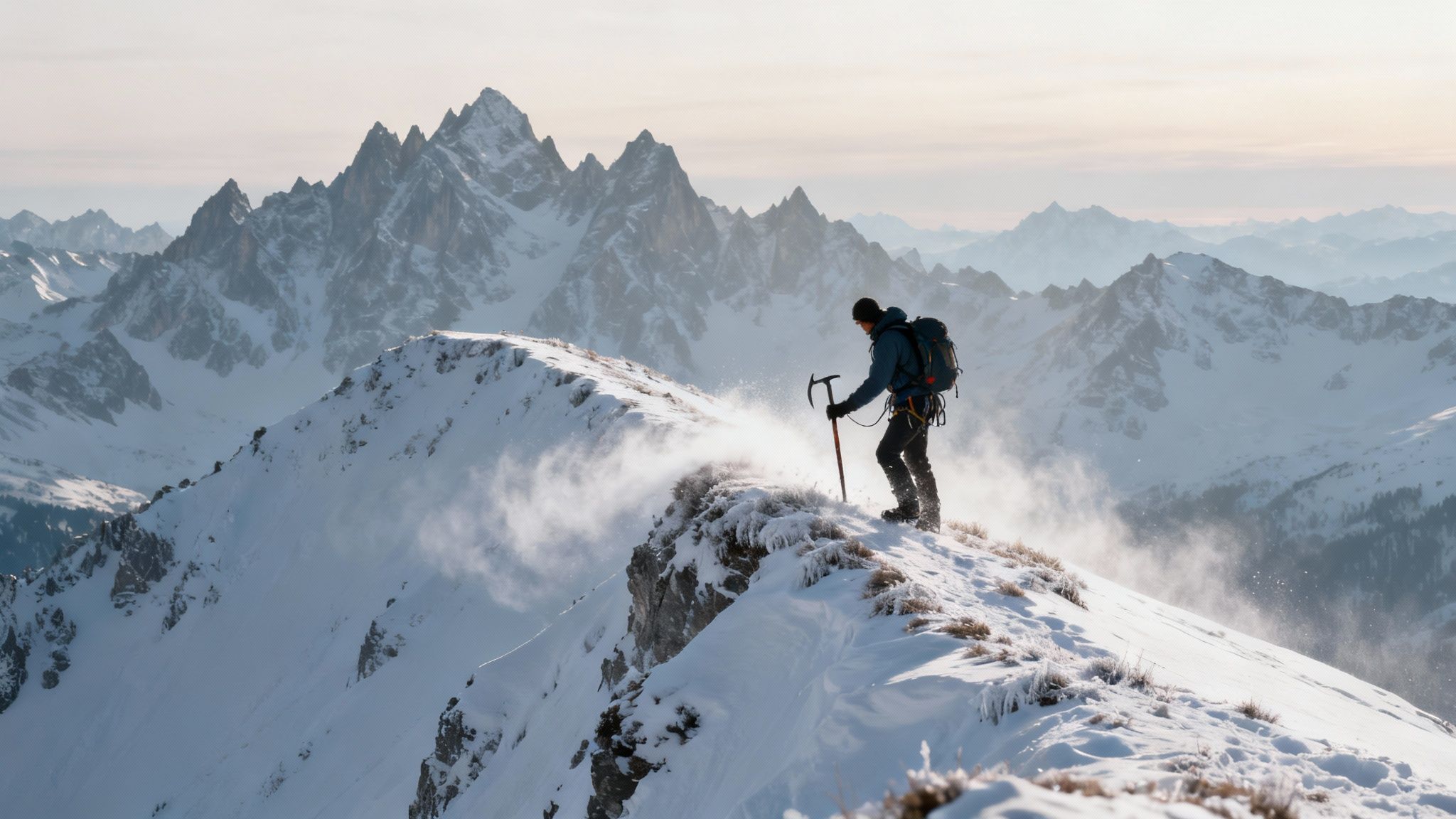
Spindrift scours a ridgeline as you sink an ice axe into frozen turf. The temperature is dropping, the light is fading. In this moment, the difference between a successful day and a serious incident is not your gear. It is your competence.
This is precisely why these courses exist. They are not just an activity; they are a requirement for anyone serious about travelling safely in cold, high-altitude environments. They build a profound respect for the mountains, shifting your mindset from conquering nature to moving intelligently within it.
Moving With Nature, Not Against It
Our philosophy at Pole to Pole is simple: we do not fight nature—we live in it. This is not some new-age mantra; it is a hard-won principle from decades of experience in military and polar exploration. A winter mountain is not an enemy to be defeated. It is a dynamic environment that demands skill, humility, and precise decision-making.
This approach means learning to understand the mountain on its own terms:
- Reading the snowpack to see the story it tells about avalanche risk.
- Interpreting the weather to make sound judgements on your route choice and timing.
- Managing your own body to keep hypothermia and exhaustion at bay.
These are not skills of brute force. They are about quiet competence, efficiency, and the ability to stay calm when the conditions turn against you. It is the same mindset that has seen explorers from Roald Amundsen to Sir Ranulph Fiennes succeed where others have failed.
"Plants and animals don’t fight the winter; they don’t pretend it’s not happening... They prepare. They adapt." — Katherine May, Wintering
This captures the ethos of proper winter training perfectly. It is a process of adaptation. You learn the drills and procedures that allow you to function effectively when the margin for error shrinks to almost zero.
A Foundation for Greater Challenges
Whether your goal is a summit in the Scottish Highlands, a corporate team looking to build genuine resilience, or preparing for a Last Degree expedition to Antarctica, the journey starts here.
The skills learned on winter mountaineering courses are the fundamental building blocks for every cold-weather objective you will ever have. They provide the only kind of confidence that matters—the kind earned through competence, not bravado. This training is the bridge between your ambition and the proven ability to see it through.
Why Structured Training is Non-Negotiable
The mountains do not forgive complacency. Ambition might be what pulls us towards high, cold places, but it is structured training that ensures we get to return from them. If there is one lesson etched into mountaineering history, it is that competence is not optional—it is the line between a tough day out and a tragedy.
One of the most sobering reminders comes from Scotland’s own unforgiving landscape. In November 1971, a school group set out onto the Cairngorm Plateau. It was an expedition from which five teenagers and one of their leaders would not return. Caught in a blizzard with conditions spiralling out of control, the group suffered a catastrophic series of failures in navigation, equipment, and emergency procedure. The Cairngorm Plateau disaster became Britain's deadliest mountaineering incident and a brutal case study in just how quickly winter mountains can turn.
That event forced fundamental changes in UK winter mountaineering safety. It cemented the need for formal qualifications and rigorous training, and the lessons learned that weekend directly inform how modern winter mountaineering courses are taught today.
From Tragedy to Modern Protocol
The legacy of the 1971 disaster is woven into the very fabric of modern mountain safety. It exposed critical gaps that structured courses are now specifically designed to fill.
-
Decision-Making Under Pressure: The leaders on the plateau were forced to make life-or-death decisions in a whiteout with almost no information. Modern training simulates this pressure, teaching you to assess a situation calmly and make a call based on procedure, not panic.
-
Navigation as a Lifeline: When visibility dropped to zero, the group became completely disorientated. We now drill navigation in whiteout conditions as a core skill. Map and compass become your primary tools, because a GPS battery can die in minutes at -15°C; a compass will not.
-
Emergency Procedures: The group’s attempt to bivouac in the storm was tragically inadequate. Our courses dedicate serious time to constructing emergency snow shelters and mastering survival protocols—turning a potential disaster into a managed, if uncomfortable, night out.
Building Competence Through Cohorts
This methodical approach to skill-building is the heart of structured learning. It is a system built not just on theory, but on applying lessons learned in the harshest environments. For anyone interested in the teaching methods behind this, looking into concepts like mastering cohort based courses offers real insight into these shared learning environments. The cohort model builds a powerful shared experience and reinforces learning under expert guidance.
At the Pole to Pole Academy, our curriculum is a direct reflection of these hard-earned principles. We do not just teach you how to use an ice axe; we teach you why you are using it that way and, more importantly, when to make the critical decision to turn back.
This is why we say formal training is non-negotiable. It honours the lessons of the past by preparing you for the future. Whether you are facing the fierce winds of the Cairngorms or the vast emptiness of a polar ice cap, the procedures are your lifeline. They give you a clear path forward when instinct alone is not enough. This is what turns a hopeful adventurer into a competent mountaineer.
The Core Skills You Will Master
A proper winter mountaineering course is about more than learning a few tricks. It is a systematic process of layering competence, deconstructing the complex art of staying safe and efficient in the mountains into a series of tangible, repeatable skills. The curriculum starts with the fundamentals and builds progressively towards making complex decisions when you are cold, tired, and under pressure.
This is not about theory; it is about building muscle memory. When visibility drops to zero and the wind is howling, your response has to be automatic and correct. Here is a breakdown of the core competencies you will acquire, moving from foundational techniques to more advanced applications.
Movement on Snow and Ice
This is the bedrock of winter travel. If you cannot move securely over frozen terrain, all other skills are purely academic. Think of your winter boots, crampons, and ice axe not as separate items, but as a single, integrated system designed to keep you stable and safe.
Instruction always starts with the basics:
- Efficient Walking: You will master different crampon techniques—like flat-footing and front-pointing—so you can ascend and traverse slopes using the least amount of energy possible.
- Ice Axe Fundamentals: The axe becomes an extension of your body. You will learn to use it for balance on steep ground, as a third point of contact, and even for cutting steps in hard snow or ice. Our instructors favour axes from manufacturers like Grivel or Petzl.
- Self-Arrest: This is the one, non-negotiable, life-saving drill. You will practise stopping a slip—head first, feet first, on your front and on your back—over and over again, until driving the axe’s pick into the snow becomes pure instinct.
This diagram shows how modern safety protocols are built on a foundation of skills developed from analysing past incidents.
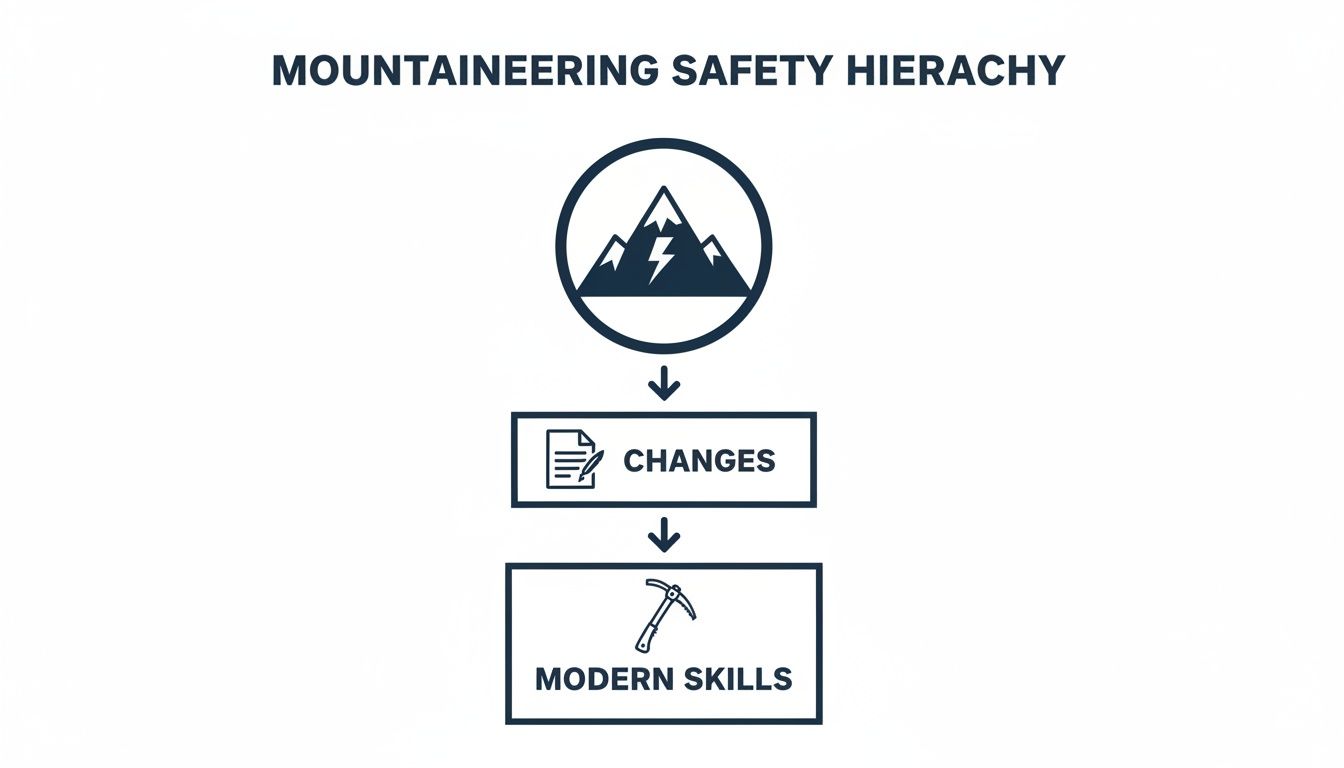
Today's core curriculum is a direct response to historical mountain disasters. It is about turning hard-won lessons into life-saving techniques.
Avalanche Awareness and Avoidance
Understanding avalanches is a critical part of any winter course. The goal is not to survive one; it is to develop the knowledge to avoid getting caught in one in the first place. This is a science that relies on careful observation and interpretation.
Key elements you will get to grips with include:
- Snowpack Analysis: You will learn to dig snow pits to examine the different layers within the snowpack, identifying weak points and understanding how factors like temperature and wind affect stability.
- Terrain Assessment: This is about learning to read a slope’s angle, its aspect (which way it faces), and its features to spot potential avalanche paths and dangerous terrain traps.
- Transceiver Use: You will practise with an avalanche transceiver, probe, and shovel until you can perform a search for a buried victim quickly and efficiently. It's a skill you hope you never have to use, but one you must have dialled.
Competence in the mountains is not about what you can do, but what you choose not to do. Recognising a high-risk slope and deciding on a different route is the mark of an expert, not a coward. It shows you understand that the environment is ultimately in charge.
Navigation and Ropework
When the clouds roll in, the landscape can lose all definition. A featureless white world, known as a whiteout , is dangerously disorientating. This is where traditional navigation skills become absolutely vital.
You will learn to navigate with precision using just a map and compass, because electronic devices can and do fail in the cold. Pacing and timing become your tools for measuring distance, ensuring you can find your way from one known point to the next, even with zero visibility.
You will also be introduced to fundamental ropework, focusing on safety for steeper ground or glacier travel. This means covering essential knots (and learning to tie them with gloves on), creating solid snow anchors (belays), and understanding the basics of protecting a team on exposed terrain. It is the starting point for the more advanced climbing and crevasse rescue techniques taught on higher-level courses.
Winter Camp Craft and Emergency Procedures
Just staying warm, dry, and fed in winter is a technical skill in its own right. A good course will teach you the discipline of winter camping, from operating a stove efficiently to melt snow for water to managing your tent in high winds. These routines are all about conserving energy and keeping morale high.
Crucially, you will also learn how to build emergency shelters. Being able to construct a snow hole or a trench can be the difference between a managed night out and a life-threatening situation if you are caught out by bad weather or an incident. A well-built shelter can protect you from winds of over 100 kph (60 mph) and keep the internal temperature close to 0°C , even when it is -20°C outside.
Understanding the theory is one thing, but for a deeper dive into the specific gear that underpins these procedures, you might find our guide on packing for resilience and essential equipment useful. Every piece of kit plays a precise role in this system.
How to Choose the Right Winter Mountaineering Course
Not all training is the same. Choosing the right winter mountaineering course is a serious decision, one that shapes your skills and, more importantly, keeps you safe when it truly matters. You can tell a lot about a provider by their philosophy, the qualifications of their instructors, and where they choose to teach. It pays to look past the marketing and dig into the principles of the organisation you are trusting with your development.
This is not a decision to rush. Your choice should align with your own ambitions, whether that is standing on top of your first Scottish Munro in the snow or getting ready for the cold emptiness of a polar expedition.
Instructor Qualifications and Ratios
The single most important part of any course is the person leading it. In the UK, the gold standard is the Winter Mountaineering and Climbing Instructor (WMCI) qualification, previously known as the MIC. This is the highest award for winter instruction, held by a small number of seriously experienced professionals and overseen by Mountain Training UK. Anyone holding a WMCI has been tested to their limits in the toughest conditions imaginable. Always check who will be leading you.
Just as critical is the ratio of students to instructors. When you are learning on steep, unforgiving ground, you need close supervision for real-time feedback and to manage risk.
A low ratio is not a luxury; it is a non-negotiable part of staying safe. When you are learning how to place an ice axe correctly or read a slope that could slide, you need immediate, specific guidance. A crowded course cannot offer that level of focus.
This is why proper winter courses in the UK, especially in places as demanding as the Cairngorms, stick to strict 1:2 instructor-to-student ratios for any technical climbing. For general winter skills, it is rarely more than 1:6. These small numbers are what make the learning effective and the environment safe, ensuring you get detailed coaching on everything from your crampon technique to your navigation. This standard allows providers to offer everything from one-day introductions to intensive five-day programmes that build your skills safely and progressively. You can get a sense of the accredited courses available through organisations like VisitScotland.
Evaluating Training Locations
The mountains themselves are your best teachers, and different locations offer very different lessons. Where you choose to train should depend entirely on what you want to achieve down the line.
- The Cairngorms, Scotland: This is one of the best and most accessible training grounds on the planet. Its notoriously wild weather and huge, arctic-like plateau create the perfect laboratory for forging real-world winter skills. If you can navigate here in a total whiteout, you can navigate almost anywhere.
- The West Highlands, Scotland: Places like Glen Coe and Ben Nevis throw steeper, more technical ground at you. This is the place to be if you are looking to move into winter climbing on classic routes like Ledge Route or Tower Ridge.
- Svalbard: Deep inside the Arctic Circle at 78° North , Svalbard is the final exam. It forces you to deal with the realities of polar bear protocols, crippling cold, and genuine remoteness. It is the ultimate proving ground before you take on a major polar journey.
The Pole to Pole Pathway
At Pole to Pole, we do not see training as a one-off event. It is a continuous path of building competence. Our entire approach is built on this clear, progressive pathway, rooted in the discipline and precision from our military and polar exploration backgrounds.
We start with the fundamentals, usually forged in the unforgiving Scottish winter, before guiding you into more serious environments. But our focus goes beyond just the technical skills. We train the mind—how to make good decisions under pressure, how to be resilient, and how to work as a team. This structured progression ensures that by the time you join a major expedition, your skills are not just something you learned; they are a part of who you are. To see how this journey unfolds, explore our detailed expedition training course programme.
The Unseen Element: Your Mindset in the Mountains
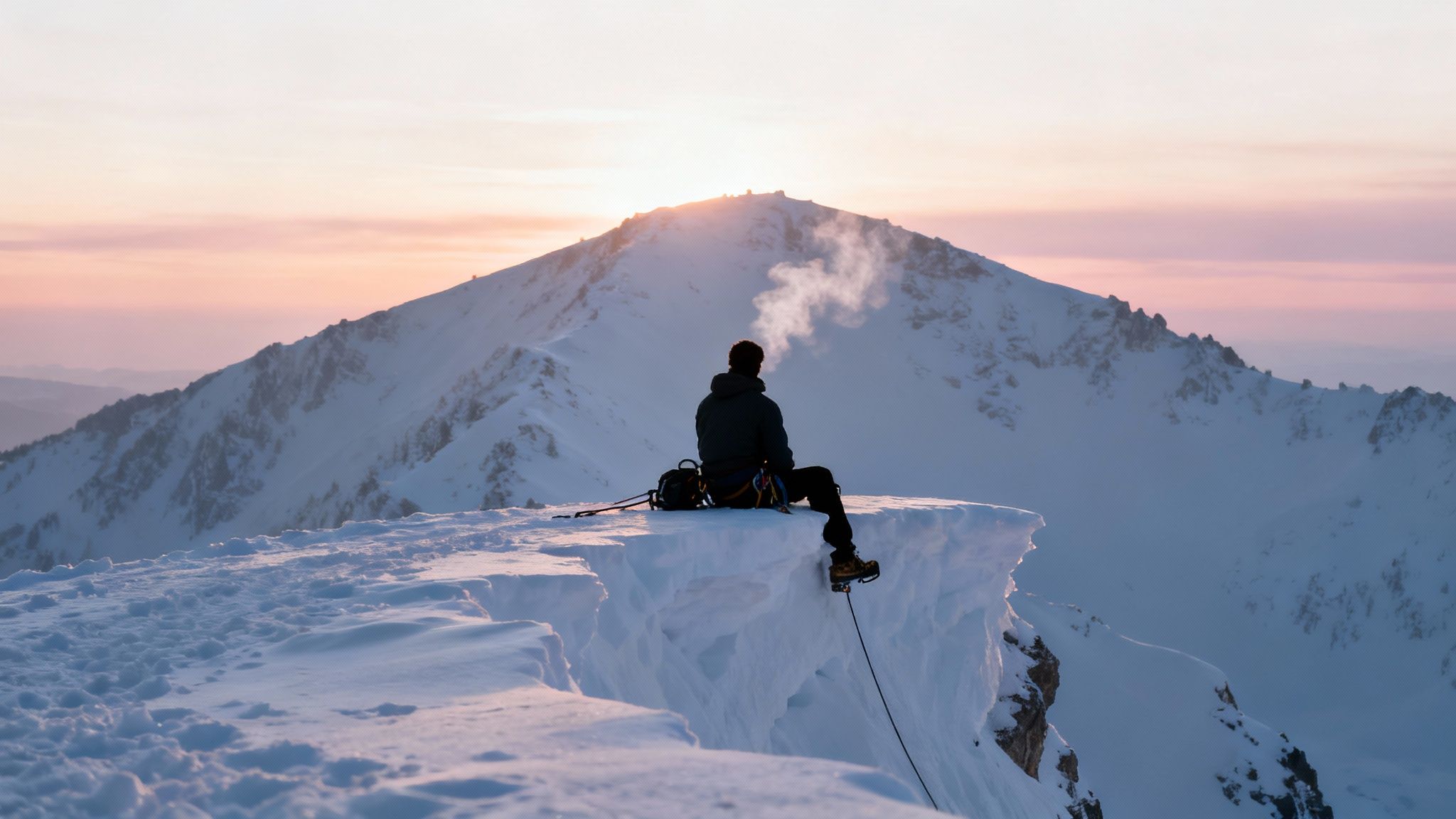
Technical skill gets you up the slope. Knowing how to use an ice axe and crampons is essential. But it is the muscle between your ears that gets you home.
The further you push into serious winter terrain, the less it becomes about physical strength and the more it becomes a game of psychology. This is why a proper winter mountaineering course spends as much time forging your mindset as it does teaching hard skills.
This is central to the Pole to Pole philosophy. It is a belief born from decades of operating in places where one bad decision has absolute consequences. The ability to stay calm, think clearly, and stick to procedure when you are cold, exhausted, and under pressure is not a natural talent. It is a drilled and practised skill.
Decision Making Under Duress
In a warm classroom, decisions are easy. In a Cairngorms whiteout, with the wind hitting 80 kph (50 mph) and the temperature at -10°C , clear thinking is the first thing to go.
The only way to prepare for this is to train in it. You have to experience the corrosive effects of stress and fatigue to learn how to fight them. This is where you learn to rely on process, not emotion.
It means:
- Trusting your compass bearing when every instinct is screaming that you are lost.
- Spotting the first signs of hypothermia in your teammate and acting decisively, even if it means turning back from the summit.
- Sticking to your turnaround time , no matter how close the objective feels.
This disciplined approach is what separates professionals from amateurs. It is the same decision-making framework used by special forces, endorsed by the likes of Jason Fox and Aldo Kane, and it is just as relevant in a high-stakes boardroom.
The toughest decisions are not made on a map; they are made in your head. Learning to manage your own internal state—fear, ego, ambition—is the ultimate skill. It is what defines a true leader, in any field.
Determination vs. Stubbornness
There is a fine line between resilience and recklessness. Determination pushes you towards a logical goal. Stubbornness is refusing to change course when all the evidence—worsening weather, a struggling teammate, the ticking clock—tells you that you must.
On our courses, we do not just teach you how to push on. We teach you when, and how, to turn back. It is arguably the most important lesson in the mountains. The mountain does not care about your schedule or your ambition. Acknowledging that is a sign of strength, not weakness.
Managing this internal battle is crucial. For a deeper dive into this, explore our guide on how to prepare your mind and body for the unknown.
Group Dynamics in the Cold
Finally, you are never alone out there. Your effectiveness is tied directly to the person next to you. Cold and fatigue are amplifiers; they turn small frictions into serious problems.
We teach you how to communicate, resolve conflict, and lead in a small team. Learning how to give and receive feedback, look after your partners, and keep morale high are skills that translate directly from a Scottish Munro to a polar tent.
Mastering them is what turns a group of individuals into a resilient, functioning team.
Your Pathway from Training Ground to Expedition
The skills you forge in a tough Scottish winter are not just for Scotland. They are the foundation for operating in the most serious environments on Earth. Think of a winter mountaineering course as your first deliberate step on a much longer journey, giving you the solid competence you need for any real cold-weather ambition.
That moment you navigate a whiteout on the Cairngorm plateau? That is the exact skill you will draw on when crossing an Antarctic ice cap. The discipline it takes to manage your layers at -5°C in Glen Coe is precisely what keeps you going at -35°C in Svalbard. This is not a coincidence. It is a methodical path from the training ground to a full-blown expedition.
From Core Skills to Polar Objectives
We created the Pole to Pole Academy to guide people along this very pathway. Our approach is progressive, making sure every participant builds their capability in a structured, logical way before taking on bigger challenges. The journey makes sense.
-
Foundational Training: It all starts here, with our core winter skills and expedition training in places like Scotland or Sweden. This is where you master the non-negotiable fundamentals: movement, navigation, and camp craft.
-
Intermediate Application: With that base, you might join a more committing trip, like our Svalbard Crossing expedition. This is where you apply your skills over multiple days in a true polar environment, complete with the strain of pulk-hauling and the reality of polar bear protocols.
-
Major Expeditions: Once you have that solid block of experience, a Last Degree expedition to the South Pole, with a pulk weighing 45-50kg, starts to feel like a realistic goal.
As you step up from training ground to full expedition, looking after your body becomes critical. Understanding the role of the best recovery tools for athletes can make a huge difference to your endurance and readiness.
Offsite On Purpose
This pathway is not just for individual explorers. Our ‘Offsite On Purpose’ programmes apply the same methodology to the corporate world. We take leadership teams out of the boardroom and drop them into an environment that demands real resilience, crystal-clear communication, and decisive leadership.
The lessons learned managing risk on a mountainside translate directly to the boardroom. A winter mountaineering course is so much more than a certificate. It is the start of a process. It is the point where your ambition finally meets competence, and the first true step towards discovering what is possible.
Common Questions About Winter Mountaineering
To round things out, let us tackle some of the most common questions we get from people thinking about taking their first steps into winter mountaineering. These should clear up a few practical points and show why proper training is so crucial.
What Sort of Fitness Do I Really Need?
Good, solid hill fitness is the foundation. You need to be comfortable walking for 6-8 hours in the hills, carrying a rucksack that weighs about 10kg (22 lbs). This is not about explosive, gym-style power; it is all about endurance.
If you arrive with a decent level of cardio fitness, you can focus your energy on learning the technical skills – how to use an axe, how to read an avalanche forecast – instead of just struggling to keep pace.
Do I Need to Buy All the Gear Immediately?
No. Any reputable provider, including Pole to Pole, will supply the essential technical kit. This includes the high-value items: your ice axe, crampons, and helmet.
What you are expected to bring is your personal clothing – a solid layering system is key – and a pair of sturdy, B2-rated winter boots. We will send you a detailed kit list, but the expensive hardware is provided. It means you can try the sport properly before you start investing significant money.
The best piece of kit in the world is useless if you do not know how to use it. Our courses are about building your skills with professional-grade equipment, so you gain real competence with the tools you will eventually own.
How Does a UK Winter Course Prepare You for a Polar Expedition?
The skills are not just similar; they are the absolute bedrock of what you will do in the polar regions. Everything you learn in a Scottish winter is directly transferable. It is the foundation.
Learning to navigate in a Cairngorms whiteout is, for all intents and purposes, the same as navigating on the Antarctic plateau. Figuring out how to manage your layers to avoid sweating in Scotland teaches you the vital moisture control you will need when it is -30°C .
The ropework, the camp craft, the mental grit you develop in the UK mountains – these are the core competencies for any committing expedition. A Scottish winter is one of the best and most demanding training grounds on the planet for any serious objective you have in mind.
The journey from aspiring mountaineer to a competent expeditioner is a deliberate one, built on expert training and hard-won experience. Pole to Pole provides the structured pathway to get you there, safely and effectively.