Your Definitive Guide to a Winter Skills Course Scotland
A winter skills course in Scotland is non-negotiable for anyone serious about travelling through its mountains when they're blanketed in snow. It is the training that builds your foundation: how to use an ice axe and crampons, how to navigate when you cannot see your hand in front of your face, and how to read the ever-present risk of avalanches.
This is where you graduate from hillwalking into the entirely different world of winter mountaineering.
Understanding the Unique Demands of a Scottish Winter
To get a real sense of why this training matters, put yourself on the Cairngorm plateau. You're near the summit of Ben Macdui ( NN 989 989 ), and the weather turns. It always does. In a matter of minutes, the temperature plummets, the wind howls, and visibility drops to almost nothing. The snow-covered ground melts into the grey sky, and suddenly you are in a disorienting, featureless whiteout.
This is not a worst-case scenario. This is just another day in a Scottish winter.
The culprit is our maritime climate. It is nothing like the dry, predictable cold of the polar regions. Scotland’s winter is defined by its dampness and its sudden, often violent, mood swings. Temperatures constantly dance around 0°C , creating a relentless freeze-thaw cycle. The result? Complex, icy terrain hidden just beneath a fresh dusting of snow.
The Myth of Conquering Nature
This kind of environment quickly teaches you the foolishness of trying to "conquer" or "battle" the mountains. Stubbornness in the face of an approaching storm is not strength; it is a massive liability.
Our philosophy is simple: we do not fight nature—we learn to live within it. A skills course is not about bravado. It is about building the quiet competence you need to make good decisions when you are tired, cold, and the pressure is on.
It is about learning to read the mountain's subtle cues. Understanding why wind slab is building up on a particular slope, recognising the exact moment it is time to turn back, and knowing how to work your gear with numb fingers. This is the hard-earned wisdom that separates a winter mountaineer from a hillwalker.
Our training is not about teaching you to endure the environment; it is about giving you the skills to operate with confidence within it. The objective is not just to survive but to move efficiently and make informed choices, turning a potentially hazardous day into a rewarding one.
The skills you learn here will take you anywhere. Mastering persistent damp and navigating in a total whiteout builds a powerful foundation for bigger ambitions. As you can see in our guide to the Pole to Pole Winter Expedition Experience , getting these fundamentals right is the first step to operating in any cold-weather environment on the planet, from the Highlands to the high Arctic.
The unique challenges of Scotland make it one of the world's finest—and most honest—training grounds.
What You’ll Actually Learn in the Scottish Mountains
A winter skills course in Scotland is not about sitting in a classroom. It is about applied knowledge, where every single lesson gets put to the test against the unforgiving reality of the mountain. These core skills are not just a list to tick off; they are a complete system for moving safely and efficiently through some of the UK’s most demanding terrain.
You will learn progressively, starting with the absolute fundamentals before stringing them all together on a proper mountain journey. The goal is to build real competence. From that competence, genuine confidence grows—not the other way around.
This is the only way it works. You cannot just decide to be confident. You have to earn it by mastering the skills that matter when it counts.
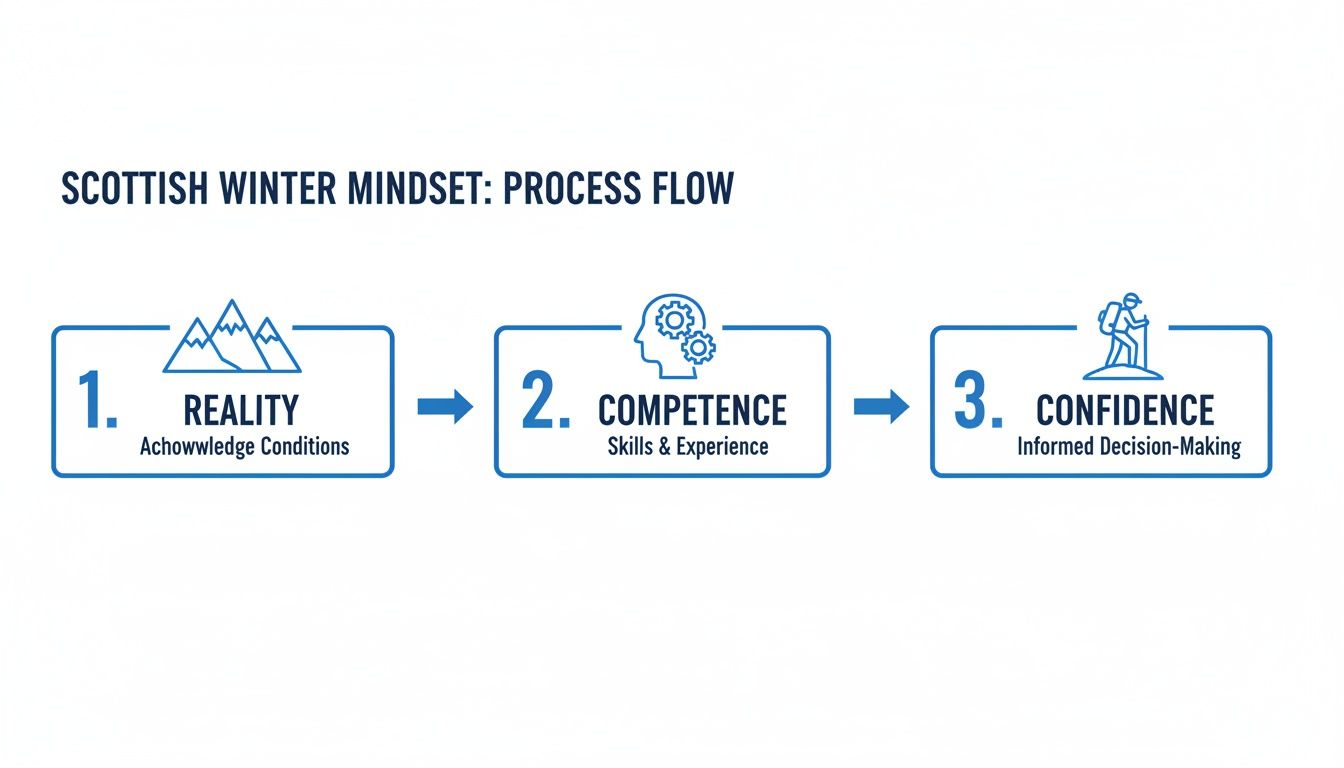
Confidence is not the starting point; it is what you walk away with after mastering essential, practical skills in a real-world setting.
Ice Axe and Crampon Work
An ice axe is not a fancy walking pole. On steep, frozen ground, it is your lifeline. A huge part of any good course is dedicated to its proper use, taking you from the basic principles to immediate, hands-on practice.
You will get to grips with:
- Walking Techniques: How to hold and use the axe for balance and support as the slope changes, learning the dagger, anchor, and brace positions.
- Cutting Steps: Using the adze (the flat part) to carve secure footholds on traverses or short, steep sections of hard snow.
- Self-Arrest: This is the big one. It is a non-negotiable, life-saving skill. You will practise stopping a slide—head first, feet first, on your back, on your front—over and over until it becomes pure muscle memory.
Crampons are your direct connection to the ice. You will be taught how to fit them properly to your rigid B2 or B3 boots and how to walk with a deliberate, flat-footed technique to stop yourself from tripping. The focus is on moving efficiently over ice and hard-packed snow, making sure every point bites in for maximum security.
Navigating in a Whiteout
When the clag descends on the Cairngorm plateau, visibility can drop to less than 10 metres . All landmarks disappear. In this environment, trusting your GPS is a rookie error—the cold kills batteries fast. Real navigation is a disciplined, manual process.
A whiteout strips the mountain bare. There are no reference points. It is the ultimate test of your navigation skills, and getting it right has nothing to do with luck. It is about following a meticulous, repeatable procedure.
The training is all about learning to trust your map and compass implicitly. The key skills are:
- Pacing and Timing: Learning to accurately measure the distance you have travelled over completely featureless ground.
- Bearing Accuracy: Taking and following precise compass bearings without a single visual landmark to aim for.
- Micro-Navigation: Using tiny changes in the slope and subtle contours to pinpoint your exact position on the map.
You will spend hours with your head down, practising these skills, often taking turns to lead the group across a vast, white expanse. It is tough mental work, but it builds a deep reliance on process—a skill that is directly transferable to big expedition life, as championed by polar explorers like Børge Ousland.
Avalanche Awareness and Avoidance
Avalanche risk is simply part of the deal in the Scottish winter. Understanding it is not about being scared; it is about making smart, informed decisions. A winter skills course in Scotland gives you the foundation to make safer choices.
You will learn to read the daily forecasts from the Scottish Avalanche Information Service (SAIS), understanding which aspects and elevations are most at risk. More importantly, you will learn to connect that forecast to the actual snow under your feet.
This breaks down into three parts:
- Recognising Terrain: Identifying classic avalanche hotspots, like slopes between 25 and 45 degrees , cornices, and terrain traps like gullies that can bury you deep.
- Observing the Snowpack: Learning to spot visual clues of instability, like cracking snow or signs of recent avalanche activity.
- Planning Your Route: Choosing routes that keep you away from hazards, planning your day from the warmth of the bunkhouse before you even step outside.
You will also get an introduction to the essential rescue kit—transceiver, shovel, and probe—and run through a basic companion rescue scenario. But the main lesson is always avoidance. The best rescue is the one you never needed.
Choosing Your Scottish Highlands Training Ground
Scotland is not a single, uniform training ground. The mountains have their own distinct personalities, and the best providers choose their patch of ground very deliberately to teach specific skills. Deciding where to take your winter skills course in Scotland is really about deciding which lessons you want to learn first.
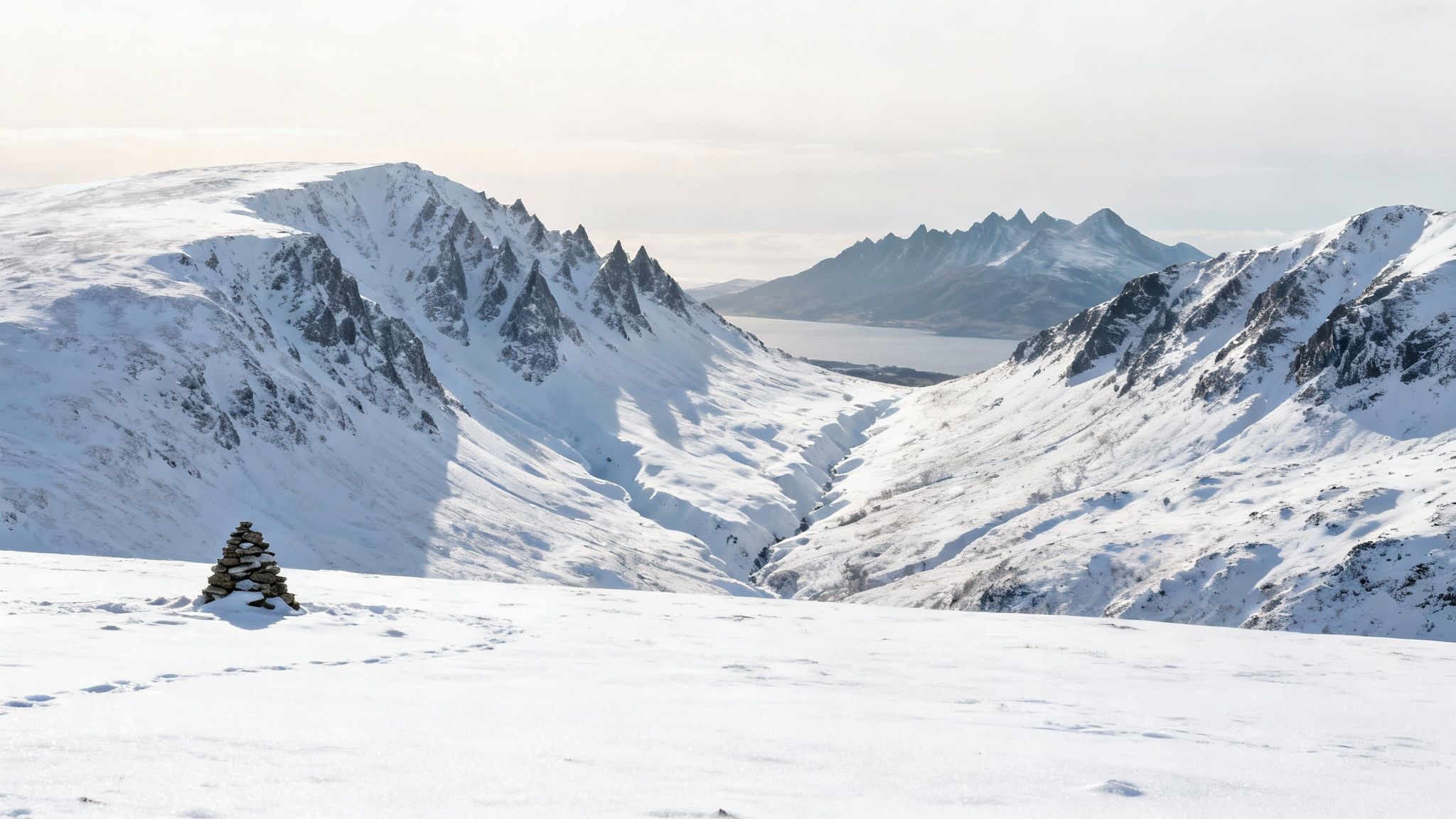
We focus on two primary zones, each throwing a different set of challenges at you to build a well-rounded winter mountaineer. These are not just convenient spots; they are selected because they force you to make the kind of decisions you would face in much bigger, more remote mountain ranges.
The Cairngorms National Park
The Cairngorms are all about scale. Home to a vast, arctic-like plateau, this is the ultimate classroom for winter navigation. When the visibility drops—and it will—the rolling, often featureless terrain around summits like Cairn Gorm ( NJ 005 040 ) becomes a serious test.
Here, the focus is on painstaking map and compass work, pacing, and timing. There are no shortcuts. The environment itself enforces a discipline and a process that are absolutely critical for anyone with ambitions for bigger expeditions. The Northern Corries also offer reliable, accessible slopes for getting to grips with your ice axe and crampons.
Glencoe and the Fort William Area
The west is a different beast entirely. The mountains around Glencoe and Fort William, including the UK’s highest peak, Ben Nevis ( NN 167 713 ), are steeper, rockier, and altogether more complex. The maritime climate hits harder here, often dumping huge amounts of snow and plastering the crags in ice.
This is the natural place to build confidence moving on steep, tricky ground. The sharp ridges of Aonach Mòr or the hidden gullies of Glen Coe are perfect for dialling in your crampon technique, practising ice axe arrests, and learning the fundamentals of snow anchors and ropework. The sheer complexity of the terrain also provides constant, real-world lessons in avalanche awareness and smart route choice.
A Sample 3-Day Itinerary
To give you a clearer picture, most foundation courses follow a logical progression, no matter the location. The idea is always to build the core skills first, before linking them together on a proper mountain day. Each day builds methodically on the one before.
The goal is not to rush you to a summit. The true objective is competence. The summit is just a by-product of good decisions and solid skills executed well.
This sample itinerary gives you a feel for how your understanding and confidence will develop over a short, intense course.
Here's a breakdown of what a typical foundational course looks like:
| Day | Morning Session (Approx. 4 hours) | Afternoon Session (Approx. 4 hours) |
|---|---|---|
| Day 1 | Foundations : Kit check, winter boot and crampon fitting, basic movement on snow, ice axe use | Self-Arrest Practice : Introduction to and repeated practice of ice axe arrests on a safe, steep slope |
| Day 2 | Winter Navigation : Map and compass work, pacing, timing, and interpreting avalanche forecasts | Consolidation : A short mountain journey applying navigation and movement skills in unison |
| Day 3 | Mountain Journey : Full day objective, putting all skills into practice on complex terrain | Route Choice and Debrief : Focus on decision-making, emergency procedures, and review of the day |
As you can see, the learning is layered, ensuring you are not overwhelmed and that the skills have a chance to stick.
Providers across these key regions offer well-structured programmes for all levels. When choosing your training ground, it can be helpful to explore broader outdoor-focused Scotland experiences to get a feel for the different areas and what they offer.
Reputable providers are plentiful. A foundational two or three-day winter skills course in Scotland will typically cost between £195 and £395 per person . These courses almost always maintain a low instructor-to-client ratio, usually 1:6 , to guarantee both safety and quality, hands-on instruction. Companies like Highland Ascents are a good starting point for checking out specific course details.
Essential Kit And Layering Systems For Scottish Conditions
In the Scottish mountains, your equipment is your life support system. This is not about shiny, new kit; it is about the right kit—gear that is tough, reliable, and built for the uniquely damp, biting cold that defines a Scottish winter. Get it wrong, and you are not just looking at a bit of discomfort. You are inviting genuinely dangerous situations.
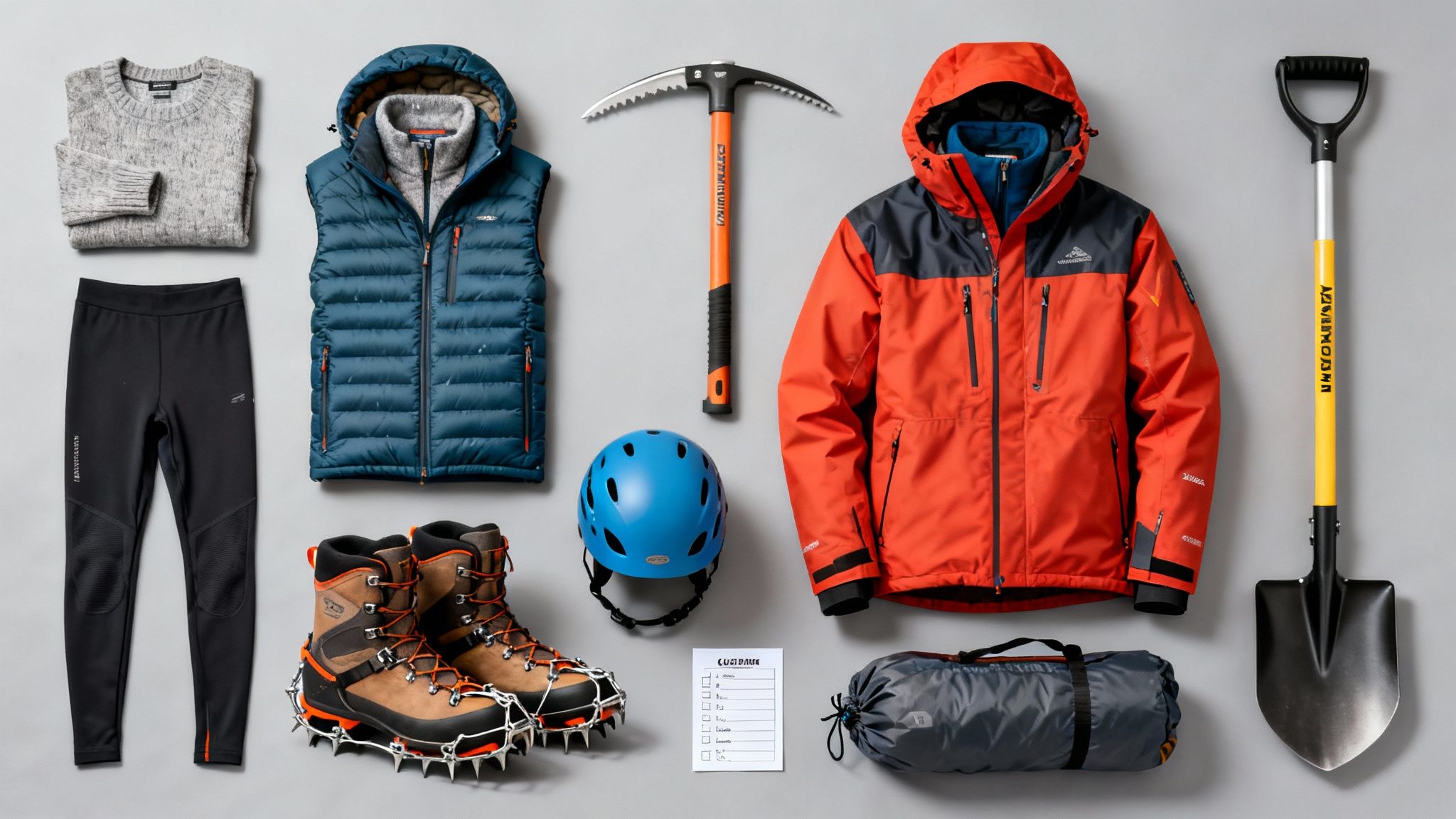
There is a massive difference between standard hillwalking gear and what you need for a serious winter skills course in Scotland . What keeps you happy on a crisp, dry day in the Brecon Beacons will fail you spectacularly in a Cairngorms blizzard. Here, moisture management is everything.
Mastering The Layering System
In a Scottish winter, sweat is your enemy. Once your clothes are damp, they suck heat from your body at an alarming rate, putting you on a fast track to hypothermia. Think of your layers as a hands-on tool you have to constantly manage to control your temperature—stripping one off before a steep climb, adding it back on the second you stop.
It all boils down to three core parts:
-
Base Layer: This is what sits against your skin. Its only job is to pull sweat away from your body. Merino wool from brands like Fjällräven is the gold standard because it insulates even when it is a bit damp and will not smell after a few days. Whatever you do, avoid cotton. It is like a sponge, holding moisture right where you do not want it.
-
Mid Layer: This is your main insulation. A good fleece or a light synthetic insulated jacket works perfectly. The key is breathability; you need moisture to escape outwards. Most of us carry a couple of different weight mid-layers to adapt as the day changes.
-
Outer Shell (Hardshell): This is your armour against wind and water. It needs to be a fully waterproof and windproof jacket and trousers, with taped seams. Look for durability, too. It has got to stand up to scrapes from rock, ice, and the constant rubbing of your rucksack straps.
Your clothing system is not static. Think of it as a dynamic toolkit for managing your microclimate. Getting it right means staying dry from the inside out and warm from the outside in—a constant balancing act that is a core skill in itself.
Essential Personal And Technical Equipment
Beyond your clothes, your personal kit and technical hardware are non-negotiable. This is where reliability is king. There is a reason everyone uses gear from proven brands like Petzl and Black Diamond—it has been tested to destruction in the harshest places on earth.
Your feet are your foundation, so robust, warm boots are absolutely critical. Options like these waterproof winter snow boots are a great starting point, but they must be rated B2 or B3 . That stiffness is what you need to kick steps, get purchase on icy ground, and securely attach a crampon.
A detailed kit list is the bedrock of good preparation. We take this seriously, and if you want to understand our philosophy on why the right equipment is so vital, have a read of our guide on Packing for Resilience . It explains the principles we apply to every single one of our expeditions.
Comprehensive Winter Skills Kit Checklist
The checklist below outlines the essential gear you'll need for a multi-day winter skills course. Whilst you can often hire technical hardware like an ice axe and crampons, your personal clothing and equipment are your own responsibility. It is on you to ensure it is up to the job.
| Category | Essential Items | Key Considerations |
|---|---|---|
| Personal Clothing | Waterproof Hardshell Jacket & Trousers, Insulated Jacket, Fleece Mid-Layers, Merino Base Layers, Winter-Weight Trousers, Thick Wool Socks (plus spares), Warm Hat/Balaclava, Waterproof Gloves & Warm Mitts | Focus on moisture-wicking and weather protection. Bring spares of crucial items like gloves and socks. |
| Footwear | B2 or B3 Rated Winter Mountaineering Boots, Gaiters | Boots must be crampon-compatible and well broken-in to avoid blisters. Gaiters are essential for keeping snow out. |
| Technical Hardware | Walking Ice Axe ( 55-65cm is typical), C1 or C2 12-point Crampons, Climbing Helmet | Ensure crampons are correctly fitted to your boots before you are on the hill. A helmet is vital for protecting against ice and rock fall. |
| Navigation | Laminated Map (OS 1:50,000 ), Compass (e.g., Silva Type 4), GPS device/phone (as backup only) | Physical map and compass are your primary tools. Batteries fail in the cold; do not rely solely on electronics. |
| Safety & General | Rucksack ( 40-50 litres ), Head Torch with Spare Batteries, Survival Bag or Bivvy Bag, Goggles & Sunglasses, First Aid Kit, Whistle | Your pack must be large enough to carry all your gear plus a share of group safety equipment. Goggles are critical in a blizzard. |
| Sustenance | High-Energy Food, Hot Drink in a Flask (at least 1 litre ) | Bring food that is easy to eat with gloves on. A hot drink provides both warmth and vital hydration. |
Taking the time to get your kit right before you arrive does not just make the course more comfortable—it keeps you and the rest of the team safe. It is the first step in building the mindset you will need when you are out on the hill.
How to Choose Your Provider and Get Properly Prepared
Picking the right provider for your winter skills course in Scotland is the single most important decision you'll make. It is the difference between simply going through the motions and truly internalising the skills that will keep you safe. Your choice dictates the quality of the teaching, the margin for error, and ultimately, whether you leave with genuine confidence.
Just as crucial is how you prepare yourself. Arriving fit and with the right mindset means you can focus on learning, not just surviving the day.
The number of companies offering courses is huge, but a few non-negotiables separate the true professionals from the rest. The gold standard is an instructor holding the Winter Mountaineering and Climbing Instructor (WMCI) award. This is the highest qualification for winter mountaineering in the UK, a guarantee that your guide has been tested in the absolute worst conditions imaginable.
Another critical factor is the instructor-to-client ratio. For a foundational skills course, this should never be more than 1:6 . A smaller group size is essential. It means you get the hands-on coaching you need to nail skills like a life-saving ice axe arrest or navigating in a complete whiteout.
Vetting Your Provider
Before you book anything, do your homework. A credible provider will be completely upfront about their qualifications and who they work with.
- Qualifications: Check that the instructors hold the WMCI, or at the very least, the Winter Mountain Leader (WML) award. They should also be part of a governing body like Mountain Training Scotland.
- Reputation: Look for established providers. Read their reviews. Do they focus on teaching and safety, or is it all about bagging summits? You want an educator, not just a peak-bagger.
- Logistics: Get clear on what is included. Any good company will provide the technical kit—ice axe, crampons, helmet—but everything else is on you.
The demand for proper training has shot up. A recent report from Mountain Training Scotland noted a staggering 159% increase in people enrolling for Winter Mountain Leader courses in just one season. It is a clear sign that more and more people realise just how serious the Scottish winter can be. You can read more about these trends in their annual report.
Physical and Mental Preparation
You do not need to be a super-athlete, but turning up physically and mentally ready is non-negotiable. Good fitness means you can get the most out of your course instead of just trying to keep up.
Your fitness is a tool. It allows you to focus on learning new, complex skills without being distracted by exhaustion. A tired mind makes poor decisions, and in a Scottish winter, good decisions are everything.
A solid benchmark to aim for is the ability to walk for 6-8 hours over rough, hilly ground, carrying a rucksack that weighs around 10kg . This is a realistic simulation of a day in the mountains, and it ensures you will have the stamina to stay switched on from start to finish.
Getting your head in the right space is just as important. This is not just about being "tough." It is about developing resilience, being prepared to make decisions when you are cold and tired, and understanding that you are part of a team.
The skills you learn here are the building blocks for much bigger adventures. This is the training ground, the place where you forge the competence needed for serious expeditions. Building this foundation is a core part of the philosophy at The Pole to Pole Academy, where we hone expeditionary skills for the world's most demanding environments. A Scottish winter is the perfect place to start that journey.
Got Questions About Scottish Winter Skills?
Good. You should have. Stepping into the Scottish mountains in winter is a serious undertaking. To help you get your head in the right space, here are straight answers to the questions we hear most often.
How Fit Do I Really Need to Be?
Let’s skip vague terms like “good fitness.” They do not help anyone. Here is the real-world benchmark: can you hike for 6-8 hours across rough, hilly ground whilst carrying a rucksack that weighs about 10kg?
Think of your fitness as a resource. When you are physically comfortable, your brain is free to focus on learning complex new skills—like reading an avalanche slope or arresting a slide with your ice axe. An exhausted mind is a liability in the mountains. Simple as that.
Do I Need to Fork Out for All the Expensive Kit?
No. Any provider worth their salt will supply the core technical gear for the course. This is the specialist, expensive stuff you need to operate safely.
This always includes:
- A walking ice axe
- A pair of 12-point crampons (and they will make sure they are fitted correctly to your boots)
- A climbing helmet
What you are responsible for is your personal clothing and kit. That means your waterproofs, your layering system, your rucksack, and—critically—a pair of B2 or B3 rated winter mountaineering boots. Those rigid soles are not optional; they are essential for your crampons to lock on securely.
Is a Scottish Course a Good Stepping Stone for Bigger Expeditions?
Absolutely. In fact, it is arguably better preparation than training in a more stable, predictable cold environment.
Why? Because the damp, penetrating cold and notoriously poor visibility of the Scottish Highlands teach you a level of self-management you just do not learn elsewhere. Learning to handle persistent moisture in your layers is a masterclass in staying functional. Nailing a compass bearing when you cannot see your own feet builds a procedural discipline that is the bedrock of all serious expeditionary travel. People like Sir Ranulph Fiennes built their careers on these exact skills.
What’s a Typical Group Like?
The mix is almost always one of the best things about the course. You will find people from every walk of life, all there for the same reason: to learn to move safely in the winter mountains.
We see everyone from twenty-somethings to people in their sixties and beyond. You might be learning alongside a seasoned summer hillwalker wanting to extend their season, an aspiring alpinist building foundational skills, or someone who simply wants to experience the raw beauty of the Highlands in winter. That shared goal creates a powerful, supportive team vibe, fast.
At Pole to Pole , we know that the skills forged in the Scottish winter are the foundation of expedition competence. This is where you build the resilience and the mindset for any cold-weather objective, anywhere on Earth. If you're ready to lay that groundwork, we are ready to show you how.