Drakes Passage Waves: A Pole to Pole Guide
The stories you hear about the Drake Passage waves almost always come before the journey itself. They paint a picture of a wild, two day crossing at the bottom of the world a barrier between South America and the Antarctic Peninsula.
But for those of us who have made the voyage, this stretch of water is not an obstacle to be conquered. It is a fundamental part of the Antarctic experience.
A Rite of Passage to the White Continent
Crossing the Drake is the first real, tangible step of any sea-bound Antarctic expedition. It’s a rite of passage, connecting you directly to the history of polar exploration. You are in the wake of explorers like Shackleton and Amundsen.
This is not a journey of brute force; it is one of respect and adaptation. At Pole to Pole, we hold a core belief: we don’t fight nature, we live in it. The crossing is a pure expression of that idea.
The transit has a way of filtering your mind. It strips away the noise of the modern world and attunes you to the profound silence of the continent ahead. The rhythmic, powerful swell of the ocean becomes a form of meditation, focusing you on what is to come. It is the perfect acclimatisation, not just for the body, but for the spirit.
The Journey as Preparation
Those two days at sea are invaluable. This is not dead time; it is a critical phase of preparation for the expedition. During the crossing, you will be occupied:
- Attending detailed briefings: Our expedition leaders—seasoned professionals with years of polar experience—will walk you through safety protocols, environmental guidelines, and exactly what to expect on the Peninsula.
- Acclimatising to the vessel: You will learn your way around the ship, find your sea legs, and settle into the unique rhythm of expedition life.
- Connecting with your team: A shared crossing builds a bond. It forges the group dynamics that are essential for a successful expedition.
- Observing unique wildlife: These nutrient-rich waters are a haven for seabirds. It is not uncommon to see a wandering albatross gliding effortlessly behind the ship for hours.
This transition period is a key part of the journey. It ensures you arrive on the continent not as a tourist, but as a prepared, informed member of an expedition team.
The passage demands patience and a certain level of acceptance—the very qualities you need to truly appreciate the pristine wilderness that awaits. For anyone planning their own journey, understanding the practicalities is the first step. Our guide on how to get to the Antarctic breaks down the entire process. The Drake Passage is simply the first, and most profound, chapter of that story.
Understanding the Forces Behind Drake Passage Waves
To properly understand the Drake Passage, you must understand the immense planetary forces that give it its character. The powerful drakes passage waves are not random chaos; they are the product of a unique geographic and oceanic collision that exists nowhere else on Earth. It is where oceans, currents, and winds meet with an intensity that is formidable.
The passage is the chokepoint where three great oceans—the Atlantic, Pacific, and Southern—converge. That alone would be enough to create a complex and dynamic sea, but the real driver here is the Antarctic Circumpolar Current (ACC) , the most powerful ocean current on the planet.
Imagine a colossal river, one that circles the entire globe without encountering a single landmass. That is the ACC. It flows endlessly eastward around Antarctica, gathering momentum with every nautical mile.
The Great Squeeze
The Drake Passage itself, stretching approximately 800 kilometres ( 500 miles ) between South America’s Cape Horn and Antarctica's South Shetland Islands, acts as a natural funnel. All the energy of the ACC is squeezed through this relatively narrow gap, concentrating its power.
This physical geography and the forces at play represent a convergence of planetary-scale phenomena. The passage's depths, averaging 3,400 metres , interact with a current flowing at up to 200 million cubic metres per second .
To put that into perspective, the Drake Passage pushes through about 600 times more water every second than the entire Amazon River. This funnelling effect is a key reason why the Drake generates such legendary swells. If you wish to look deeper into how this impacts the journey, there are some useful insights into the Drake Passage crossing time.
The Unbroken Fetch of the Furious Fifties
On top of the current, you have the relentless westerly winds. Known as the ‘Furious Fifties’ because of their latitude, these winds also circle the globe with virtually no land to slow them.
The uninterrupted distance the wind blows over the water is called fetch . An unlimited fetch such as this allows the wind to pump a tremendous amount of energy into the ocean’s surface, steadily building larger, stronger, and more powerful waves over thousands of kilometres.
The concept map below shows how all these elements come together to define the Drake Passage experience. It is not just a body of water; it is a gateway.
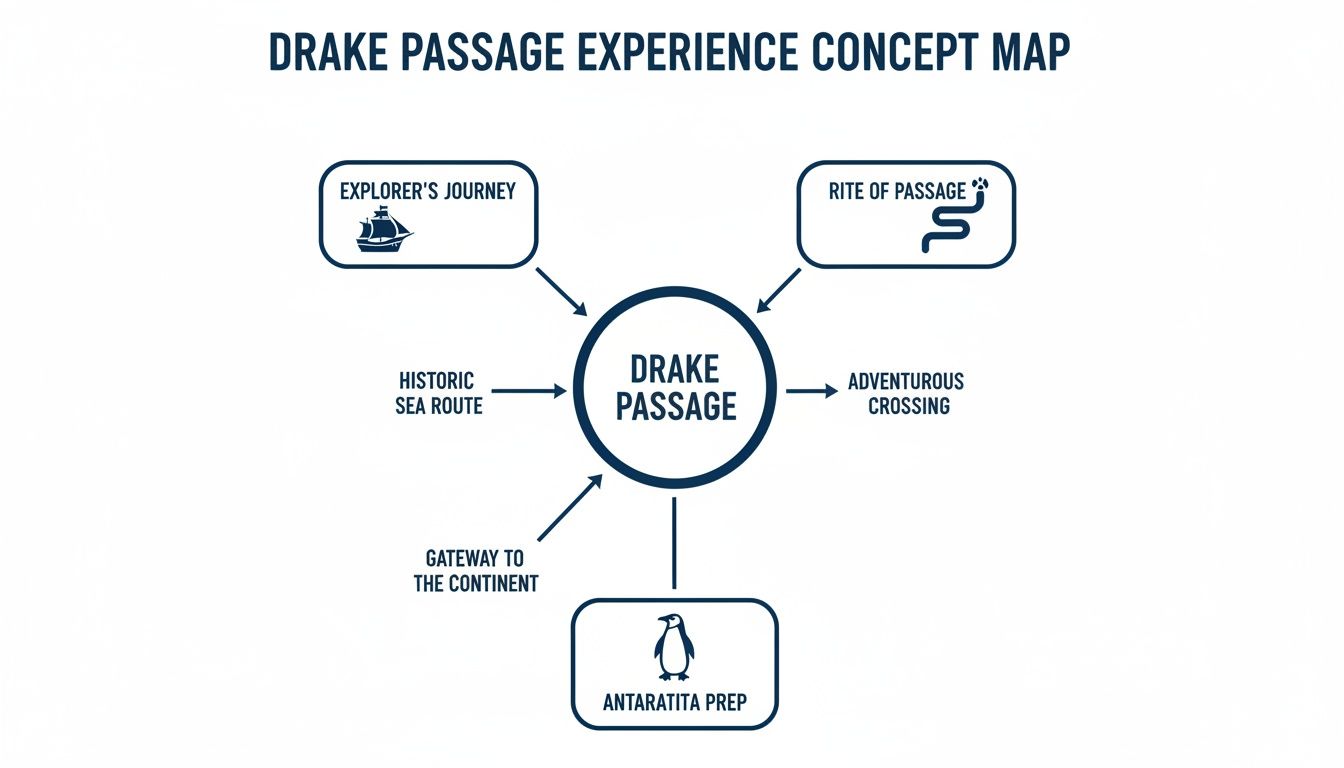
This journey is far more than a geographical crossing. For any Antarctic expeditioner, it is a rite of passage—an essential part of preparing for the continent ahead.
It is this combination—a powerful, unobstructed current squeezed through a deep channel, relentlessly driven by high-energy winds with an infinite fetch—that creates the formidable and often unpredictable drakes passage waves .
There is no malice to it; it is just physics on a planetary scale. Understanding this helps an explorer move from fearing the crossing to respecting it. It becomes a profound introduction to the forces that govern the polar world—the first lesson in the Pole to Pole ethos: we don't fight nature, we learn to move with it.
The Drake Shake vs The Drake Lake: What to Expect

Amongst seasoned Antarctic travellers, you will hear two phrases used to describe the crossing: the ‘Drake Shake’ and the ‘Drake Lake’. These nicknames capture the passage's two distinct personalities. One journey might feel remarkably placid, whilst the next delivers the powerful, rolling seas the region is known for.
But the reality is that neither extreme is the day-to-day norm. Most crossings land somewhere in the middle—an impressive, yet entirely manageable, display of oceanic power that modern vessels are built to handle.
Knowing what is possible helps you set the right expectations and mentally prepare for the transit. It is a rite of passage, and whatever conditions you get are simply part of your unique story.
Gauging the Swell: A Realistic Outlook
When preparing for an expedition, hyperbole is unhelpful. Let’s look at the actual numbers. In typical conditions, you can expect to see swells averaging between 3 to 5 metres (10–16 feet). This creates a noticeable and consistent rolling motion on the ship, something you find your sea legs for quite quickly.
Of course, the Drake Passage has earned its reputation for a reason. During more severe weather, the passage confirms its status as one of the world's most formidable maritime routes. Both historical and modern observations have consistently documented drakes passage waves reaching 13–15 metres (42–49 feet). In truly exceptional storms, some captains have even reported waves approaching 20 metres (66 feet). To get a deeper look at the conditions, see this guide to this legendary passage from Secret Atlas.
These numbers are not meant to intimidate; they are meant to inform. They illustrate the raw energy of the Southern Ocean and highlight why travelling with an experienced crew on a purpose-built polar vessel is non-negotiable.
The key is to accept the conditions rather than resist them. Use the time to read, attend lectures from the expedition team, or simply watch the seabirds from the bridge. This mental shift from enduring to experiencing is fundamental.
An expeditionary mindset is about adapting to the environment as it is. Whether you are met with a ‘Shake’ or a ‘Lake’, the goal is the same: cross safely and arrive in Antarctica ready for what lies ahead. The conditions are a variable you cannot control, but your response is entirely within your hands.
Drake Passage Sea State Conditions
To help translate wave heights into what you will actually feel onboard, we have put together a simple table. This framework helps demystify the crossing, turning abstract weather data into a practical guide for your two-day transit towards the Antarctic Peninsula.
| Condition | Common Name | Typical Wave Height (Metres) | Onboard Experience |
|---|---|---|---|
| Calm | Drake Lake | 0–2 metres | Minimal vessel movement. Smooth sailing with easy walking around the decks. Excellent for wildlife spotting. |
| Moderate | Drake Passage | 3–5 metres | Consistent, noticeable rolling. "Sea legs" required. Secure loose items in your cabin. Most common condition. |
| Rough | Drake Shake | 6–9 metres | Significant vessel motion. Decks may be closed. Handrails become essential. Movement around the ship is limited. |
| Severe | Heavy Drake Shake | 10+ metres | Intense conditions. Passengers advised to remain in cabins. All outdoor access is restricted for safety. |
No matter the conditions, remember that the ship's stabilisers will be working to smooth out the motion, and the captain will always be navigating a course designed for maximum comfort and safety. The passage is a dynamic environment, but it is one that is deeply understood by the professionals who navigate it every day.
How Modern Vessels Handle the Drake
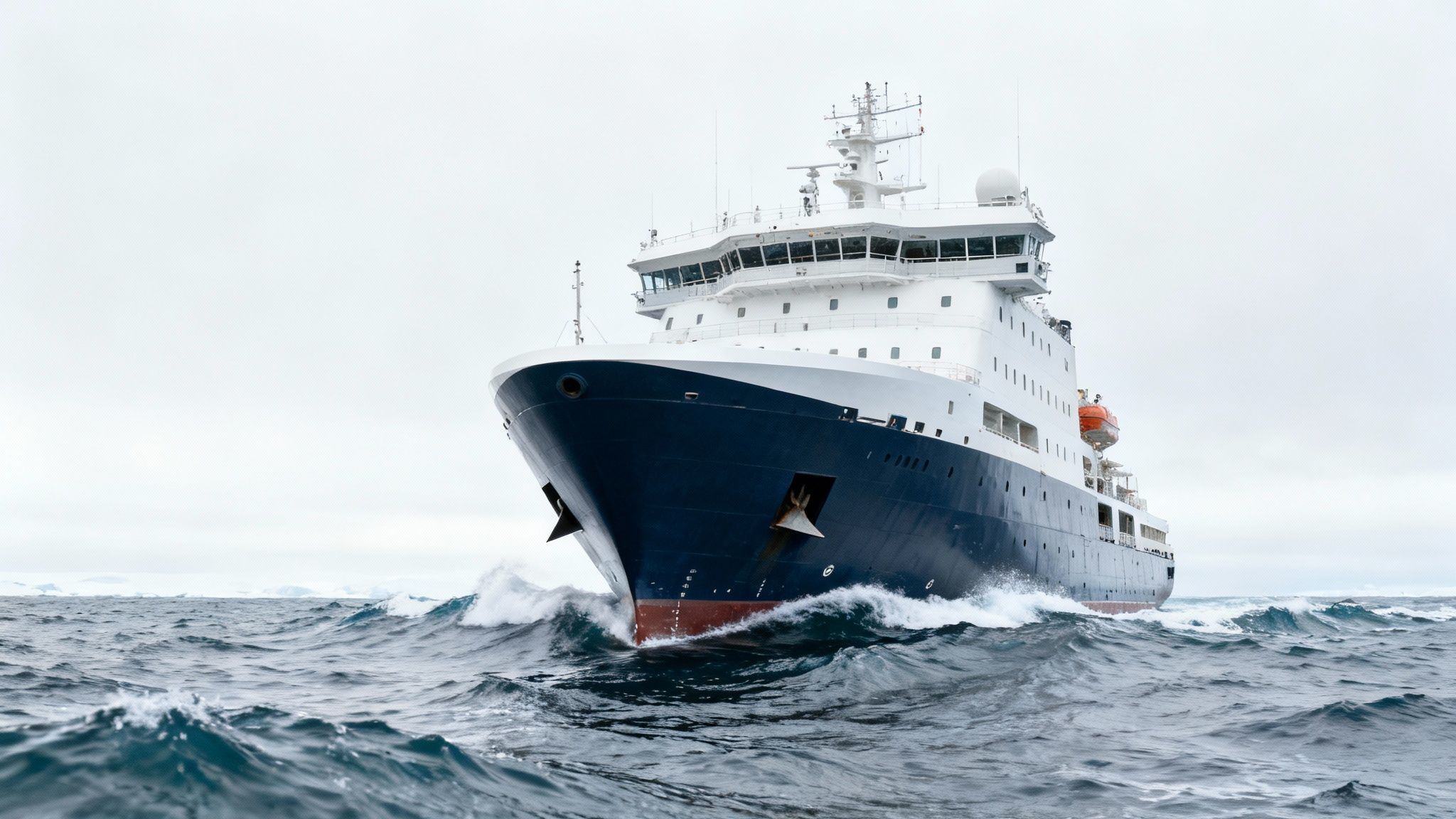
The old stories from Shackleton’s time paint a picture of small wooden ships tossed about, completely at the mercy of the Southern Ocean. Today, things are profoundly different from then. The raw power of the drakes passage waves has not changed, but our ability to navigate them has been transformed by engineering and decades of experience.
Modern polar expedition vessels are not cruise ships pointed south. They are purpose-built tools, designed from the keel up for the most extreme marine environments on Earth. Every feature is a direct answer to the forces of the Drake. This is not about fighting the ocean; it is about moving through it with intelligence and respect.
The goal is to engineer safety and stability into the very heart of the ship, making sure that whilst the world outside is wild, the experience inside is secure and as smooth as possible.
Advanced Stabilisation and Hull Design
The single biggest advance for passenger comfort is active fin stabilisers. Picture them as large, retractable wings fitted beneath the waterline. As gyroscopes sense the slightest roll, these fins pivot in real-time to counteract the wave’s push, keeping the vessel steady.
They work a bit like the ailerons on an aeroplane's wing, constantly making small adjustments to keep everything level. This technology can reduce the ship's roll by up to 85% , turning a 'Drake Shake' into something far more manageable.
But it is not just about add-ons; the very shape of the hull is crucial. Several key design elements work together:
- Ice-Strengthened Hulls: This is non-negotiable for polar travel. These hulls are significantly thicker than a standard ship's, giving them immense structural integrity against both waves and ice.
- Deep Draughts: Polar ships sit lower in the water. This increases their natural stability in heavy seas, acting like a counterweight to lessen the side-to-side motion from wind and waves.
- Innovative Bow Designs: A significant development here is the X-BOW® , a patented inverted bow. Instead of crashing up and slamming down on waves, this design pierces through them. The result is a much smoother ride with less pitching, reduced vertical jolts, and better fuel efficiency, allowing the ship to hold its course more effectively in rough seas.
These features all work in harmony, creating a resilient and stable platform for your journey. It is a testament to how engineering can deliver safety without taking away from the profound feeling of being in a truly wild place. That same ethos of resilience and preparation is central to all our expeditions, especially our demanding ocean challenges .
The Human Element: Route Planning and Expertise
All the technology in the world is useless without the right hands guiding it. The most important safety system on any vessel is a highly experienced captain and their crew. The team on the bridge of a polar ship has a deep, almost intuitive understanding of these waters, built over countless crossings.
They do not just react to the weather; they get ahead of it. Using sophisticated satellite forecasting and live ice-chart data, captains constantly analyse the bigger picture, plotting the safest and most efficient path across the Drake.
A route is never just a straight line drawn on a map. The captain will constantly adjust the course and speed, sometimes adding hours to the trip, to find the path of least resistance. They might steer into the lee of a storm or time their transit to miss the worst of a swell.
This dynamic, intelligent routing is the most effective tool we have for softening the blows of the Drake Passage waves. It is a quiet, professional competence that ensures you arrive in Antarctica feeling ready and focused for the adventure ahead.
Preparing Your Mind and Body for the Crossing
The most advanced vessel is only one part of the equation. The other, arguably more important, is the human element. How you approach the Drake Passage crossing determines not just your comfort, but the quality of your entire Antarctic experience.
This is your first real test. It is where the expeditionary mindset we cultivate at Pole to Pole—a mindset built on acceptance, not resistance—is put into practice. Arriving in Antarctica focused and ready starts here.
Managing the Physical Crossing
Seasickness is a simple, physical reaction to the ship’s motion. It is nothing to be ashamed of, and for most people, it is entirely manageable. The key is to be proactive. Waiting until you feel unwell is often too late.
We always recommend speaking with your doctor long before you travel. Items such as patches or tablets can be incredibly effective, but they work best when you use them before we even leave the Beagle Channel.
Beyond medication, a few simple actions can make a world of difference:
- Look to the horizon. Fixing your eyes on a stable point in the distance helps your brain make sense of the movement your body feels.
- Get fresh air. Spending time on deck (when it is safe, of course) can work wonders. The cool, fresh air is a powerful antidote to nausea.
- Eat light, stay hydrated. Sip water and stick to plain foods like crackers. Now is not the time for heavy, greasy meals or too much alcohol.
- Find the centre. The middle of the ship on a lower deck is the most stable point, experiencing the least amount of pitching and rolling.
Adopting an Expeditionary Mindset
Your mental approach is just as vital as your physical comfort. The drakes passage waves present the first challenge where you have to accept what you cannot control. Fighting the motion is a fast route to exhaustion; the goal is to learn to move with it.
This is not dead time. It is an opportunity. Use these two days to attend lectures from the expedition team, read about Shackleton’s exploits, or just watch the albatrosses shadow the ship.
This transit strips away the noise of the outside world, giving you space to mentally prepare for the profound quiet of the continent ahead. It is a forced exercise in patience and resilience—core skills for any expeditioner. We go deep on this at the Pole to Pole Academy; you can learn more about our approach to training for the unknown and preparing your mind and body.
Practicalities matter, too. Wearing the right gear is crucial. Understanding the essentials for a comfortable offshore day will give you useful insight into layering for unpredictable conditions like these.
Embrace the crossing. See it as a rite of passage, an integral part of the adventure. That way, you will not just endure it; you will experience it. You will arrive on the Antarctic Peninsula not as a mere passenger, but as a prepared, focused member of the expedition.
A Few Questions We Hear About the Drake Passage
The Drake Passage has a reputation, and it is natural to have questions about what the crossing really involves. Here are some straight answers to the queries we hear most often, designed to give you a clear picture of this essential part of your Antarctic adventure.
How Long Does It Take to Cross the Drake Passage?
You can generally expect the crossing to take around 48 hours . This is not set in stone. The final duration depends on the ship's speed and, more importantly, the sea conditions. Our captains are masters of polar navigation and will often adjust the course and pace to find the most comfortable path through the Drake Passage waves , which might add some time to the journey. Every Pole to Pole itinerary is built with this flexibility in mind, so there is always ample time for a safe, unhurried crossing.
Is Crossing the Drake Passage Safe?
Yes. Stepping aboard a modern, purpose-built expedition vessel is profoundly different from the voyages of early explorers. These ships are specifically designed to handle these waters, equipped with advanced navigation, satellite weather forecasting, and powerful stabilisers that take the edge off the motion.
More than that, the crews are seasoned professionals who have spent years navigating the world's most challenging seas. Safety is not just a box to be ticked; it is the guiding principle behind every single decision, from planning the route months in advance to the moment-by-moment operations on board.
What Should I Pack Specifically for the Drake Passage?
Whilst your main kit is geared for Antarctica, the crossing is about two things: comfort and managing potential seasickness. We strongly suggest packing any seasickness medication you prefer and keeping it in your day bag, not packed away in your main luggage.
For the two days at sea, think casual and comfortable. You will be spending time attending lectures, spotting birdlife from the observation lounge, or reading a book. It is a good idea to have a small daypack with your immediate essentials, so you can settle in without rummaging through your larger bags. We would suggest including:
- Any personal medications you need.
- A good book or an e-reader.
- Headphones for music or podcasts.
- A reusable water bottle to stay hydrated.
Can I Just Fly Over the Drake Passage?
You can. There are ‘fly-cruise’ trips that skip the sea journey, flying you from South America to the South Shetland Islands to meet a ship. But at Pole to Pole, we believe the crossing is an irreplaceable part of the experience. It is a true rite of passage.
This journey connects you to every explorer who came before and gives you time to mentally disconnect from the world you left behind. It prepares you, step by step, for the immense scale and remoteness of the continent ahead. We encourage everyone to embrace it.
The journey across the Drake Passage is the gateway to a significant adventure. At Pole to Pole , we ensure every stage is managed with expertise and a deep respect for the environment. Explore our expeditions to find your own rite of passage.