How to Get to the Antarctic A Practical Expedition Guide
Getting to Antarctica isn't about booking a single flight. It's a logistical problem, and it all starts with one fundamental decision. Most expeditions begin from Ushuaia in Argentina or Punta Arenas in Chile, but from there, the path splits into three very different journeys: the classic expedition cruise , a time-saving fly-cruise , or a full-on human-powered expedition into the continent’s vast interior.
Your Blueprint for Reaching the Antarctic Continent
The real question isn’t where to go, but how you want to experience it. Before you even look at a map, you need an honest discussion with yourself. Are you here for the incredible coastal wildlife and relative comfort of a ship, or is your goal a deep, physical immersion in the polar environment?
Your answer to that question is the single most important filter for everything that follows. It dictates your timing, your budget, your physical preparation, and the very nature of the experience you'll have on the ice. Get this right from the start, and the rest of the planning falls into place.
The Three Primary Routes to the Ice
Your journey will almost certainly fall into one of these three categories, each with its own rhythm and set of demands.
-
Expedition Cruise: This is the traditional sea voyage, usually lasting 10-20 days . It involves the legendary Drake Passage crossing, a two-day journey that's a rite of passage for many polar travellers. This is the best option if you want to experience the full ocean journey and focus on coastal landings, glaciers, and wildlife.
-
Fly-Cruise Combination: If you're short on time or wary of the Drake's notoriously rough seas, this is your answer. You fly from Punta Arenas, Chile, straight to King George Island ( 62°02′S 58°21′W ) in the South Shetlands, meeting your ship there. It cuts out about four days of sailing time.
-
Human-Powered Expedition: This is the sharp end. It’s for those aiming to ski to the South Pole or explore the continental interior. You’ll fly with a specialist logistics provider to a base like Union Glacier Camp, then set off on skis, pulling all your supplies in a pulk.
This flowchart breaks down the basic paths, helping you see how your priorities for time and experience shape the journey.
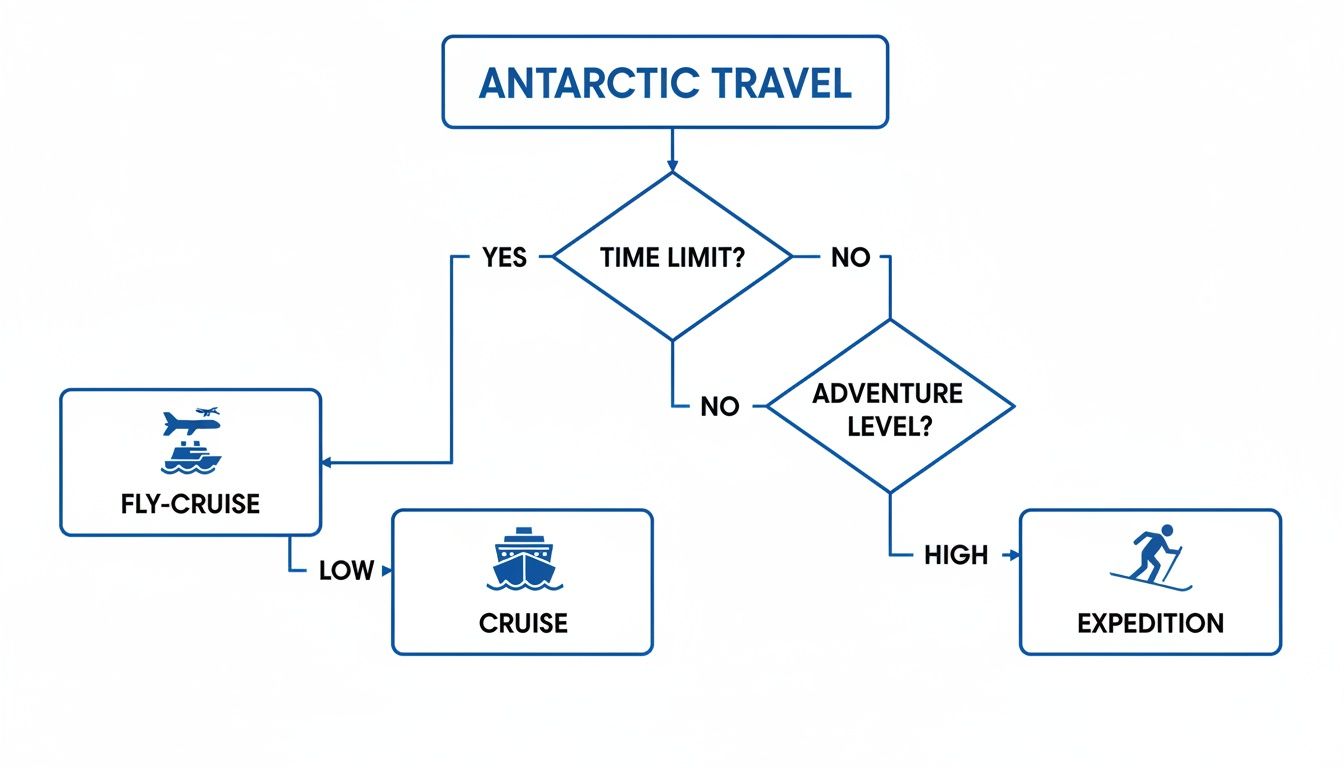
As you can see, the choice between a cruise, fly-cruise, or a deep-field expedition is the foundation upon which the entire trip is built.
To give you a clearer picture, here’s a quick breakdown of how these three main options stack up against each other.
Antarctic Travel Methods at a Glance
| Travel Method | Typical Duration | Estimated Cost Range (GBP) | Drake Passage Crossing | Best For |
|---|---|---|---|---|
| Expedition Cruise | 10–20 days | £6,000–£20,000+ | Yes, by sea (2 days each way) | Wildlife enthusiasts, photographers, and those wanting the full sea voyage experience. |
| Fly-Cruise | 8–12 days | £8,000–£25,000+ | No, fly over it | Time-conscious travellers or those prone to seasickness who want to maximise time on the Peninsula. |
| Human-Powered Expedition | 14–60+ days | £40,000–£100,000+ | No, fly to the interior | Experienced adventurers seeking a profound physical and mental challenge, like skiing to the Pole. |
This table should help you narrow down your initial thinking. Cost, time, and your tolerance for rough seas are the big factors that push people towards one path over another.
Following Historical Footprints
The challenge of just getting to the continent is nothing new. Back in 1907, Ernest Shackleton’s Nimrod Expedition was the first British-led effort to explicitly target the South Pole, reaching a Farthest South of 88°23'S . His logistical blueprint was methodical: depart London, load up with provisions in New Zealand, then battle 2,400 kilometres (1,500 miles) of treacherous ocean to make landfall.
That same deliberate, step-by-step approach to reaching Antarctica resonates today. The skills Shackleton and his men honed are the very ones we drill in our Pole to Pole Academy courses. You can read more about this incredible story and the wider history of Antarctic exploration.
Choosing Your Vessel: Expedition Cruise vs Fly-Cruise
For most people, the journey to the Antarctic Peninsula begins at sea. But how you make that sea journey is your first big decision, and it fundamentally shapes the entire trip. You’ve got two main choices: the traditional expedition cruise or the faster fly-cruise.
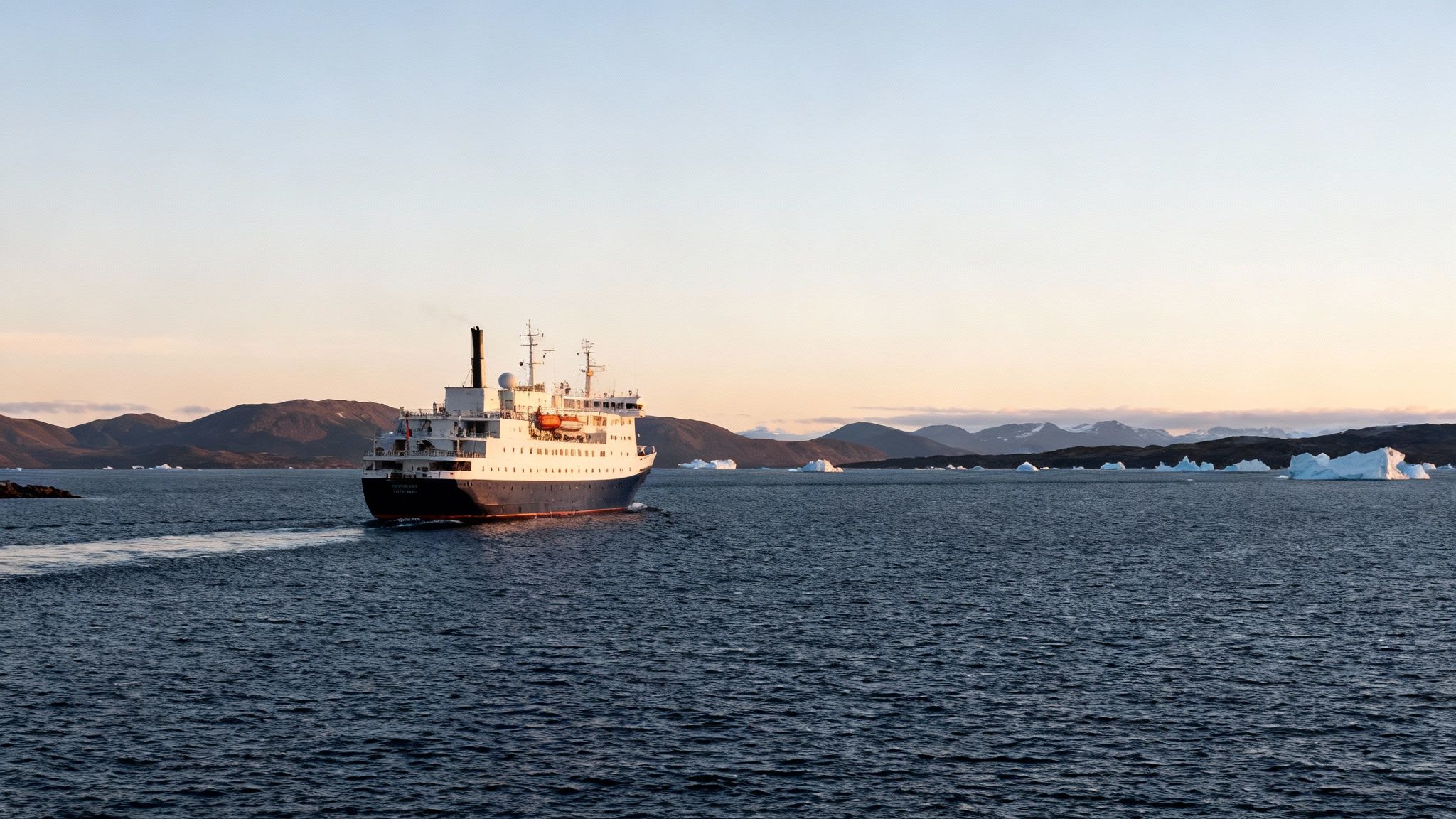
This isn’t just about logistics. It’s about how you want to arrive, what you’re willing to endure, and what you want from the story you’ll tell afterwards. Each path has its own character, with real trade-offs to consider.
The Classic Expedition Cruise
This is the archetypal Antarctic journey. You board your ship in Ushuaia, Argentina, and sail across the Drake Passage—the legendary stretch of water separating South America from the White Continent. For many, crossing the Drake is a rite of passage.
The crossing takes roughly 48 hours each way. It can be famously unpredictable, ranging from the glassy calm of the ‘Drake Lake’ to the formidable ‘Drake Shake’, with swells that will test the stomach of even the most experienced sailor. It’s not for the faint of heart, but it’s a core part of the adventure narrative.
That time at sea is far from wasted. It’s a period of enforced decompression, where you disconnect from the world and prepare for what’s ahead. Onboard lectures from geologists, historians, and biologists give you the context to truly understand the continent you’re about to step on. It’s a deliberate, immersive build-up.
You find your sea legs, learn to move with the rhythm of the ship, and settle into expedition life. Modern vessels have excellent stabilisers and seasickness medication is effective, but you need to go in with realistic expectations.
The Efficient Fly-Cruise Option
If you’re short on time or have a deep-seated aversion to rough seas, the fly-cruise is a brilliant alternative. It bypasses the Drake Passage completely, saving you around four days of travel.
You’ll fly on a two-hour charter plane from Punta Arenas, Chile, landing at Frei Station on King George Island ( 62°12'S, 58°57'W ). From there, you walk a short distance to the shore and board your ship, which is already waiting in the calm, protected waters of the South Shetland Islands. This gets you into the heart of the action fast, maximising your time for Zodiac cruises, wildlife watching, and shore landings. For anyone on a tight schedule, this is a game-changer. Our complete guide to the gateway to Antarctica, Punta Arenas , offers more detail on this important departure hub.
But there’s a big caveat: weather. The flight to King George Island is entirely dependent on a clear weather window. Delays of a day or more aren’t uncommon, which can eat into your itinerary. You’re essentially trading the certainty of a sea crossing for the potential uncertainty of Antarctic aviation.
A Practical Comparison
| Feature | Expedition Cruise | Fly-Cruise |
|---|---|---|
| Departure Port | Ushuaia, Argentina | Punta Arenas, Chile |
| Drake Passage | Crossed by sea ( ~48 hours each way ) | Bypassed by air ( ~2-hour flight ) |
| Typical Duration | 10–20 days | 8–12 days |
| Primary Risk | Seasickness and rough conditions | Weather delays for flights |
| Best For | Immersive journey, time for lectures, rite of passage | Time-sensitive travellers, avoiding seasickness |
Once you've settled on a cruise, the sheer number of booking options can feel overwhelming. It’s worth checking out the best cruise booking sites to simplify the process. Ultimately, the choice between these two excellent options comes down to your personal priorities: time, budget, and your appetite for the full Southern Ocean experience.
The Human-Powered Route: Planning a True Expedition
If your ambitions stretch beyond the Antarctic Peninsula and into the vast, white interior, you’re moving from tourism into the realm of true expedition. This is a different beast altogether. Planning a human-powered journey, whether it’s to the South Pole or another deep-field objective, is a serious undertaking that demands methodical, long-term preparation.
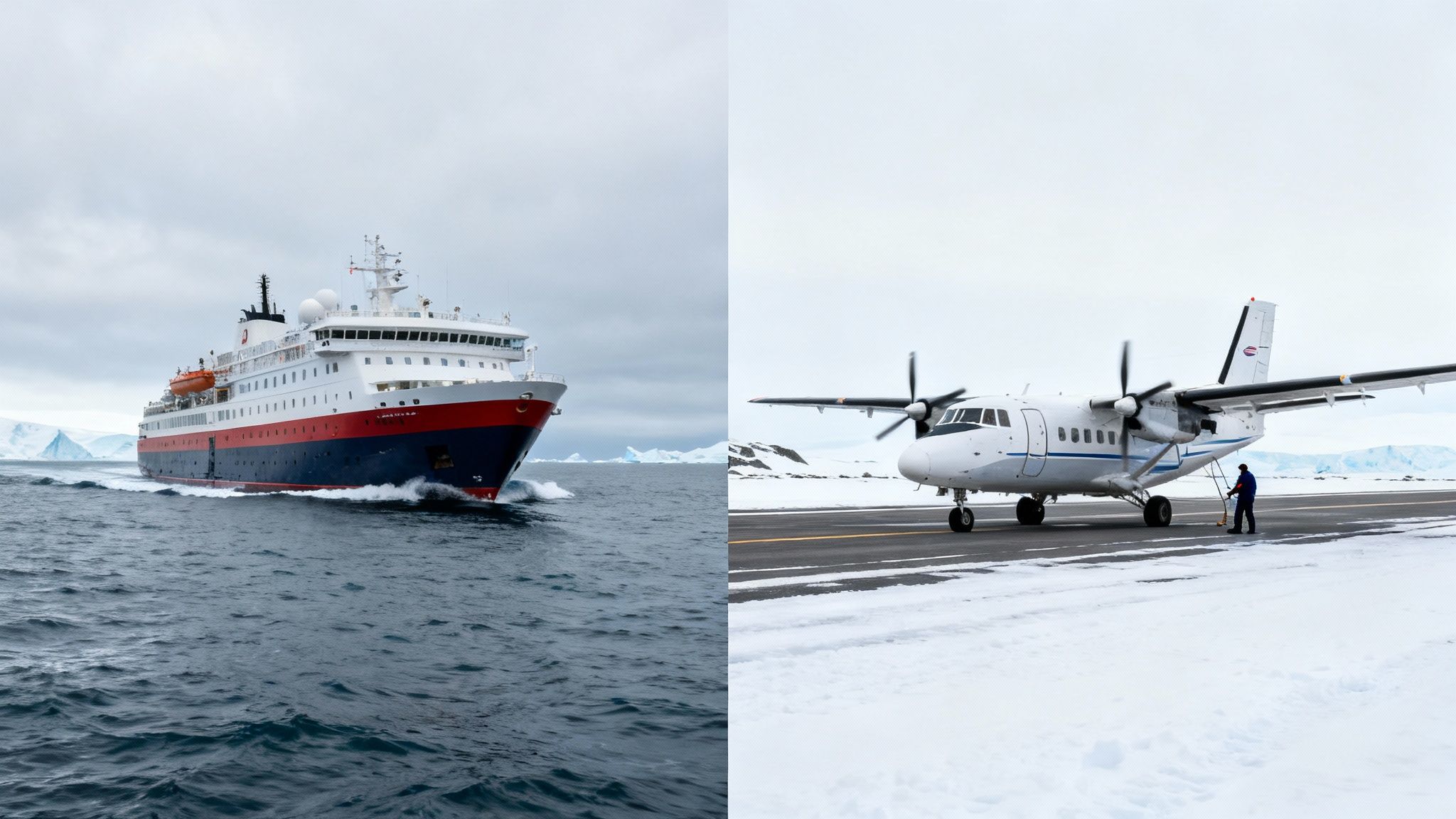
Unlike coastal voyages, these journeys kick off with a specialised flight from Punta Arenas, Chile. You’ll board an Ilyushin IL-76, a beast of an aircraft, and land on a blue-ice runway at Union Glacier Camp ( 79° 46′ S, 83° 14′ W ). This remarkable camp, run by Antarctic Logistics & Expeditions (ALE), is the central hub for almost every private expedition into the continent’s interior. It’s the gateway from which all human-powered adventures begin.
Defining Your Expedition Objective
Once you’re at Union Glacier, two main expedition goals typically emerge. Each requires a totally different level of commitment, time, and physical grit, but both demand a mindset forged long before you ever step foot on the ice.
-
The Last Degree Ski Journey: This is the most common goal for guided expeditions. A short Twin Otter flight from Union Glacier drops you at the 89th parallel. From there, you ski the final 60 nautical miles (111 kilometres) to the Geographic South Pole. It’s a formidable challenge, usually taking between 8 to 12 days .
-
Full Coast-to-Pole Expedition: This is the classic, unassisted journey that echoes the great explorers like Amundsen and Scott. You start from a coastal point like the Ronne Ice Shelf or Hercules Inlet and ski the entire distance—over 1,130 kilometres (700 miles) . This is a massive undertaking that can last up to 60 days .
The choice between these two is fundamental. One is an intense, focused effort; the other is a profound test of endurance and self-reliance.
The Reality of a Polar Journey
Whatever your objective, the daily routine on the ice is stripped back to the absolute essentials. An expedition day becomes a disciplined cycle: melt snow, ski, navigate, and manage your body and your gear. Repeat.
You can expect to ski for 8-10 hours every day , covering 15-20 kilometres (9-12 miles) depending on the snow and terrain. You’ll be pulling a pulk—a sledge loaded with all your food, fuel, and shelter. For a Last Degree trip, that pulk will weigh between 45-50kg (100-110 lbs) . For a full coast-to-pole journey, the starting weight is far greater.
This is where the physical and mental preparation becomes non-negotiable. It’s not about brute strength; it’s about sustainable, all-day endurance and the mental resilience to perform simple tasks flawlessly in extreme cold. Think of Robert Falcon Scott's Discovery Expedition, which launched from the UK. His team covered over 1,200 miles by sledge and ski, a testament to the old-school approach of departing British ports and enduring the Southern Ocean's fury. Pole to Pole’s South Pole challenge mirrors that spirit, with fixed-date departures training people to ski-haul over 580 statute miles to the pole. You can find more on this historic UK-Antarctic timeline on the official British Antarctic Territory heritage site.
Building Competence Before Confidence
Roald Amundsen’s success wasn't built on bravado; it was built on meticulous preparation. He tested his kit, perfected his routines on Norway’s Hardangervidda plateau, and left nothing to chance. That same ethos guides modern polar travel. You don't just show up in Antarctica and hope for the best.
"We don't fight nature—we live in it. The objective is not to conquer the environment, but to become competent enough to move through it safely and efficiently. That competence is the true foundation of confidence."
This is precisely why training is essential. Programmes like those at the Pole to Pole Academy aren’t a luxury; they’re a fundamental part of the process. Before you even consider booking a flight to Chile, you must master the basics in a controlled but challenging environment.
This means getting out to places like Svalbard or Sweden and learning to:
- Manage your layering system to prevent sweating.
- Navigate in a complete whiteout.
- Set up a tent quickly and efficiently in high winds.
- Operate a stove and melt snow safely inside your tent.
These skills are the bedrock of any successful expedition. The Antarctic is an unforgiving place that will expose any weakness in your preparation or mindset. Gaining proficiency beforehand is the only responsible way to approach a journey like skiing the Last Degree to the South Pole. It ensures you arrive on the continent not as a hopeful tourist, but as a capable member of the team.
Mastering Your Logistics: Paperwork, Fitness, and Kit
An Antarctic journey is won or lost long before you ever set foot on the ice. The success of any serious expedition rests on a foundation of meticulous preparation. It might not be the most glamorous part, but getting your logistics, physical condition, and equipment dialled in is absolutely non-negotiable.
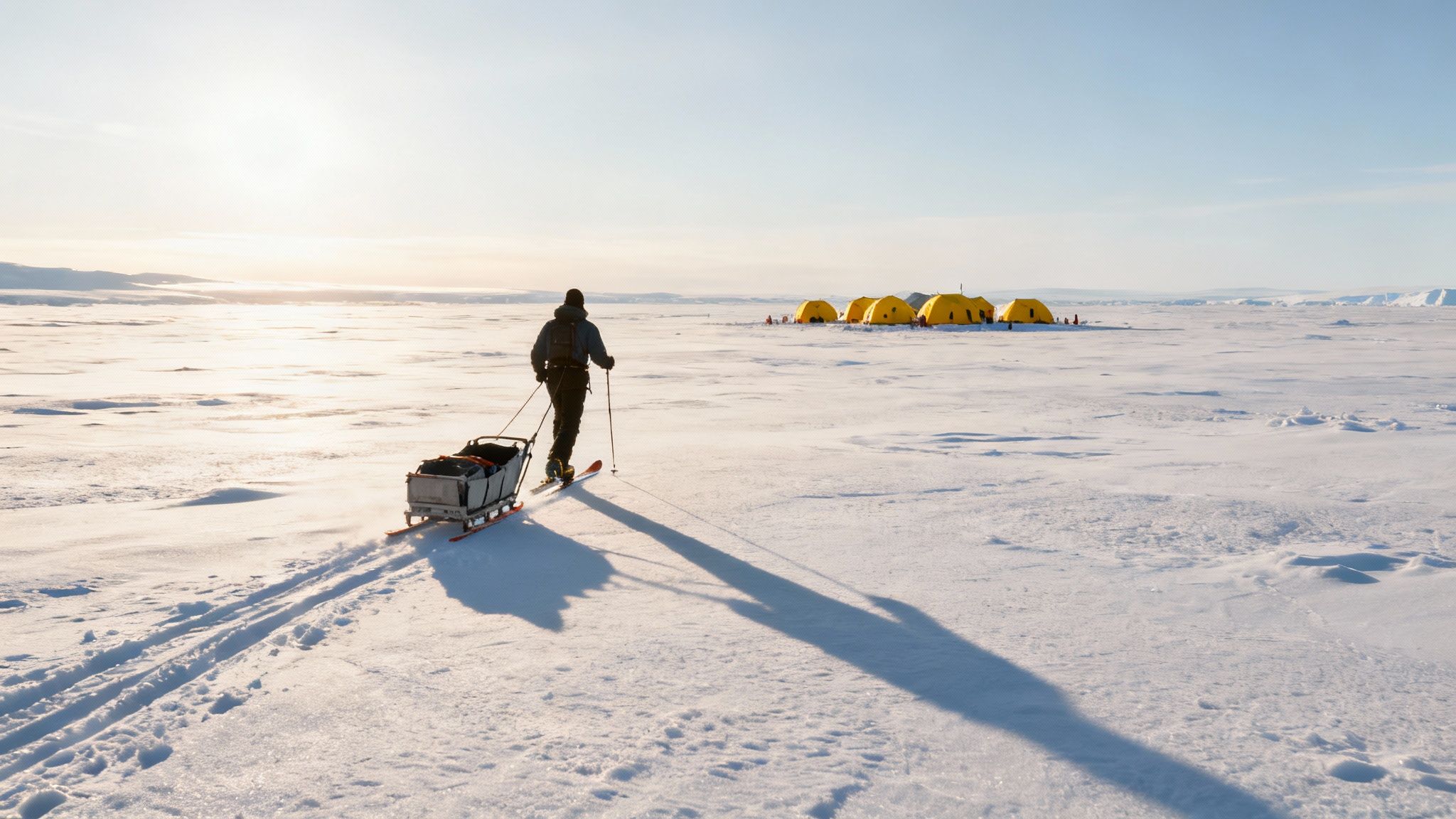
This kind of logistical discipline has deep roots in British Antarctic history. During the Second World War, Operation Tabarin (1943-1945) was a masterpiece of planning that established the UK's first permanent bases on the continent. Launched from Britain amid wartime threats, it saw personnel successfully overwinter in temperatures dropping to -40°C , proving that structured preparation is the key to polar survival.
Navigating the Essential Paperwork
Your first hurdle is administrative. Any private expedition that goes beyond standard tourist routes falls under the Antarctic Treaty System. This means you have to secure a permit from your home country’s responsible government body—for British citizens, that's the Foreign, Commonwealth & Development Office (FCDO). Be prepared for a thorough process; they will require detailed route plans, an environmental impact assessment, and robust contingency plans.
Alongside the permit, specialist insurance isn't a recommendation; it's mandatory. Your standard travel policy will not cut it. You need a policy with comprehensive medical evacuation coverage, and a minimum of £200,000 is a realistic starting point. An emergency flight from the Antarctic interior can easily soar past that figure, so this is one area where you absolutely cannot cut corners.
We cover this and other essential logistical elements in our guide to planning an expedition from the inside .
To keep things clear, here’s a checklist of the non-negotiables you'll need to sort out long before you fly south. Think of this as your roadmap to getting expedition-ready.
Essential Pre-Expedition Checklist
| Category | Requirement | Recommended Lead Time | Pole to Pole Insight |
|---|---|---|---|
| Documentation | Valid Passport & Visas | 12+ months | Check expiry dates. Some countries require 6 months' validity beyond your return. Don't leave it late. |
| Permits | Antarctic Treaty Permit (for private expeditions) | 12-18 months | The application is complex and detailed. Start the conversation with your national authority early. |
| Insurance | Specialist Medical Evacuation & Repatriation | 6-9 months | Get multiple quotes. Read the small print on policy exclusions for specific activities like skiing or climbing. |
| Health | Full Medical & Dental Check-up | 4-6 months | An untreated cavity can become excruciating at altitude and in the cold. Get everything checked and signed off. |
| Fitness | Endurance Training & Strength Conditioning | 9-12 months | Start with a baseline assessment. Focus on sustained, low-intensity cardio (like tyre pulling) and core strength. |
| Gear | Purchase & Rigorous Field Testing | 6-12 months | Specialist kit sells out fast. Buy early, then take it out in the worst weather you can find. Test everything. |
| Skills | Navigation, First Aid, Camp Craft | 6-9 months | Join a course or train with experts. Practice setting up your tent with thick gloves on until it's second nature. |
This table isn’t exhaustive, but it covers the big-ticket items that can derail a trip if overlooked. The key takeaway? Start everything earlier than you think you need to.
Building Expedition-Ready Fitness
Getting fit for a polar expedition is a world away from gym fitness. It's not about lifting the heaviest weights or sprinting. It's about building the deep, grinding endurance needed to perform for hours on end, day after day, in extreme cold.
A good benchmark is being able to pull a heavy tyre for several hours whilst keeping your heart rate steady. This develops the specific strength in your core, back, and legs that mimics hauling a pulk. Just as vital is your mental fitness—the ability to stay calm, methodical, and focused when you’re cold, exhausted, and under pressure is what truly defines an expeditionary mindset.
The Antarctic doesn't care about your personal bests. It rewards consistency, resilience, and the quiet determination to perform simple tasks perfectly, every single time, no matter how you feel.
Assembling Your Equipment System
Think of your kit as your life support system. It’s not a random collection of items but an integrated system where every component has to work together flawlessly. Testing every single piece before you leave is non-negotiable.
Layering System
This is your first line of defence against cold and moisture.
- Base Layer: High-quality merino wool or synthetic layers are essential for wicking sweat away from your skin. Brands like Fjällräven offer excellent options.
- Mid-Layers: Fleece and synthetic-fill insulation provide warmth. You’ll carry different weights to adapt to conditions and your effort level.
- Shell Garments: A windproof and highly water-resistant outer jacket and trousers are your shield against the elements. This layer must be breathable to let moisture escape.
Specialised Expedition Kit
Beyond clothing, your core equipment must be utterly bombproof. For deep-field expeditions, we rely on gear that has been proven over decades.
- Tents: A four-season expedition tent like a Hilleberg Keron is the standard. Its tunnel design is incredibly stable in high winds and is designed for easy setup with gloves on.
- Stoves: A multi-fuel stove that burns white gas, like an MSR XGK-EX, is essential for its unwavering reliability in extreme cold and its efficiency at melting snow.
Your gear choices are just as important as your physical training. Every item must be selected with purpose, tested rigorously, and packed with the discipline of someone whose life may very well depend on it.
Budgeting Your Antarctic Journey: A Realistic Breakdown
Let's talk about the cost of getting to Antarctica. This needs a frank, practical approach. It’s not about hunting for a cheap deal; it’s about understanding the immense value behind the logistics that make safe travel to the world’s most remote continent even possible.
Yes, the financial outlay is significant. But it's best to view it as just another logistical element to be planned and solved, like your fitness or your gear.
The cost swings wildly depending on how you choose to get there. Each option—cruise, fly-cruise, or private expedition—carries a different price tag directly tied to its complexity, length, and the level of support you need.
Expedition and Fly-Cruise Costs
An expedition cruise is how most people experience the Antarctic Peninsula. The financial spectrum here is broad, dictated by the ship's size, its on-board facilities, and the type of cabin you book.
- Entry-Level Cabins: For a classic 10-12 day voyage, expect to invest somewhere between £7,000 and £12,000 per person. This typically gets you a spot in a shared twin or triple cabin on a well-regarded expedition ship.
- Premium Suites: If you’re looking for more space, a private balcony, and upgraded facilities, costs can easily climb to £25,000 or more, especially on the newer, more comfortable vessels.
Fly-cruise options, where you fly over the Drake Passage, usually come at a premium. The price reflects the staggering cost of chartering specialised aircraft and maintaining a runway in Antarctica. Even though the trip is shorter, the logistical intensity means you should budget slightly more than you would for a standard cruise of similar quality.
Breaking Down a Private Expedition Budget
A human-powered expedition into the interior is a completely different financial ball game. The budget isn't an all-inclusive package; it's a detailed breakdown of highly specialist services and critical support.
Here’s a realistic look at the major expenses:
- Logistics Provider Fees: This is your biggest single cost, by far. It covers your flight to the Antarctic interior (like Union Glacier), all your field support, communications, and the all-important emergency response capability. For a Last Degree ski journey, this alone can range from £50,000 to £65,000 .
- Guide Fees: The expertise of a qualified and experienced polar guide is non-negotiable. Their fees vary, but this is a crucial investment in your safety and the success of the entire expedition.
- Flights and Accommodation: You’ll need to budget for return flights to Punta Arenas, Chile, plus several nights of accommodation and meals there before and after you’re on the ice.
- Specialist Insurance: As we’ve mentioned, comprehensive search and rescue and medical evacuation insurance is mandatory. It’s not cheap and can cost several thousand pounds.
- Personal Equipment: Whilst you might rent some items, buying your own high-quality personal kit—from your layering system to your sleeping bag—is a big investment. If you're starting from scratch, budget at least £5,000-£8,000 .
It is an expensive undertaking. There is no way around that. But the cost directly funds the incredible safety net, infrastructure, and expertise that allows individuals to travel safely in one of the planet's most hostile environments.
The Hidden and Overlooked Costs
Beyond the big-ticket items, several other costs need to be factored into any realistic budget. Ignoring these can put a real strain on your plans at the worst possible moment.
Make sure you account for:
- Contingency Funds: Weather is the ultimate boss in Antarctica. Delays are not just possible; they're common. A contingency fund for extra hotel nights, food, and flight changes in Chile or Argentina is absolutely essential.
- Gear Rental and Shipping: Renting bulky items like skis and pulks (sledges) can be a smart move, but those fees add up. If you're shipping your own equipment, freight costs can be substantial.
- Pre-Trip Training: Investing in a proper polar training course isn't an optional extra; it's a core part of your preparation and should be considered part of the expedition budget itself.
- Fuel Overheads: For those planning a journey by private vessel, or even just for a deeper insight into cruise operational costs, understanding effective boat fuel cost reduction strategies shows just how much of a major variable this can be.
Careful, methodical financial planning is every bit as vital as your physical training or your kit selection.
Your Antarctic Questions Answered
When you’re planning something as significant as a trip to Antarctica, the questions come thick and fast. It’s natural. Getting solid, straight-talking answers is the foundation of any successful expedition. Here’s what you need to know, based on years of experience on the ice.
When Is the Best Time to Go to Antarctica?
The window for Antarctic travel is locked into the southern summer, which runs from late October through to March. But what you’ll experience changes quite dramatically month by month.
- October–November (Early Season): This is Antarctica at its most raw. Think vast, pristine landscapes blanketed in deep snow and choked with sea ice. It’s also when you’ll catch penguins in their courtship rituals and starting to build their nests.
- December–January (Peak Season): This is when you get the best weather, with temperatures on the Peninsula often hovering around a balmy 0°C . The sun never sets, giving you 24 hours of daylight to play with. It’s also peak wildlife season, with penguin chicks starting to hatch everywhere you look.
- February–March (Late Season): If you want whales, this is your time. The waters are rich with krill, and sightings become incredibly common. The sun also starts to dip below the horizon again, creating some truly spectacular sunrises and sunsets.
For deep-field expeditions, like skiing to the South Pole, the season is much tighter. These trips usually only run from November to January. It's the only time the weather is stable enough to land aircraft reliably on the polar plateau.
Do I Need a Visa for Antarctica?
This is a common point of confusion. Antarctica itself isn't a country and is governed by the Antarctic Treaty System, so it has no visa requirements. Simple.
Your focus needs to be on your gateway city. For most expeditions, that means either Argentina or Chile. If you’re a UK citizen, you typically don't need a visa for a short tourist trip to either country, but do not take that for granted. It is absolutely your responsibility to check the latest guidance from the Foreign, Commonwealth & Development Office (FCDO) well ahead of time.
Things are different if you’re planning a private, non-tourist expedition. You’ll need a specific permit from your home government. For those in the UK, this is handled by the Polar Regions Department of the FCDO.
How Fit Do I Really Need to Be?
This depends entirely on what you’re planning to do. You have to be brutally honest with yourself here.
If you’re on a cruise ship, a basic level of mobility is all you need. Can you get in and out of a Zodiac boat (with help) and walk over snowy, uneven ground for a couple of hundred metres during a shore landing? If so, you’ll be fine.
For a serious, human-powered journey, the physical demands are on another planet. A Last Degree ski expedition, for instance, means hauling a 45-50kg pulk (sledge) for eight to ten hours a day, every day, for about ten days straight. At Pole to Pole, we care more about your mindset and determination than your age. Our training programmes are built specifically to forge the endurance, core strength, and mental grit needed to succeed.
What Are the Rules When You're There?
Visiting Antarctica comes with a heavy dose of responsibility. Every single activity is strictly governed by the Antarctic Treaty’s Protocol on Environmental Protection. The golden rule is simple: leave no trace. Ever.
Any reputable operator will be a member of the International Association of Antarctica Tour Operators (IAATO), and their rules aren't just suggestions—they are mandatory.
The key principles are straightforward. You must keep your distance from wildlife – that means at least 5 metres from penguins and 15 metres from seals. You must not touch or disturb the fragile plant life, like mosses and lichens. And you take absolutely everything back with you. Antarctica is a continent reserved for peace and science. Your actions must always reflect that.
The journey to Antarctica starts long before you feel the ice under your feet. It begins with planning, preparation, and the right training. At Pole to Pole , we provide the expert guidance and expedition skills courses you need to be competent and confident before you step into the world’s most extreme environment. Explore our training programmes and expeditions today.