Planning Your Trip to Svalbard: A Definitive Guide
A trip to Svalbard is not a holiday. It is an expedition.
Success in this high-latitude Arctic environment, a place governed by ice and wildlife, has nothing to do with a tourist itinerary. It is built on rigorous preparation, deep respect for the environment, and what we call an expeditionary mindset. You have to understand the severity of the conditions and accept that safety protocols are non-negotiable.
Your Essential Svalbard Expedition Framework
Planning for Svalbard requires a total shift in perspective. You are not booking a simple getaway; you are preparing to operate in one of the world's most remote and unforgiving places. Halfway between mainland Norway and the North Pole, this is a realm where nature sets the rules.
Our approach, honed over decades of leading polar operations, is built on competence, preparation, and respect. We do not fight the Arctic—we learn to live within its boundaries. This guide gives you the operational framework to do just that, moving beyond generic advice to deliver the practical, real-world knowledge needed for a safe and meaningful journey.
Adopting an Expeditionary Mindset
The single most critical piece of kit you will bring to Svalbard is your mindset. This place demands self-reliance, constant situational awareness, and the ability to make good decisions when you are cold, tired, and under pressure.
- Accepting Uncertainty: The weather can turn in minutes, from clear skies to a complete whiteout. Ice conditions dictate your route, not the other way around. A good expeditioner does not stick rigidly to a plan; they adapt the plan to reality.
- Methodical Preparation: Every detail matters. How you pack a pulk, your tent routine, how you make water—these things must be practised until they become second nature. Efficiency saves precious energy and reduces risk when the temperature drops to -20°C or below.
- Group Dynamics: In a small team, communication and mutual support are not just nice to have; they are critical for survival. As our expedition leaders Jason Fox and Aldo Kane will tell you, a team’s resilience is its greatest asset.
We operate on a simple principle: competence before confidence. True confidence in the Arctic is not bravado. It is earned through a deep, practical understanding of the environment and your own capabilities within it.
Foundational Planning Steps
Your journey starts long before you step onto the ice. The initial planning has to be deliberate and thorough. To make sure nothing gets missed, it is worth using a comprehensive travel planning checklist.
From sorting logistics to your own personal readiness, every detail needs attention. Getting these foundations right sets the stage for the operational planning to come. This guide will walk you through every critical step, from picking the right season to the mandatory safety equipment and training required by law.
Choosing The Right Season For Your Svalbard Trip
Picking the right time for a trip to Svalbard is the most critical decision you will make. This is not a place with gentle seasonal changes; it is an environment of polar opposites. Your choice fundamentally defines the entire experience, dictating everything from what you can do to the very feel of the landscape.
There is no single “best” time to go. It all comes down to what you want to achieve. Are you dreaming of watching glaciers calve under a sun that never sets? Or do you want to navigate a frozen fjord by headtorch, with the aurora dancing overhead? Understanding what each season truly means on the ground is everything.
This timeline gives a simple breakdown of Svalbard’s distinct phases, each presenting its own challenges and opportunities for proper exploration.
As you can see, the environment is ruled by two main forces: the presence or absence of the sun, and the freezing or thawing of the sea.
The Polar Summer and Midnight Sun
From late April to late August, Svalbard is bathed in 24-hour daylight . The sun does a slow, lazy circle in the sky, never dipping below the horizon. It is a strange, magnificent feeling known as the Midnight Sun.
During this time, the landscape is alive and in motion. The sea ice retreats, opening up the fjords and revealing the archipelago's incredible coastline. This is the time for wildlife.
- Conditions: Temperatures usually sit between 3°C and 7°C , but a sharp wind can make it feel much colder. The ground thaws, creating a boggy tundra that makes trekking a real slog.
- Activities: This is prime time for boat expeditions. You can get to remote bird cliffs, see huge walrus haul-outs, and witness the glacier fronts in places like Templefjorden, where the calving can be heard from kilometres away. It is also the safest way to see polar bears, observed from the security of a vessel at a respectful distance.
- Gear: A waterproof shell jacket and trousers are non-negotiable. So are a pair of sturdy, waterproof hiking boots for any time you step ashore.
The Polar Night and Winter Light
From late October to mid-February, Svalbard enters the Polar Night. The sun vanishes completely, leaving the land in a deep twilight lit only by the moon, stars, and hopefully, the Northern Lights.
But this is not a time for hibernation. The profound cold freezes the land solid, opening up vast territories for exploration by ski, snowmobile, and dog sled. This is followed by the "Winter Light" or "Sunny Winter" period (mid-February to mid-April), when the sun returns but the landscape is still locked in a deep freeze.
This is the classic expedition season. The cold is brutal, but the snow is stable, the sea ice is thick, and the conditions for long-distance ski touring are perfect. It requires a serious step up in skill, preparation, and resilience.
Temperatures in this long winter season regularly hit -20°C and can easily drop much, much lower. Managing moisture and having a disciplined layering system—often using gear from specialists like Fjällräven or Aclima—becomes a matter of survival.
This is exactly the environment our expedition training courses are built for. You learn the meticulous routines needed to operate safely in extreme cold, from melting snow for water to setting up a bombproof camp in a gale.
To help you decide, here’s a quick overview of what each season offers.
Svalbard Seasonal Activity Guide
| Season | Approximate Months | Daylight Hours | Typical Temperature Range (Celsius) | Primary Activities |
|---|---|---|---|---|
| Polar Summer | Late April – Late August | 24 hours (Midnight Sun) | +3°C to +7°C | Boat expeditions, wildlife watching (polar bears, walrus, birds), glacier viewing, hiking. |
| Autumn | September – October | Decreasing daily | +2°C to -5°C | Photography (low light), hiking before heavy snow, Northern Lights begin. |
| Polar Night | Late October – Mid-February | 0 hours | -12°C to -20°C (or colder) | Northern Lights viewing, snowmobiling, dog sledding, ice caving. |
| Winter Light / Spring | Mid-February – Mid-April | Increasing daily | -10°C to -20°C | Ski touring, long-distance ski expeditions, snowmobiling, photography. |
Each season transforms Svalbard into a completely different world. Your choice is not just about weather; it is about choosing which version of the Arctic you want to experience.
The Shoulder Seasons: Autumn and Spring
The transitional periods are short but have their own unique character. Autumn (September to October) brings back the night, dusts the mountain tops with the first snow, and creates stunning, low-angled light. It is a quiet, beautiful time before winter takes its grip.
Spring (late April to May) is a dynamic window where the 24-hour sun is back, but the winter snowpack and sea ice are still around. This is a favourite for experienced ski tourers and photographers, giving you the best of both worlds: full daylight and classic winter scenery. But be warned, conditions are unpredictable as the thaw begins. It demands experience and very careful planning.
Ultimately, your choice of season is a choice of environment. Pick the one that fits your goals and, just as importantly, your level of preparation.
Navigating Entry Requirements And Arctic Law
Getting to Svalbard is not like planning a trip anywhere else. There is a whole different set of rules, and a few common misunderstandings can trip you up before you even leave home.
The big one is the visa situation. Thanks to the Svalbard Treaty of 1920, the archipelago itself is technically a visa-free zone for everyone. Sounds simple, right? But here is the catch: getting there is the part that matters.
Every flight to Svalbard goes through mainland Norway, which is part of the Schengen Area. So, whilst you do not need a visa for Svalbard, you absolutely must have the legal right to enter Norway to catch your flight from Oslo or Tromsø.
For most people outside the EU/EEA, this means you will need a double-entry Schengen visa . You use the first entry to fly into Norway on your way to Svalbard, and the second one for your return journey back through the mainland. This is a non-negotiable detail that catches a surprising number of travellers out. Part of the application also involves proving you have adequate insurance, so be sure you understand the specific Schengen visa insurance requirements.
The Governor's Law
Once you land, you are under the watchful eye of the Governor of Svalbard, or the Sysselmesteren . This is not just a local council; it is the governing body that enforces a strict set of laws designed to protect both the incredibly fragile Arctic environment and you. These are not suggestions. They are legally binding regulations, and the consequences for ignoring them are serious.
The core principle of Svalbard law is simple but powerful: all human activity must happen on nature’s terms. This shapes everything you do, from where you can go to how you deal with wildlife.
The Reality Of Polar Bear Defence
One law, more than any other, defines life and travel outside the main settlement of Longyearbyen: you must have the means to scare off a polar bear. This is an absolute legal requirement.
It is forbidden to lure, pursue or otherwise seek out polar bears in such a way as to disturb them or expose them or others to danger. However, any person travelling outside the settlements has a duty to secure themselves against polar bear attack.
In practical terms, this means being properly equipped with a high-powered rifle (like a Mauser M98) and a flare gun. But more importantly, it demands that you have the skill and composure to use them under immense pressure. This is not just about ticking a box on a form; it is a profound responsibility. The goal is always to deter a bear, never to harm it. Using a firearm is the absolute last resort.
This is exactly why professional training is so essential. Our courses at the Pole to Pole Academy are built around these real-world scenarios, giving you the skills and, just as importantly, the judgement needed to travel safely and responsibly in polar bear country. Getting the logistics right is half the battle, a process we break down in our guide to the lessons and logistics behind a major expedition.
Structuring Your Svalbard Itinerary
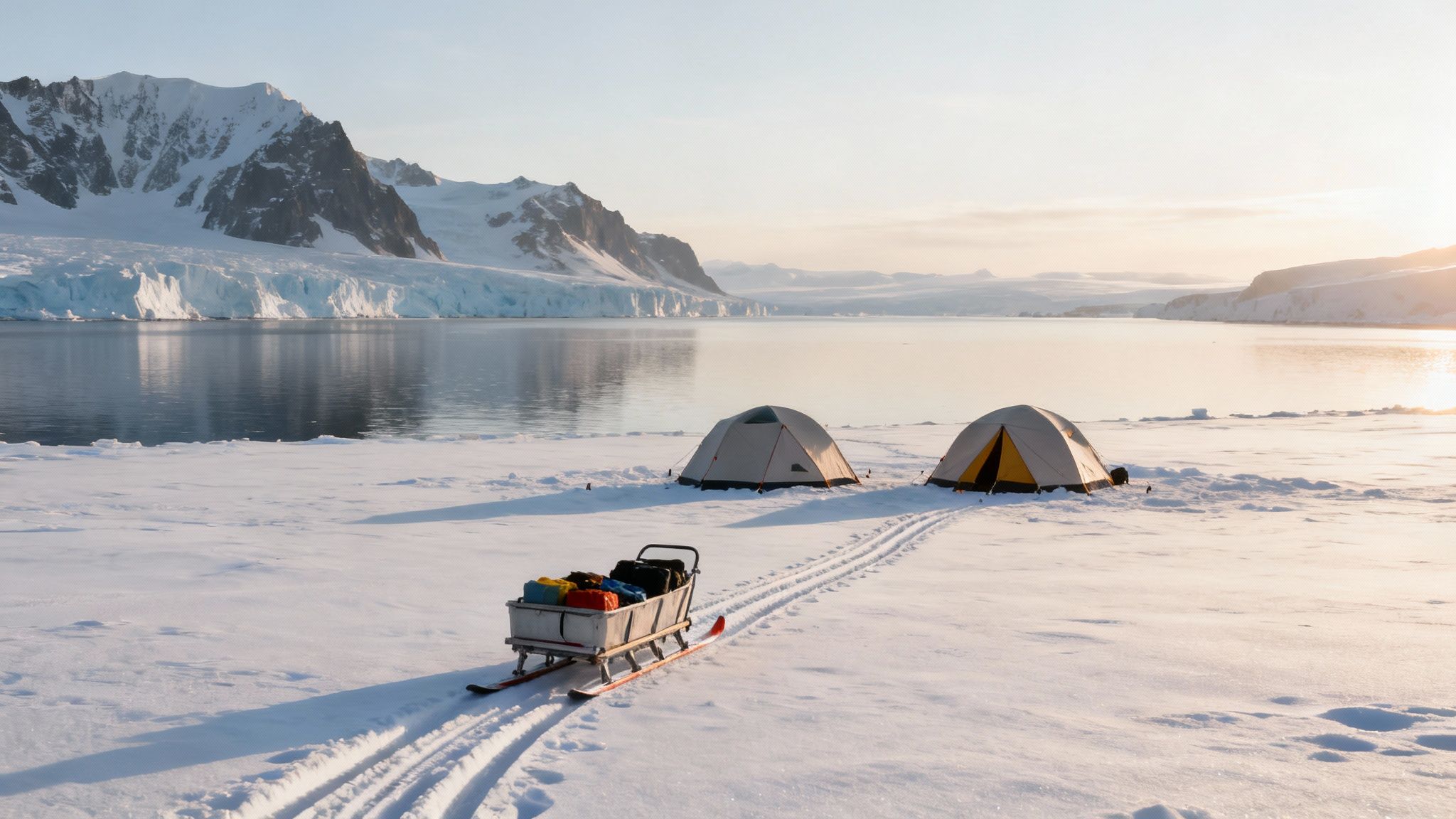
A good Svalbard itinerary starts with an honest look at what you want to achieve, how much time you have, and your physical condition. The classic mistake is underestimating the sheer effort involved and trying to cram too much in. The Arctic does not reward rushing.
So, let's break down three very different ways to experience a trip to Svalbard . They range from a short, settlement-based taster to a full-blown polar epic, each demanding a different level of fitness, commitment, and skill.
The 4-Day Longyearbyen Basecamp
Think of this as a solid introduction to the high Arctic without needing a full set of expedition skills. You will use Longyearbyen as your home base, heading out on daily trips into the surrounding wilderness. It is the perfect choice if you are short on time or just want to get a feel for the place before committing to something bigger.
A typical programme could look something like this:
- Day 1: Arrive at Longyearbyen (LYR), get your gear sorted, and have a crucial safety briefing on polar bear protocols in town.
- Day 2: Jump on a guided snowmobile or dog-sled trip into a nearby valley to learn the basics of Arctic travel.
- Day 3: Take a boat to the abandoned Russian settlement of Pyramiden or the glacier face at Barentsburg (summer only), or explore an ice cave (winter).
- Day 4: Check out the exterior of the Svalbard Global Seed Vault and visit the Svalbard Museum before heading home.
This approach gives you a powerful sense of the Arctic landscape whilst keeping you on relatively well-trodden and safe paths. As for fitness, anyone with a decent standard of health can handle this.
The 10-Day Ski Touring Expedition
This is a serious step up. A ten-day ski tour is not just a series of day trips; you are out in the wild, completely self-sufficient. This is a real expedition, and it demands physical grit and a disciplined approach to camp life every single day.
The focus here shifts from sightseeing to the pure rhythm of polar travel. A good objective for a trip this long might be exploring the vast glacier systems around Templefjorden, just southeast of Longyearbyen.
This is where real expedition skills are made. Your entire world shrinks to the daily routine: melting snow for water, navigating with a map and compass, building a secure camp, and managing your energy in the biting cold.
A normal day involves 6-8 hours of skiing, covering anywhere from 10-15 kilometres depending on the snow and terrain. You will carry your share of the group kit, either in a rucksack or towed behind you in a small pulk. This kind of effort needs proper physical preparation, with a focus on cardio and core strength.
The Full Svalbard Ski Crossing
This is a true pinnacle for any polar traveller. Crossing Spitsbergen from south to north or east to west is a massive undertaking. It means weeks on the ice, advanced skills, and a level of mental and physical resilience that cannot be faked. This is absolutely not for beginners.
You need to be an expert in every part of polar travel, from crevasse rescue to navigating in a total whiteout. Each person will be hauling a pulk weighing between 45-50kg , loaded with all your personal gear, food, fuel, and team equipment for the whole trip.
This is the kind of challenge you build up to, using shorter trips like the 10-day tour as stepping stones. The physical and mental pressure is immense. Success hinges on a well-drilled team working together with discipline and focus. Pulling off a full crossing is a testament to your preparation and sheer will.
These itineraries show a clear path of progression. If the bigger trips have caught your eye, the first step is to learn the fundamentals. Take a look at our range of expert-led ice adventures; they provide the perfect training ground to build the skills you will need for these formidable Arctic challenges.
Essential Gear And Training For The Arctic
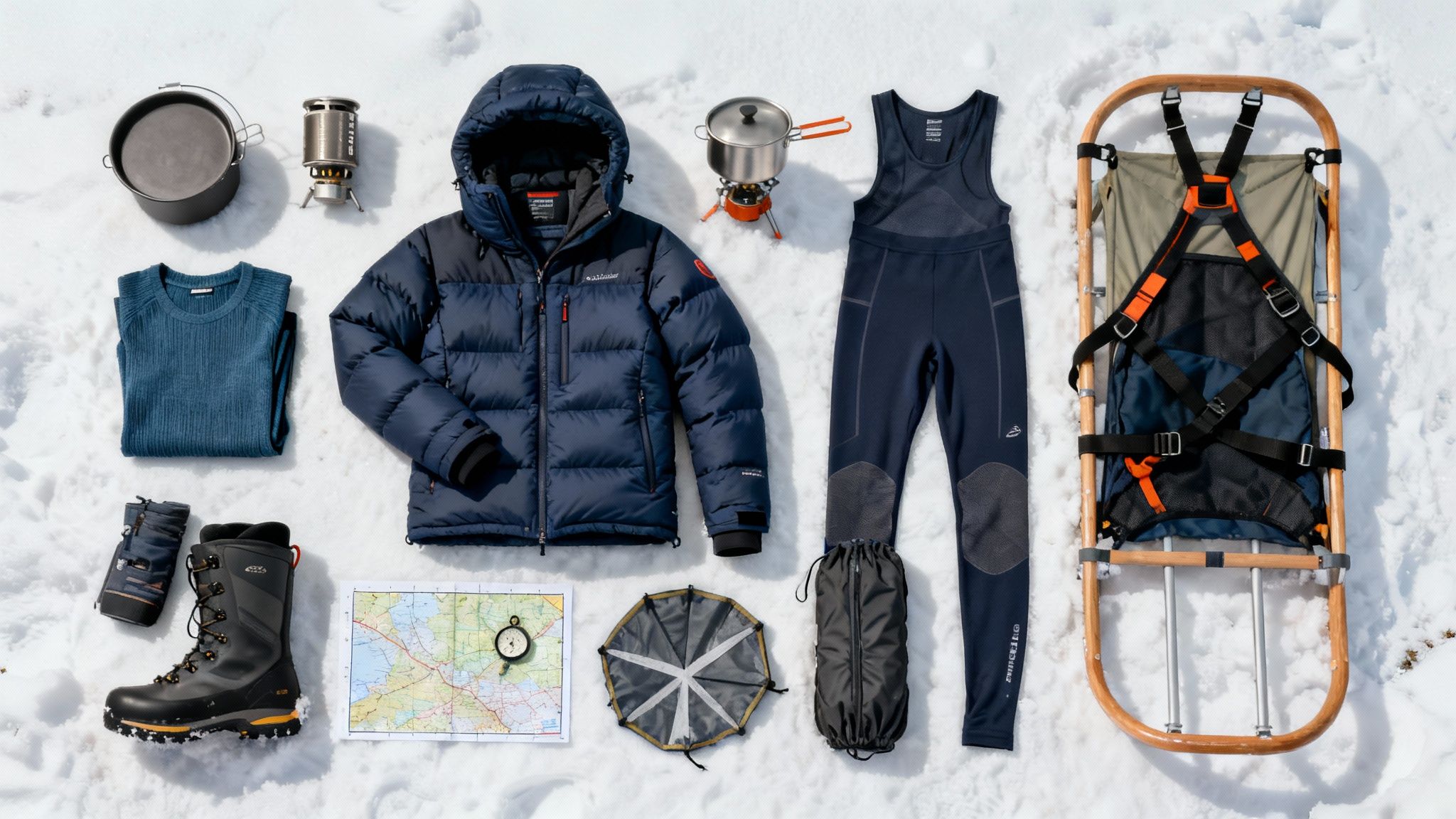
Out here, your equipment is not just a collection of nice things to have. It is your life-support system. A successful trip to Svalbard comes down to understanding the ‘why’ behind every single piece of kit, from your innermost base layer to the tent protecting you from a polar gale. Our philosophy is simple: we do not fight nature, we learn to live in it. That education begins with your gear.
The absolute foundation of any cold-weather system is layering. It is a simple concept, but so many people get it wrong. The real purpose is not just warmth; it is about trapping air and managing moisture—your true enemy in the cold. We always start with a high-quality merino wool base layer to wick sweat away from the skin.
On top of this come the mid-layers, which provide insulation. The choice between natural down and modern synthetics is a critical one. Down offers an unbeatable warmth-to-weight ratio but is completely useless when wet. Synthetic insulation, whilst bulkier, keeps you warm even when damp. The right choice depends entirely on your expedition's conditions and how long you will be out.
Advanced Kit and Shelter
For multi-day ski expeditions, we get into more specialised equipment. Vapour Barrier Liners (VBLs) are socks and liners worn right against the skin. They stop your body’s moisture from soaking your boots and sleeping bag insulation. They are not comfortable, but they are essential for staying warm on long journeys.
Your shelter has to withstand ferocious katabatic winds. We rely on expedition-grade tents from manufacturers like Hilleberg, whose designs have been proven in the harshest conditions on Earth. Being able to pitch one of these quickly and securely, whilst wearing heavy gloves in a blowing gale, is a fundamental skill.
Mandatory Skills and Training
Gear alone is never enough. Competence is what keeps you alive. The Governor of Svalbard mandates that anyone travelling outside the main settlements must be prepared for a polar bear encounter. This is not a friendly suggestion; it is a legal requirement born from decades of hard-won experience.
The right kit is only half the equation. The other half is practised skill and sound judgement under pressure. Confidence in the Arctic is not about bravado; it is the quiet result of methodical preparation and training.
This means being proficient with a high-calibre rifle, like a Mauser M98, and knowing the ladder of deterrence—from shouts and flare guns to a final, last-resort action. This is a profound responsibility where the goal is always, always to avoid a confrontation in the first place.
Beyond this, you need a solid grounding in Arctic fieldcraft:
- Navigation: You must be able to navigate with a map, compass, and GPS working together, especially when a whiteout cuts visibility down to nothing.
- Camp Craft: This covers everything from efficient stove operation for melting snow to precise tent routines that prevent heat loss. It is about meticulous organisation.
- Self-Awareness: You have to learn to spot the early signs of cold injuries like frostbite and hypothermia, both in yourself and in your teammates.
These are not skills you can pick up from a book. They have to be built through hands-on practice in a tough environment. Our Pole to Pole expedition training course is designed specifically to drill these non-negotiable skills, giving you the foundational competence you need for any serious Arctic adventure.
Budgeting For Your Svalbard Trip
A trip to Svalbard is a serious investment. Getting the budget right is one of the most important parts of planning your expedition, ensuring you are properly prepared and can appreciate what goes into a well-run journey into the high Arctic.
Costs swing wildly depending on what you want to do. A few days based in Longyearbyen is one thing; a multi-week ski crossing is something else entirely. But no matter the objective, the main expenses are always the same.
Breakdown Of Core Expenses
Every budget needs to cover a few key pillars. Flights into Longyearbyen (LYR) are your first hurdle, usually connecting through Oslo or Tromsø. Once you arrive, accommodation and guided day trips will form the bulk of a shorter stay. For longer, more serious expeditions, the biggest cost is almost always the expedition fee itself, which bundles in the complex logistics, expert guiding, and safety net you will rely on.
- Flights: Your international travel to Norway, plus the final leg up to Longyearbyen.
- Accommodation: Hotels and guesthouses in and around Longyearbyen.
- Guided Activities: Day trips like snowmobiling, boat tours, or ice caving.
- Expedition Fees: All-in costs for multi-day trips covering guides, food, fuel, permits, and safety equipment.
- Gear: The cost of buying specialised kit or renting what you need in Svalbard.
The Value Of A Reputable Operator
It is tempting to just look at the final price tag, but that misses the point entirely. When you book a trip to Svalbard with an experienced operator, you are buying value that goes far beyond a simple transaction. You are buying safety, logistical peace of mind, and deep, hard-won local knowledge.
A reputable guide service is not a luxury; it is a critical safety component. The fee covers meticulous planning, emergency response capability, and the hard-won judgement of professionals who have operated in these conditions for years.
This includes navigating the complex permit system required by the Governor of Svalbard, providing proven gear like Hilleberg tents and proper communications, and handling all the food and fuel logistics. It is a framework that lets you focus on the expedition, knowing the backbone is solid.
The Non-Negotiable Cost of Insurance
Finally, your budget absolutely must include comprehensive travel insurance. Your standard holiday policy will not cut it here. You need cover specifically for remote wilderness travel and, most importantly, emergency medical evacuation from the Arctic .
The cost of a rescue in this environment is astronomical. This is not a corner you can afford to cut; it is a fundamental part of responsible travel.
Your Questions Answered: Svalbard Travel FAQs
We have covered the big picture: when to go, what you will need, and how to stay safe. But experience tells us it is the practical, day-to-day questions that often weigh on people’s minds. Here are the answers to the questions we get asked most, based on years of running expeditions on the ground.
Is A Trip To Svalbard Safe?
Yes, but only if you follow the rules. This is not a place for improvisation. The biggest risk comes from polar bears, and the Governor of Svalbard enforces strict regulations for anyone venturing outside the main settlements. If you are not with a guided group, carrying a rifle and a signal pistol is a legal requirement, not a suggestion.
The other major factor is the weather. It is brutal and can turn in the blink of an eye. Any good operator lives and breathes safety, with emergency plans for every eventuality. If you are travelling independently, getting professional training is not just a good idea – it is a matter of survival.
What Level Of Fitness Do I Need?
This completely depends on what you plan to do. If you are basing yourself in Longyearbyen and joining guided day trips, anyone with decent general health can have a superb time. You just need to be comfortable walking on snowy, uneven ground for short stretches.
A multi-day ski crossing, on the other hand, is a different beast entirely. It demands serious cardiovascular endurance and strength that you can only build through dedicated training. You will be skiing for 6-8 hours a day, pulling all your own gear in a pulk. We assess everyone who joins our expeditions and give you clear training goals to make sure you are ready for the challenge.
Your physical fitness is a non-negotiable safety tool. Showing up unprepared for a serious expedition does not just put you at risk; it jeopardises the entire team. Be honest with yourself and with us about where you are at.
What Is The Best Way To See Polar Bears?
The only safe and responsible way to see polar bears is from a distance, almost always from the deck of an expedition ship in the summer. On land, the goal is simple: avoid them at all costs.
There are strict rules in place to protect Svalbard’s wildlife. The whole point of a responsible expedition is to watch these magnificent animals in their natural world without changing their behaviour. You should never, ever try to find or get close to a polar bear on land.
Is There Mobile Phone And Internet Access?
In Longyearbyen and Barentsburg, you will have a decent mobile signal and fast internet. It feels surprisingly connected. But the moment you leave the town limits, it all disappears. Completely.
Out on an expedition, our only link to the outside world is through a satellite phone or a device like a Garmin inReach. This is not a luxury; it is a critical piece of safety equipment for any remote journey.
A successful trip to Svalbard starts with solid planning and expert advice. At Pole to Pole , we provide the training and lead the expeditions that make ambitious Arctic journeys happen. Take a look at our programmes and start planning yours.