Travel to Greenland: A Practical Guide
To travel to Greenland is to prepare for one of the planet's last true wildernesses. This is not a holiday. It's an expeditionary frontier that demands respect, competence, and a particular mindset. A successful journey here is built on solid planning, an understanding of Arctic logistics, and an appreciation for its raw, powerful beauty.
The Enduring Allure of Greenland
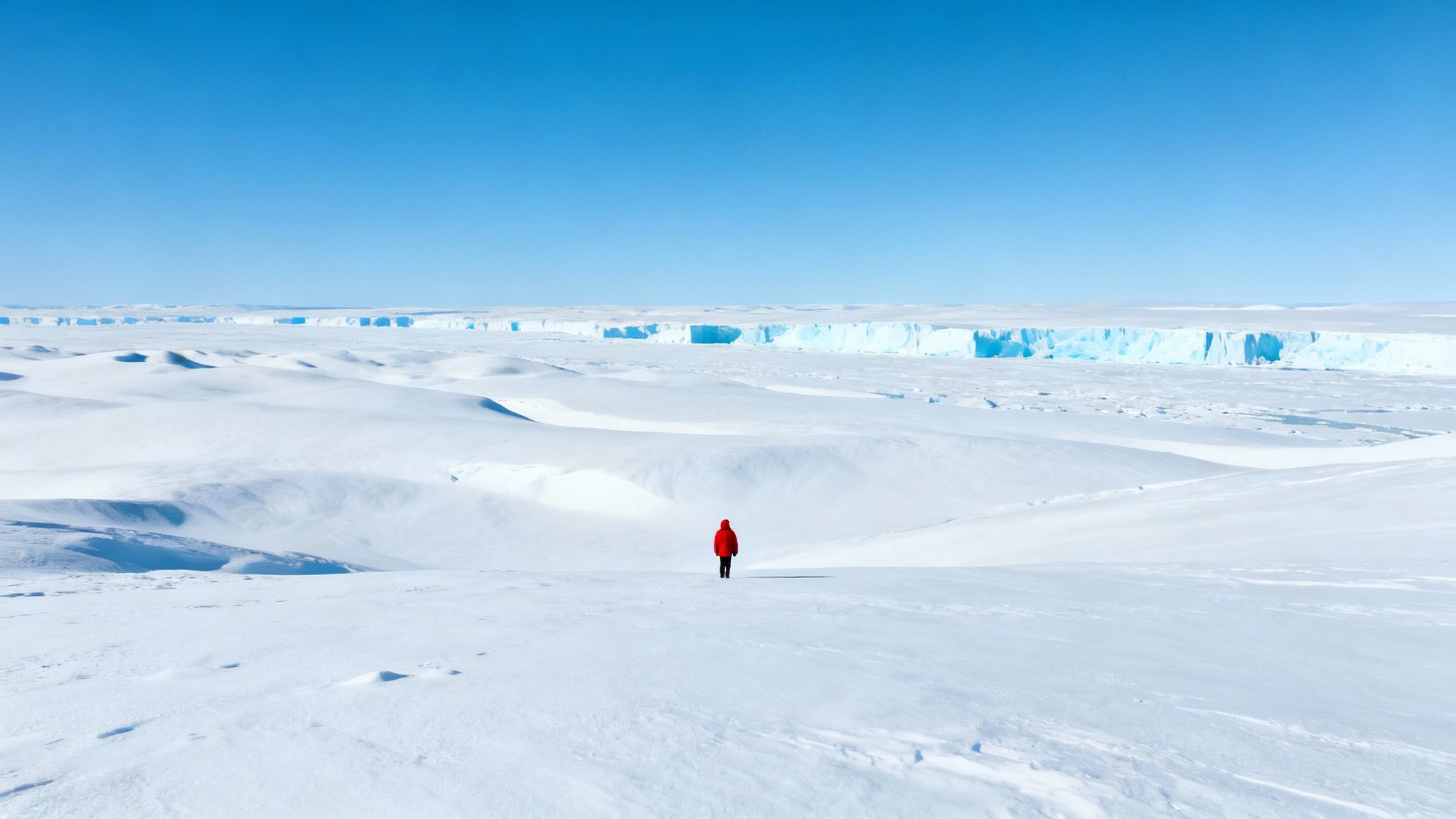
Imagine a silence so profound it feels like a presence. Not just the absence of noise, but the deep, resonant quiet of the Greenland ice cap, an expanse of white stretching towards a horizon that feels impossibly distant. This is the essence of Greenland a place that completely redefines your sense of scale.
This guide goes beyond the usual tourist itinerary. We're approaching Greenland not as a place to be seen, but as an environment to be understood and navigated with skill. Your journey here is an expedition, whether you're kayaking amongst icebergs in Disko Bay or undertaking a multi-day ski traverse. It commands respect, both for its untamed character and its critical role as a barometer for the planet’s health.
An Expeditionary Briefing
Think of this document as your comprehensive briefing. It's designed to give you the practical knowledge and expeditionary mindset needed for a successful and responsible journey. We will cover the essentials for operating effectively in this demanding environment.
- Logistical Foundations: Understanding the critical flight paths and internal transport, and why building in weather contingency days is non negotiable.
- Operational Theatres: Profiling key locations like Ilulissat and Kangerlussuaq as staging grounds for genuine exploration, not just sightseeing.
- Essential Equipment: Moving beyond generic packing lists to detail the specific, field tested kit that performs when it actually matters.
- Safety and Protocols: Covering the permits, medical considerations, and responsible travel principles that underpin any safe organisation.
Our philosophy is straightforward: we don't fight nature, we live in it. This principle is the foundation of competent exploration and is central to every aspect of planning a trip to Greenland. It shifts the focus from conquering a landscape to building the resilience and skill to move through it safely and respectfully.
This guide provides the framework. It’s for those who want to experience Greenland with quiet competence and a deep appreciation for its wild, powerful beauty.
Navigating Logistics and Access to Greenland
The first thing to accept about travelling to Greenland is that nature is in charge. Always. This is a country that runs on its own schedule, and the first step to any successful trip is understanding how to simply get there and get around. There are no roads connecting its towns; this is a land you navigate by air and by sea.
These aren’t daily shuttle flights. The schedule shifts with the seasons, and booking well in advance is absolutely critical, especially if you’re aiming for the summer months between June and August.
Mastering Internal Travel
Once you’re in Greenland, moving between settlements is a different challenge altogether. Internal travel is a huge part of the experience and it demands meticulous planning.
- Regional Flights: The country’s lifeline is Air Greenland’s fleet of Dash 8 propeller aircraft. They hop between towns and villages, offering unbelievable views, but they are completely at the mercy of the weather.
- Coastal Ferry: The Sarfaq Ittuk passenger ferry is a vital link along the west coast. It’s a much slower, more immersive way to travel between communities, running from Ilulissat in the north down to Narsarsuaq in the south.
A classic mistake for first-timers is underestimating how long these transfers take. A flight from Kangerlussuaq to Ilulissat isn't just a simple transfer; it's a leg of the expedition that needs a serious buffer against delays.
The single most important rule of Greenlandic travel is this: build buffer days into your itinerary. We recommend at least one to two extra days for any trip involving internal flights. The weather can turn in minutes, grounding planes and forcing a total change of plan. Patience isn't a virtue here; it's an operational necessity.
Strategic Planning and Considerations
Whilst tourism from some parts of Europe has ebbed and flowed, recent stats show a shift in who is visiting. A 2023 report on Greenland tourism statistics showed an overall increase in foreign overnight stays, driven by growth from the USA and other markets, whilst UK visitor numbers saw a temporary drop. Before 2019, UK arrivals were around 6,000 a year, showing a clear appetite for the kind of purpose-driven expeditions that prioritise experience over convenience.
The logistics for any serious trip go far beyond just booking flights and hotels. The complexity builds fast from chartering boats to get into remote fjords to arranging supply caches for a ski traverse. You can get a sense of what’s really involved by reading our piece on planning an expedition and its inherent logistics.
To help structure your initial thoughts, here’s a quick breakdown of the main logistical hurdles. Think of it as a framework for tackling what is a complex but entirely manageable challenge.
Greenland Travel Logistics At a Glance
The table below summarises the core logistical components you'll need to consider when planning a trip to Greenland, from how you'll arrive to how you'll get around once you're there.
| Logistic Aspect | Primary Options | Key Considerations |
|---|---|---|
| International Access | Air Greenland (from Copenhagen), Icelandair (from Reykjavik) | Seasonality dictates flight frequency. Book several months in advance. |
| Internal Transport | Regional Dash-8 flights (Air Greenland), Sarfaq Ittuk ferry | No inter town roads. Flights are weather-dependent. |
| Itinerary Planning | Build in mandatory buffer days for weather delays | A tight schedule is a liability. Plan for 24-48 hours of potential delay. |
| Seasonal Impact | Summer (June-Aug) offers 24 hour daylight and boat access. Winter (Dec-Mar) is for dog sledding and aurora. | Routes and accessibility change drastically between seasons. |
Ultimately, planning a Greenland journey is a lesson in respecting the environment. It forces you to slow down, think methodically, and be ready to adapt. The reward is access to one of the most raw and powerful landscapes on Earth.
Key Destinations and Core Activities
A trip to Greenland isn’t about ticking off sights. It’s about getting yourself to the right place to do the right thing. You need to think of these locations less as destinations and more as operational bases—gateways to genuine expeditionary activities. It’s a fundamental shift in mindset.
We see these places through the lens of potential. Ilulissat is more than a town; it’s a staging ground. Kangerlussuaq isn’t just an airport; it's the threshold to the ice sheet. This is the practical mindset you need to explore Greenland properly.
Ilulissat: The Iceberg Capital
Set on the west coast around 69°13'N 51°06'W , Ilulissat is home to the UNESCO World Heritage Ilulissat Icefjord. This is where Sermeq Kujalleq, one of the world's most active glaciers, spits colossal icebergs into Disko Bay.
But for someone on an expedition, the icefjord is a dynamic, live training environment. It's where you launch a kayak and learn to read the movement of ice, keeping a safe distance from behemoths that can roll or crack without a sound. It's the trailhead for coastal treks and the best classroom for understanding the sheer scale of Greenland's ice production.
Operating here demands precision. Navigating amongst ice this size requires a level of competence that a simple boat tour just cannot teach.
Kangerlussuaq: Gateway to the Ice Sheet
Kangerlussuaq is the logistical hub for anyone heading onto the Greenland Ice Sheet. It sits at the end of a 190 kilometre long fjord and offers direct, overland access to the ice cap’s edge a genuine rarity in Greenland.
This is where polar ski expeditions begin. It's where you make final checks on your pulk, fire up your MSR stove one last time, and calibrate everything before stepping onto the second largest body of ice on Earth. From here, teams set out for major objectives, like the old DYE 2 Cold War radar station.
The moment you step off the gravel tracks of Kangerlussuaq and onto the endless white of the ice sheet is profound. It’s where all the preparation meets reality. Every piece of kit, every hour of training, is suddenly put to the test in an environment that is as beautiful as it is indifferent.
Nuuk: Culture and Logistics
As the capital, Nuuk is the heart of modern Greenlandic life. For an expeditioner, it provides crucial context and serves as a key logistical hub, especially for journeys along the southwest coast.
It’s a chance to understand the Inuit culture that has thrived here for thousands of years, giving you a much deeper respect for the land you’re about to travel through. Logistically, Nuuk’s port and airport make it an essential resupply point and a base for exploring the complex fjord systems that define this entire region.
Core Expedition Activities Explained
Engaging with Greenland isn’t passive. It means mastering specific skills. These aren't tourist activities; they are serious disciplines that demand training and a healthy respect for risk.
- Glacier Travel: This is much more than just walking on ice. It’s about reading crevasse patterns, knowing how to use crampons and an ice axe properly, and being proficient with ropes. Crevasse rescue skills are completely non-negotiable.
- Arctic Sea Kayaking: Paddling in polar waters means understanding cold water immersion, self-rescue, and the volatile nature of glacial ice. A capsize here is a life threatening emergency, making proper training and equipment absolutely essential.
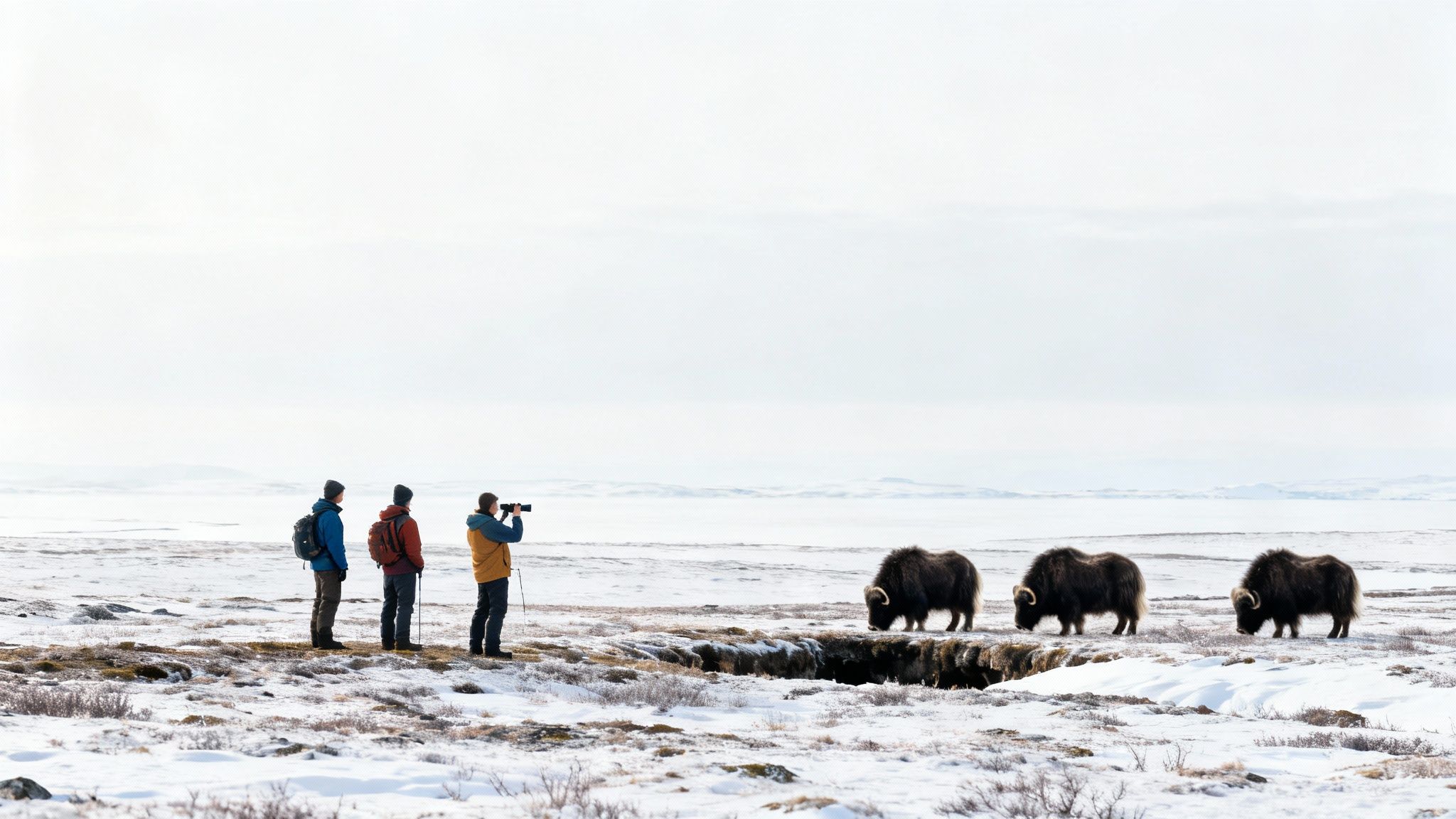
- Wildlife Observation: Greenland is home to musk oxen, whales, seals, and arctic foxes. Responsible viewing means keeping an ethical distance. For musk oxen, that means observing from several hundred metres away with binoculars, respecting their space in a fragile world.
- Winter Objectives: Come winter, the focus shifts. Dog sledding and ski touring become the main ways to travel. The long, dark nights also bring the reward: spectacular views of the aurora borealis, a payoff for operating in temperatures that can plummet below -30°C (-22°F) .
Each of these activities demands a specific skillset. They are the real world application of principles you learn in dedicated training, turning theory into genuine capability. Exploring Pole to Pole's structured ice adventures offers a clear path from foundational skills to being ready for a full scale expedition.
Packing Your Essential Arctic Expedition Gear
The difference between a successful trip and a serious incident often comes down to one thing: kit. In a place like Greenland, your equipment isn't a luxury; it's your life support. A summer tourist pottering around Ilulissat can get by with good quality outdoor clothing, but the moment you step onto the ice or head out in winter, the game changes completely. This isn't about fancy brands; it’s about proven gear, because the consequences of failure are severe.
A rookie mistake is obsessing over the outer jacket first. Your entire system has to be built from the skin outwards, with one primary goal: moisture management . Sweat is the enemy out here. Once your base layers are damp, you start losing heat at an alarming rate, even inside the world's best parka.
The Layering System is Non Negotiable
Think of your clothing less as individual items and more as a single, integrated system. The whole point is to add or remove layers to perfectly regulate your temperature as you work harder or the weather turns. We are not just wearing clothes; we are managing a personal microclimate.
- Base Layer: This layer has one job: pull moisture away from your skin. Merino wool is king here. Brands like Fjällräven or Aclima make fantastic wool base layers that trap warm air whilst letting sweat escape.
- Mid Layer: This is your insulation. Multiple thin layers of fleece or wool are far more versatile than one bulky one. A light fleece paired with a heavier one, like a Patagonia R1 and R2, gives you brilliant flexibility.
- Outer Layer (Shell): This nee ds to be bombproof against wind and water, but it absolutely must be breathable. A top quality Gore Tex shell jacket and trousers will keep the weather out without trapping all the moisture your other layers are working so hard to get rid of.
- Insulation Layer (Static): This is your big, puffy jacket. It only comes out when you stop moving for a rest break or around camp. An expedition weight down parka rated to at least -30°C (-22°F) is the standard.
And do not forget your hands. When planning for Greenland's bite, packing the best cold weather gloves is a no brainer. You need a full system: thin liner gloves for tasks requiring dexterity, thick insulated mitts for warmth, and a shell over mitt to cut the wind.
The map below shows some of Greenland’s key hubs, and where you're heading dictates exactly what you'll need to pack.
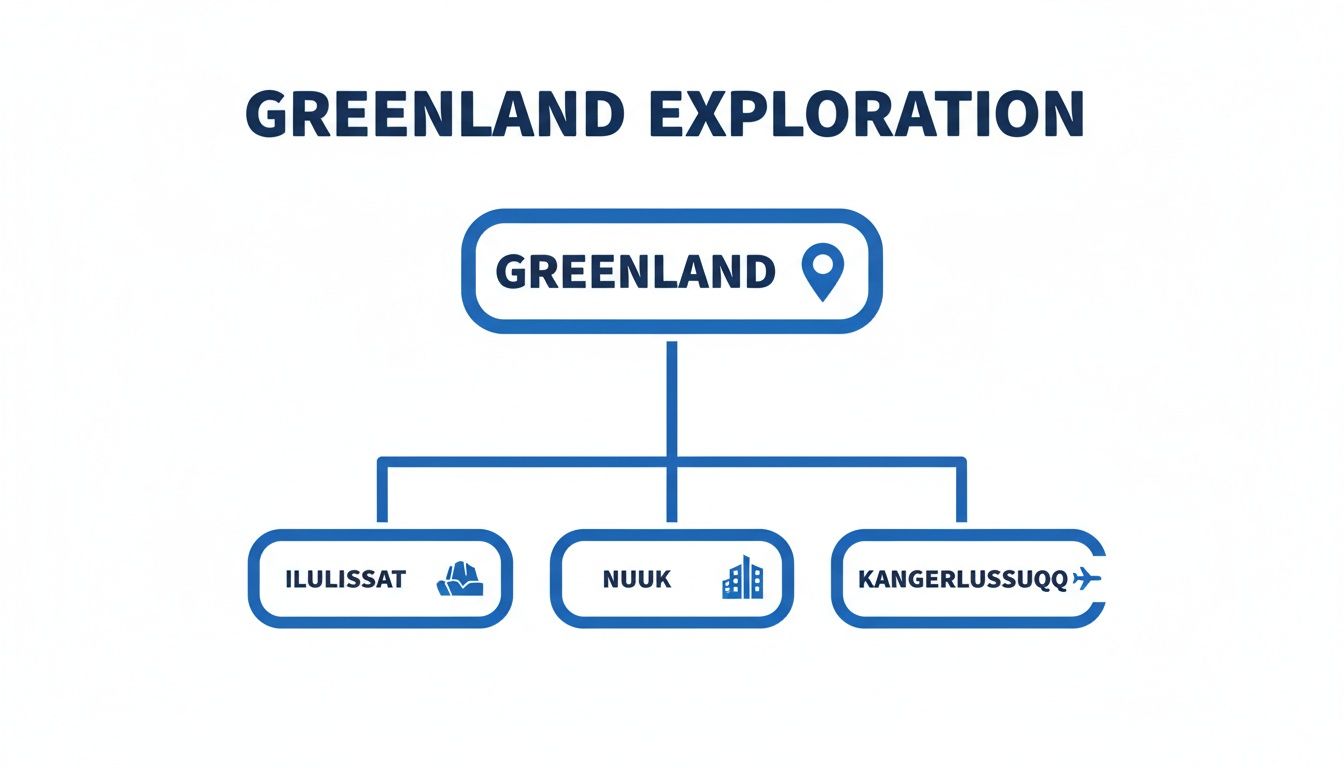
Each of these places, Ilulissat for its sea ice, Nuuk for the rugged coast, and Kangerlussuaq as the gateway to the ice sheet throw unique challenges at your gear list. Plan accordingly.
Greenland Packing Tiers Summer Tourist vs Winter Expeditioner
It’s one thing to talk about layers, but the difference between a summer visit and a full blown expedition is staggering. This table breaks down just how massive that gap is.
| Gear Category | Summer Tourist Essentials | Winter Expeditioner Non-Negotiables |
|---|---|---|
| Footwear | Waterproof hiking boots | Double layer insulated boots (e.g., Baffin, La Sportiva) rated to -50°C. |
| Outerwear | Waterproof/windproof jacket and trousers (e.g., Gore-Tex shell). | Expedition weight down parka rated to -30°C or colder; insulated shell trousers. |
| Hands & Head | Warm gloves, beanie, sun hat. | A full glove system (liner, fleece, shell mitt), balaclava, goggles, warm hat. |
| Sleeping | Not usually required unless camping; a 3-season bag is fine for huts. | -40°C down sleeping bag, two insulated sleeping mats (foam + inflatable). |
| Navigation | Smartphone GPS/map app. | GPS with lithium batteries, physical map and compass (and the skill to use them). |
| Hardware | Daypack, water bottle, sunglasses. | Pulk (sledge), 4 season tent, multi-fuel stove, snow shovel, thermos. |
As you can see, this isn't just an upgrade; it's a completely different class of equipment designed for survival, not just comfort.
Expedition Grade Hardwear
Once you move beyond clothing, the kit for a proper ski traverse becomes incredibly specialised. This is where you rely on decades of polar expertise to make the right calls.
Your pulk (the sledge you pull) becomes your entire world, carrying everything you need to stay alive. For a typical Last Degree trip, you can expect it to weigh between 45-50 kg (99-110 lbs) . Packing it is a skill in itself heavy stuff like fuel and food goes low and in the middle for stability, whilst snacks and navigation gear stay on top for easy access.
Shelter and warmth are everything. A 4 season tent like a Hilleberg Keron is not a recommendation; it is a requirement. Its tunnel design is engineered to withstand the ferocious winds of the ice cap. Your stove, a multi fuel workhorse like the MSR XGK, has to be able to melt snow for water in mind-numbing cold, a chore that will eat up hours of your day.
Your sleep system is just as crucial. A down filled sleeping bag rated to -40°C (-40°F) is the absolute minimum. You’ll pair it with two high quality insulated sleeping mats, one foam, one inflatable, to stop the snow from sucking the heat right out of you.
In a potential whiteout, navigation demands backup. A primary GPS is your go to, but you must have a compass and the skills to use it if the electronics fail. All your devices should run on lithium batteries, as they perform far better in the cold.
Understanding each piece of kit is one thing. Knowing how it all works together as a life support system is what gets you through. For a really detailed look at what goes into a polar pack, you can read our breakdown of what it takes to face the coldest place on Earth. Out there, every single item has a purpose. There is no room for anything else.
Permits, Safety and Responsible Travel in Greenland
Choosing an expedition in Greenland means accepting a different level of personal responsibility. This is not a place where you can assume help is just a phone call away. Safety here is an active process, something you build through solid preparation, strict protocols, and a deep respect for the environment.
Medical facilities are concentrated in Nuuk and a handful of other towns. Once you head into the backcountry, you are truly on your own. This is why comprehensive travel insurance is absolutely non negotiable. It must specifically cover remote evacuation by helicopter, a clause missing from most standard policies. Without it, a rescue could be financially devastating.
Securing The Right Permits
For most people visiting coastal towns, permits are not an issue. But the moment your plans include independent travel into the Northeast Greenland National Park, the world's largest or any expedition onto the ice sheet, a permit is mandatory. The process is managed by the Greenlandic government, and it’s rightly tough.
You will need to submit a detailed expedition plan, a complete equipment list, proof of that specialised insurance, and your search and rescue protocols. This is not a box ticking exercise. It's a serious assessment of your team's ability to operate self sufficiently in one of the harshest environments on Earth.
The permit process does two things. It makes sure expeditions are properly prepared, reducing risks for both the team and potential rescuers. It also acts as a vital gatekeeper, protecting an incredibly fragile ecosystem.
This official oversight reinforces a core truth: you are a guest here. Access is a privilege, and it’s earned through meticulous planning.
The Mindset of Responsible Travel
The quiet, immense authority of the Arctic landscape demands a quiet, respectful presence. Our guiding principle is simple: we aim to live within nature, not fight against it. This shapes everything we do, from managing waste to interacting with local culture.
- Leave No Trace: In the Arctic, this is an absolute rule. The slow growing tundra can hold a footprint for decades. All waste, including human waste, must be packed out. Your campcraft has to be immaculate, leaving zero sign of your passage.
- Respect for Inuit Culture: Greenlandic culture is woven into the land and its resources. Engage with humility, listen more than you speak, and support communities by hiring local guides or buying authentic crafts.
- Wildlife Protocol: As you plan, incorporate the principles of responsible wildlife tourism. Keep a significant distance from animals like musk oxen and polar bears. Your presence should never change their natural behaviour.
There's a huge, untapped interest from UK travelers for this kind of focused exploration. Research has identified a ‘hard potential’ of 1.9 million UK residents ‘almost definitely’ planning a trip, yet only 6,000 actually visited in 2019. This tells us people want serious, well run expeditions where quality and safety ( 48% prioritise this over price) are paramount.
Ultimately, a safe and responsible journey in Greenland comes down to one thing: preparation. It’s the result of skill, respect, and a mindset that puts the integrity of the environment above all else.
From Preparation to Expedition
Every meaningful journey in Greenland starts long before you ever step foot on the ice. A successful expedition is not really about the summit you reach or the distance you cover. It’s defined by the quality of the preparation that comes before it. Everything in this guide, from sorting logistics to understanding local rules is a piece of that essential groundwork.
The great polar explorers knew this better than anyone. Roald Amundsen’s painstaking preparation on Norway’s Hardangervidda plateau was not just training; it was the bedrock of his success at the South Pole. That same principle holds true today. You do not just decide to go to Greenland and hope for the best. You have to earn the right to be there through practice, repetition, and hard work.
Your Proving Grounds for the Arctic
This is the entire philosophy behind the Pole to Pole Academy. We believe real competence is forged in places that demand everything from you. Our training programmes in Sweden and Svalbard are not holidays. They’re the proving grounds for whatever you hope to achieve in Greenland.
These locations are the perfect theatre to build the skills you’ll actually need:
- For the aspiring adventurer: Get to grips with the fundamentals of polar travel, from packing a pulk and maintaining a stove to crevasse rescue and navigating in a whiteout.
- For the corporate team: Move beyond theory and into a world of real consequences to develop genuine resilience and sharp decision making under pressure.
- For the seasoned explorer: Fine tune your systems and tap into our deep logistical expertise to support your own independent goals.
We do not believe in shortcuts. The confidence it takes to ski across a glacier or navigate a remote fjord is not found in a book. It’s built through doing, through repetition, and by learning from people who have spent decades getting it right and sometimes wrong in these environments.
Meeting the Demand for True Adventure
The hunger for this kind of authentic, demanding travel is real, and it’s growing. In the UK alone, there's a huge pool of people dreaming of Greenland’s icy frontiers. A 2023 study found that nearly 9 million people between 18-75 were interested in visiting within five years. Dig a little deeper, and you find almost 2 million are ‘almost definitely planning’ a trip soon, a clear signal that the appetite for human powered expeditions is strong. You can read more on the UK market for Greenland travel.
This data just confirms what we see on the ground: more and more people are looking for something more than a holiday. They want a challenge that tests their limits and rewards them with an experience they will never forget. With 48% of these potential travellers valuing quality over price, the demand is for premium, safety first journeys led by credible experts.
Your journey to Greenland is possible. But it requires commitment, a willingness to learn, and the right guidance. That preparation starts now. Explore our training programmes and start building the competence that will unlock this extraordinary part of the world.
A Few Common Questions Answered
When you're planning a trip to a place like Greenland, the same questions tend to crop up. Here are the straight answers to the most common ones, framed from an expedition mindset.
When’s the Best Time to Go?
It all comes down to what you want to do. If you're dreaming of sea kayaking among icebergs, trekking under the midnight sun, or just feeling the raw energy of the Arctic summer, you will want to aim for June to August .
But if your goal is the classic polar experience, dog sledding across frozen landscapes, ski touring, and hunting for the aurora borealis then late winter is your window. Late February to early April gives you the best of both worlds: proper snow and cold, but with more daylight than the deep, dark months of mid winter.
How Much Cash Should I Bring?
In the main towns like Nuuk and Ilulissat, you will find that credit and debit cards work almost everywhere. It’s pretty modern.
That said, it’s always smart to have some Danish Kroner (DKK) on hand. If you venture into smaller settlements or the card machine network goes down, you will be glad you have it. We usually suggest carrying enough for a few days of small buys, coffee, souvenirs, that sort of thing.
Do I Need to Speak Danish or Greenlandic?
Whilst the official languages are Greenlandic (Kalaallisut) and Danish, you will find English is spoken widely, especially in areas that see more travellers. You will get by just fine.
A little effort goes a long way, though. Learning a few simple Greenlandic words like " Qujanaq " (Thank you) is a mark of respect and is always appreciated. It shows you’re there to connect, not just to see.
Is Greenland Safe for Solo Travellers?
In the towns and settlements, yes, Greenland is very safe. The real risks here are not social; they're environmental.
Once you step outside the towns, it's a completely different story. We strongly advise against solo expeditions unless you have extensive, verifiable polar experience. The weather can turn in an instant, wildlife is a real factor, and the sheer isolation is a risk in itself. For anything in the wild, a team-based approach is essential for safety. No exceptions.
Your journey to Greenland begins with competent preparation. At Pole to Pole , we provide the expeditionary training and logistical support necessary to explore this extraordinary frontier with skill and confidence. Explore our programmes at https://www.poletopole.com.